If you’ve ever stood in a guitar store holding a full-size acoustic — the big, rounded box that practically wraps around your torso — and thought this thing is enormous, you’re not alone. That style of guitar is called a dreadnought (named after a class of battleship, because the name makes total sense for a musical instrument). It’s the most common acoustic body shape in the world: wide, deep, loud, and great for strumming. But over the last decade, a quieter revolution has been happening. Thin-body acoustic-electric guitars — instruments with a shallower depth from front to back — have become a serious option for beginners and crossover players who want an acoustic that feels less like wrestling furniture. This article compares three specific guitars that are popular first buys for players who want to plug in (connect to an amplifier or PA system using the guitar’s built-in pickup): the Yamaha APX600, the Fender CD-60SCE, and the Fender Redondo CE. By the end, you’ll know which one fits your hands, your living room, and your plans.
| EDITOR'S PICKFender CD-60SCE Solid Top Dread… | Mid-tierYamaha APX600 VW Thin Body Acou… | Budget pickFender California Debut Redondo… | |
|---|---|---|---|
| Body shape | Dreadnought | Thin body | Redondo |
| Top wood | Solid top | — | — |
| Back/sides | All Mahogany | — | — |
| Electronics | — | — | Built-in tuner |
| Case included | ✓ | — | — |
| Warranty | — | — | 2-Year Warranty |
| Price | $399.99 | $349.99 | $169.99 |
| See on Amazon → | See on Amazon → | See on Amazon → |
What You’re Actually Comparing: Body Shape, Tone, and Playability
Before we score any winners, it helps to understand what actually changes when a guitar’s body gets shallower — and what stays the same.
A dreadnought acoustic produces most of its unplugged volume from the air inside its body. The deeper that cavity, the more low-end resonance it can generate. This is why a dreadnought sounds full and boomy when you strum hard — it’s essentially a wooden resonating chamber. A thin-body acoustic sacrifices some of that internal air volume, which means it’s typically a little quieter unplugged and can feel slightly less “open” in the low frequencies. Importantly, this trade-off matters much less the moment you plug in. Once your signal is going through a pickup and a speaker, the electronics do most of the heavy lifting.
The Yamaha APX600: Thin-Body Comfort Champion
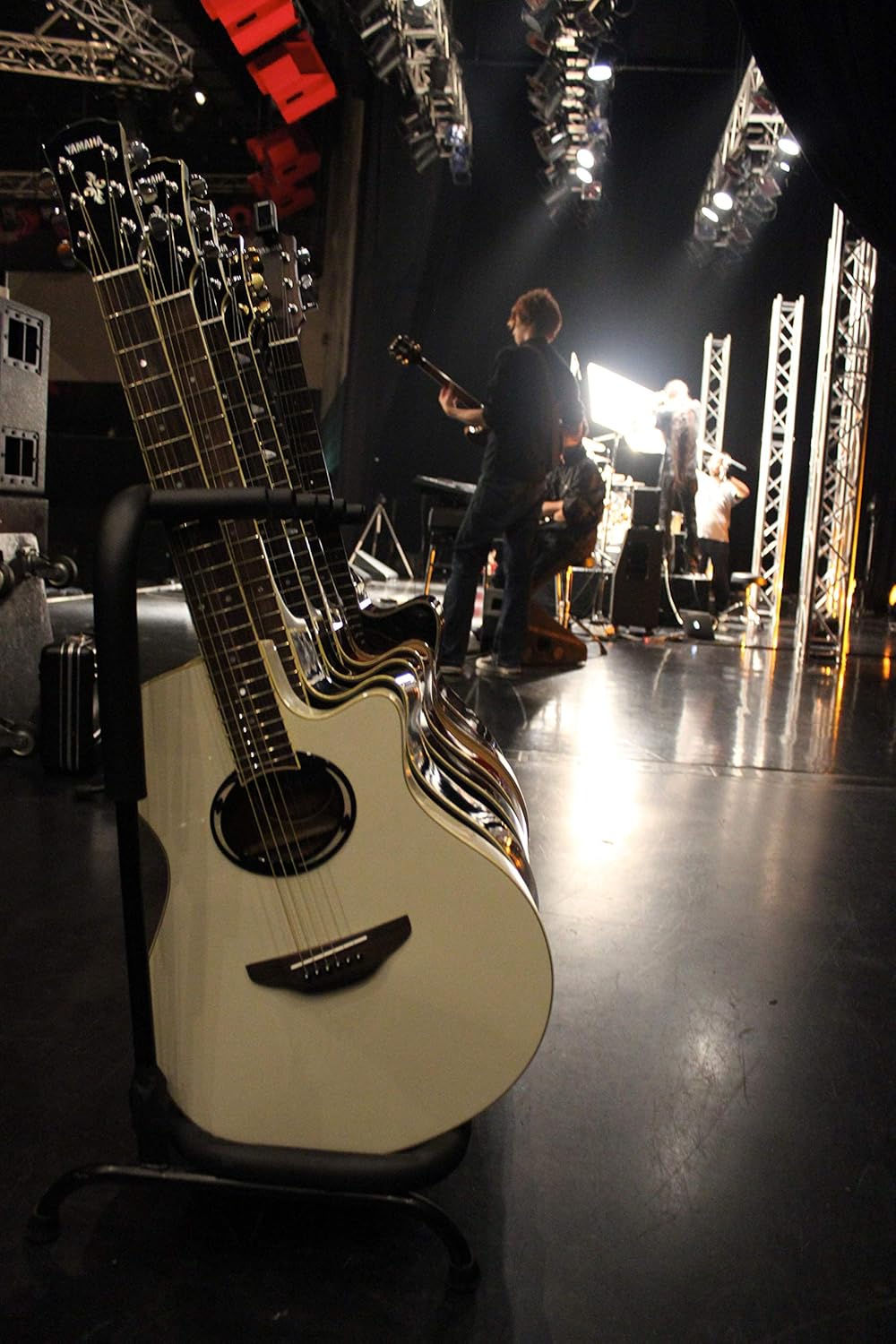
The Yamaha APX600 is the poster child for the thin-body category in this price range. Its body is noticeably shallower than a dreadnought — owners consistently describe it as the guitar that made them realize how uncomfortable they’d been with a full-depth acoustic without even knowing it. Buyer reviews aggregated on Sweetwater’s APX600 product page keep returning to a specific detail: the strumming arm no longer digs into a sharp body edge. For beginners who’ve muscled through soreness on a chunky acoustic, that’s not a small thing. Acoustic Guitar Magazine has highlighted the APX600 as a recurring recommendation in its beginner acoustic-electric coverage, specifically for players who want one guitar that can move from bedroom to small venue without fuss.
Fender
$169.99
In stock on Amazon
Check price on AmazonThe Fender CD-60SCE: Full-Size Foundation
The Fender CD-60SCE is the dreadnought in this group — full depth, full width — but it earns its place in this conversation because it’s a legitimate platform, not a throwaway starter guitar. Buyer reviews on Sweetwater consistently note that a straightforward first upgrade exists: swap the factory plastic nut and saddle (the two small components at the top and bottom of the strings that determine string height and intonation) for bone replacements, and the guitar responds noticeably better in tone and feel. That kind of documented upgrade mentality signals something real — this instrument is worth improving. Guitar World’s Best Acoustic-Electric Guitars buying guide notes that a bone nut and saddle upgrade in this price class typically runs $30–$80 depending on parts and whether you use a tech, and that the improvement in sustain and intonation is consistently described as audible.
Yamaha
$349.99
In stock on Amazon
Check price on AmazonThe Fender Redondo CE: Electric-Player’s Acoustic
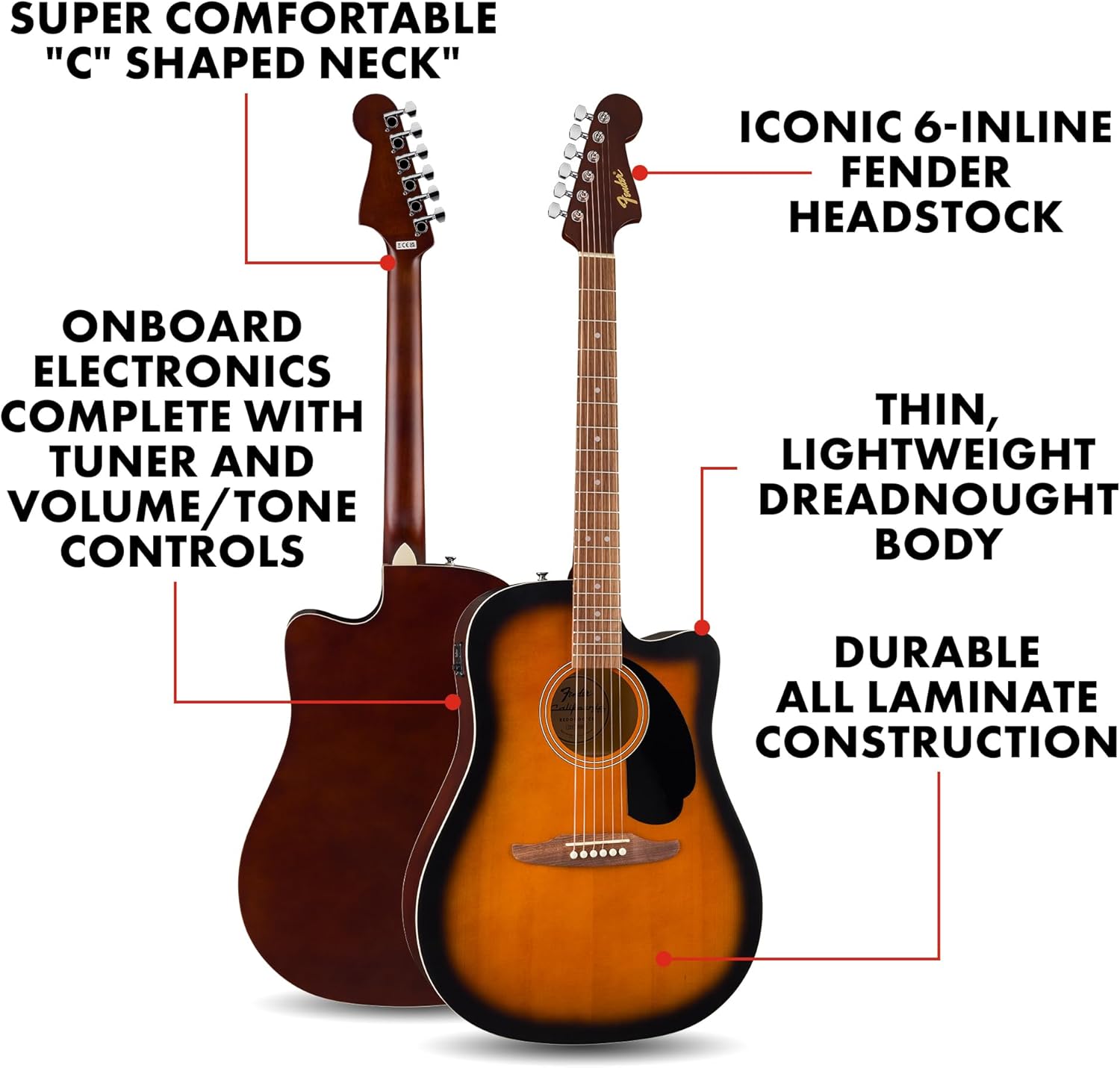
The Fender Redondo CE occupies an interesting middle ground. It’s a California-style slope-shouldered acoustic — a body shape that’s slightly smaller and more tapered than a traditional dreadnought but not as shallow as the APX600. What makes it a crossover favorite is the neck: it’s voiced and shaped more like an electric guitar neck than a traditional acoustic one. Players coming from a Stratocaster or any standard electric guitar will feel immediately at home. MusicRadar’s Best Beginner Acoustic Guitars guide notes that the Redondo CE consistently performs above its price class, playing more like a $300 guitar than a sub-$200 one — a meaningful signal for a budget-conscious first purchase.
Yamaha
$349.99
In stock on Amazon
Check price on AmazonThe Tone Question: Mahogany vs. Spruce, Plugged and Unplugged
This comparison runs into an important tonal fork in the road: top wood. The “top” is the front face of the guitar — the piece of wood the strings vibrate against most directly. It has more influence on tone than almost any other single piece of wood in the instrument.
The CD-60SCE uses an all-mahogany construction (top, back, and sides are all mahogany). Mahogany is warm, mid-focused, and a little less bright than spruce. It’s forgiving of aggressive strumming and tends to suit players who gravitate toward folk, blues, or Americana styles. A useful reference point: the CD-60S (the version without a pickup or cutaway) is widely regarded as one of the best-sounding unplugged guitars under $300. The SCE version adds the electronics and a cutaway (the scalloped notch in the body that lets your hand reach the higher frets) — so you’re essentially paying a modest premium for real, practical functionality.
The APX600 uses a spruce top with nato (a mahogany-family wood) back and sides. Spruce tends to be brighter, more articulate, and more responsive to light fingerpicking. The result is a guitar that sounds detailed and present — especially useful when you’re plugged into a small amp or a PA, where midrange clarity cuts through a mix better than warm, low-end-heavy tone.
The Redondo CE also uses a spruce top, and its slope-shouldered shape keeps the sound balanced and easy to project. As MusicRadar’s beginner acoustic coverage observes, it represents strong value in its price bracket, with tonal characteristics that suit both strumming and light fingerpicking.
At a glance:
| Guitar | Body Style | Top Wood | Cutaway | Built-In Tuner |
|---|---|---|---|---|
| Yamaha APX600 | Thin body | Spruce | Yes | Yes |
| Fender CD-60SCE | Dreadnought | Mahogany | Yes | Yes |
| Fender Redondo CE | Slope-shoulder | Spruce | No | Yes |
Decision Framework: Which Guitar Fits Your Situation?
Rather than ranking these guitars on a single scale, the more useful question is: what does your situation actually require?
Buy the Yamaha APX600 If Comfort and Stage-Readiness Come First
The APX600’s thin body is genuinely transformative for smaller-framed players, for anyone transitioning from electric guitar who finds acoustic bodies unwieldy, and for players whose strumming arm fatigues quickly. The built-in tuner is accurate and fast — buyer reviews on Sweetwater consistently praise it as reliable enough for live use. The APX600 is also the most stage-ready of the three right out of the box, with Yamaha’s System 66 piezo pickup performing well in live sound environments. Acoustic Guitar Magazine’s beginner roundup coverage cites the APX600 as a natural first choice for players who want one acoustic-electric that handles open mics and small gigs without requiring additional gear.
Fender
$169.99
In stock on Amazon
Check price on AmazonBuy the Fender CD-60SCE If You Want Room to Grow Unplugged
The dreadnought body gives you the fullest unplugged tone of the three. If you ever want to play around a campfire or in a living room without plugging in, this is the guitar for it. The all-mahogany warmth suits singer-songwriters, folk players, and anyone who leans into strumming rhythmic patterns more than fingerpicking. And if you’re the type of player who enjoys tinkering — or who will want to upgrade the guitar rather than replace it — the nut-and-saddle swap is a well-documented, low-cost improvement. Guitar World’s acoustic-electric buying guide documents this upgrade path clearly: bone nut and saddle parts are inexpensive, the procedure is straightforward for a guitar tech, and players consistently report the improvement is audible in sustain and intonation accuracy.
Yamaha
$349.99
In stock on Amazon
Check price on AmazonBuy the Fender Redondo CE If You’re Coming from Electric Guitar
The electric-style neck profile — thinner, more rounded, with a flatter radius (meaning the fretboard has less curve to it) — removes one of the biggest friction points for crossover players. The slope-shoulder body is also a comfortable physical middle ground: less enormous than a dreadnought, without the slightly reduced unplugged resonance of the APX600. MusicRadar’s beginner acoustic coverage positions the Redondo CE as a particularly strong pick for players whose hands already know electric guitar geometry. The absence of a cutaway is the only real knock against it for players who need upper-fret access, but most beginners and intermediate rhythm players won’t miss it.
Yamaha
$349.99
In stock on Amazon
Check price on AmazonCan These Guitars Handle a Real Gig?
Short answer: yes, with appropriate expectations.
None of these instruments is a gigging-first guitar in the way a $1,200 Taylor 214ce or a mid-range Martin is. But all three include functional onboard preamps with built-in chromatic tuners, which means you can plug into a DI box or a PA system at an open mic, a small bar, or a church gig without needing an external tuner pedal. Buyer reviews aggregated on Sweetwater mention all three guitars in live situations — open mics, small venues, worship settings — without complaints about the electronics.
The APX600 has the most purpose-built live pedigree of the three. The thin body reduces feedback risk (the squealing loop that happens when a pickup picks up its own amplified output) at higher volumes, which is a practical advantage in smaller venues. The CD-60SCE’s full dreadnought body can be more feedback-prone at high stage volumes, but it’s perfectly manageable at the low-to-moderate volumes a beginner is likely to encounter.
Frequently Asked Questions
Does a thin-body acoustic-electric sound noticeably worse than a dreadnought when played unplugged? Yes, modestly. A thin body like the APX600’s will have a slightly less full, slightly less loud unplugged sound compared to a full-depth dreadnought. Whether that matters depends on your use case. If you’re playing mostly plugged in, the difference essentially disappears. If you regularly play acoustic with other people in a room, the dreadnought’s extra projection is real and noticeable.
Is the built-in tuner on these guitars accurate enough to rely on? Buyer reviews aggregated on Sweetwater consistently describe the built-in tuners across all three guitars as reliable for practice and live use. They won’t replace a dedicated strobe tuner for precision recording work, but for everyday playing and open-mic situations, they’re functional.
What’s the real difference in tone between all-mahogany and spruce-top guitars in this price range? Mahogany leans warm and woody — strong in the mids, a bit soft in the treble. Spruce leans brighter and more articulate — clearer highs, more detail on individual notes. In the $200–$300 price range, the wood difference is real but subtle compared to higher-end instruments. Heavy strummers often prefer mahogany’s warmth; fingerpickers tend to favor spruce’s clarity.
Is replacing the nut and saddle on the CD-60SCE worth doing? Based on buyer-reported upgrade paths documented in Sweetwater reviews and Guitar World’s coverage of budget guitar improvements, a bone nut and saddle upgrade typically costs $30–$80 total. Owners consistently describe the improvement as audible — better sustain, improved intonation, and a slightly more resonant tone. It’s a smart second step after purchase.
Which of these is most comfortable for a smaller-framed player or someone coming from electric guitar? The Yamaha APX600 is the most comfortable for smaller-framed players due to its thin body depth. The Fender Redondo CE is the most comfortable for electric guitar crossover players due to its slimmer, flatter neck profile. If you’re both smaller-framed and coming from electric, the APX600 is the stronger pick — its combination of thin body and comfortable reach is consistently praised in Sweetwater buyer reviews as a revelation for players who assumed acoustic guitars were just physically difficult.