If you’re reading this because someone you love wants to play guitar — or because you want to play guitar yourself and you don’t have hundreds of dollars to gamble on the wrong first instrument — you’re in the right place. The Squier brand (pronounced “Sky-er”) is Fender’s entry-level line, built to deliver that iconic Stratocaster shape and feel without the four-figure price tag. The Stratocaster — a “Strat” — is the single most copied electric guitar design in history: three pickups (the magnets under the strings that capture vibration and send it to an amplifier), a contoured double-cutaway body, and a tremolo arm that lets you bend pitch by hand. Within the Squier lineup, two models sit at the bottom of the price ladder and constantly get compared against each other: the Debut Stratocaster and the Affinity Stratocaster. This article breaks down which one actually makes sense for your situation, your budget, and — critically — the person who is going to be playing it.
What You’re Actually Comparing (and Why It’s Not as Simple as “Cheaper vs. Better”)
The instinctive assumption is that the Affinity costs more, therefore it’s better, and if you can afford it, buy it. That framing is too simple, and it leads real buyers to make the wrong call.
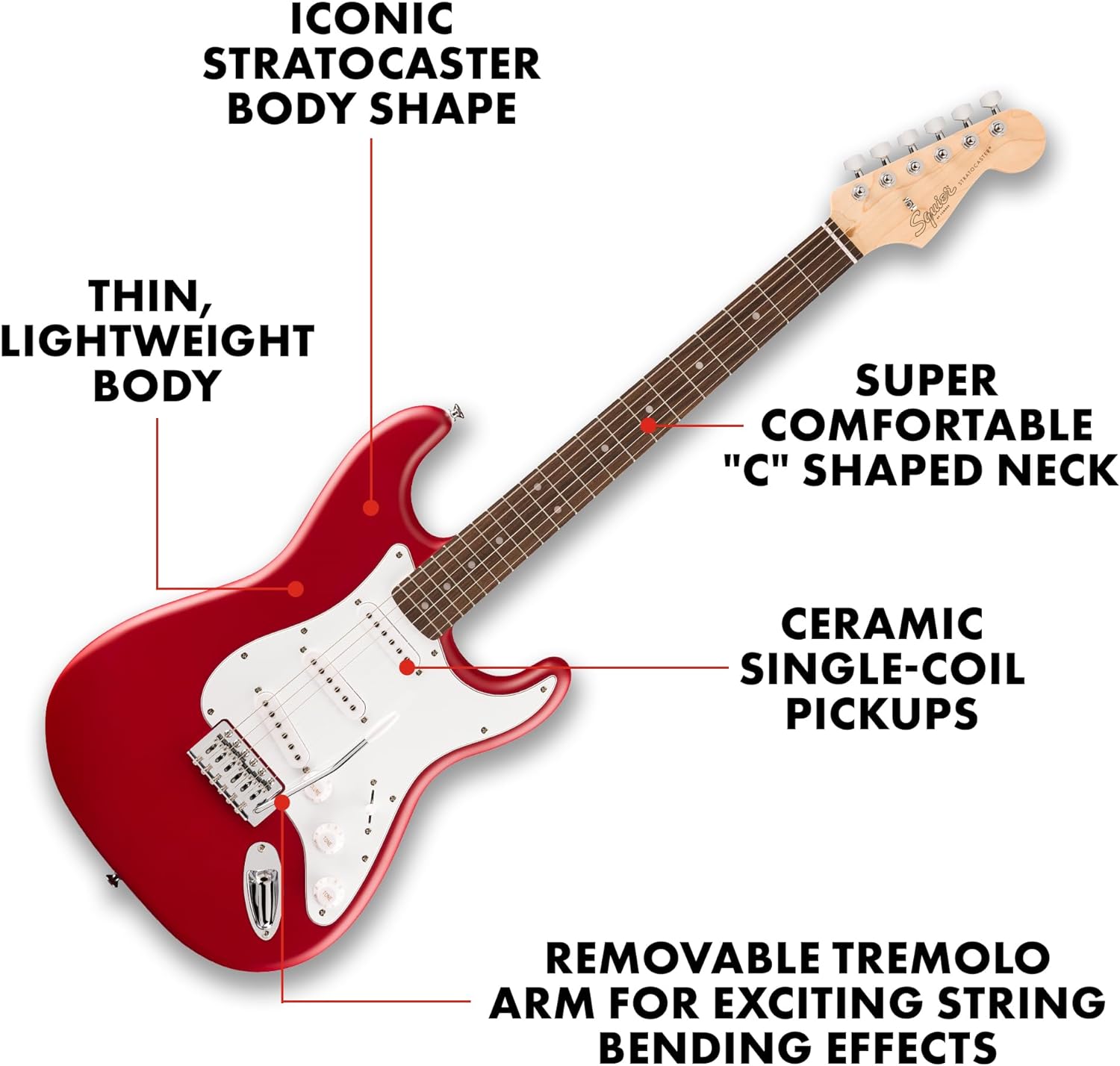
The Squier Debut Stratocaster is Fender’s most accessible entry point — it slots in below the Affinity and is commonly sold in a bundle that includes a small practice amplifier (the Fender Frontman 10G), a gig bag, a cable, a clip-on tuner, picks, and a strap. It is designed explicitly as a first guitar for younger and beginner players. According to Fender Musical Instruments Corporation’s Squier Debut Series warranty documentation, the Debut carries a 2-year limited warranty — unusually strong coverage for this price tier. Published specifications list an Indian Laurel fretboard (the plank of wood along the neck that players press strings against), a poplar body, and a shorter-scale option at 24.75 inches that reduces string tension and can make the instrument physically easier for smaller hands.
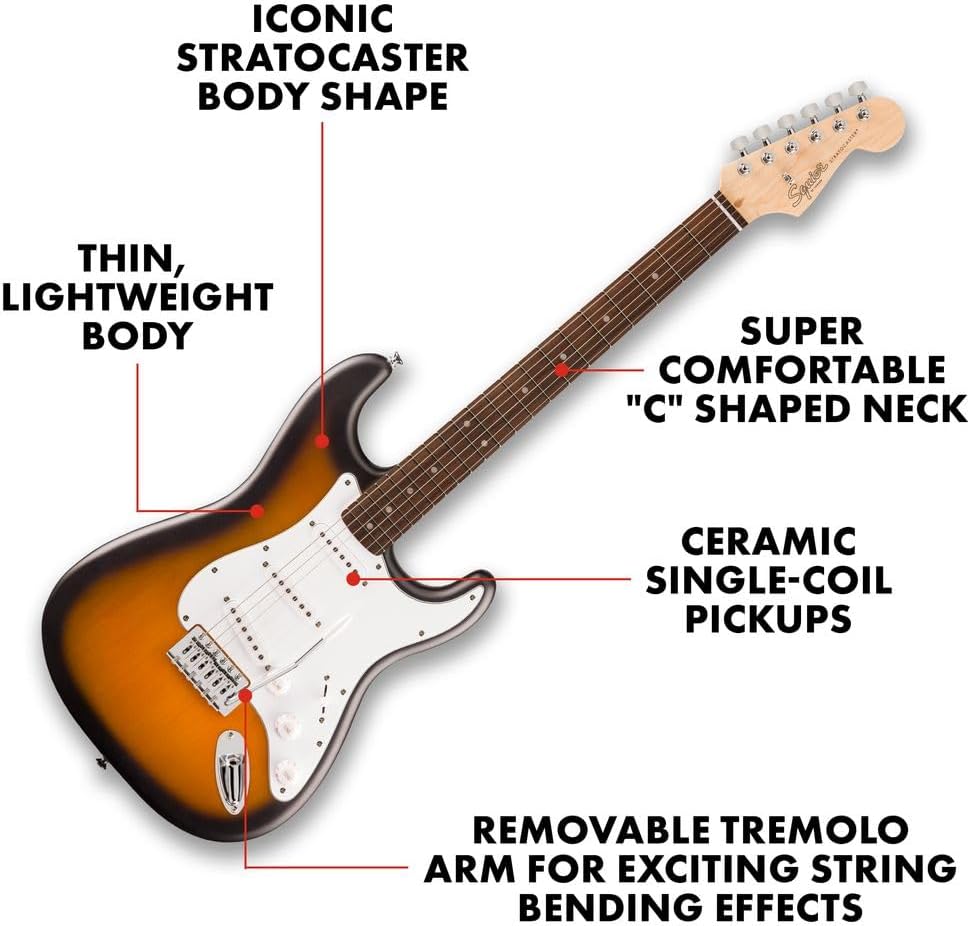
The Squier Affinity Stratocaster sits one rung up. It uses an Indian Laurel or maple fretboard depending on the configuration, a poplar body, and a full 25.5-inch scale length — the same measurement as a standard American Fender Stratocaster. MusicRadar’s review of the Affinity Stratocaster describes its unplugged acoustic tone as “rich, thick, and warm,” and notes that it punches above its price class in factory setup quality and overall resonance. Guitar World’s best beginner electric guitars guide consistently places the Affinity Stratocaster among its top recommendations for adult beginners, citing its standard dimensions and production consistency.
Feature comparison at a glance:
| Feature | Debut Stratocaster | Affinity Stratocaster |
|---|---|---|
| Scale length | 24.75” or 25.5” | 25.5” |
| Bundle option available | Yes (amp, bag, accessories) | No (guitar only) |
| Warranty | 2 years limited | 1 year limited |
| Upgrade compatibility | Moderate | Strong |
| Primary target | Age 8–14, new adult beginners | Teen and adult beginners |
Head-to-Head: Three Key Dimensions
H3: Value for a First-Time Buyer Starting from Zero
For someone who owns nothing — no amp, no cable, no picks, no tuner — the Debut bundle is the clearest single-purchase path to playing guitar on day one. Sweetwater Sound’s product aggregation notes for the Squier Debut Stratocaster consistently describe the out-of-box experience as one of the stronger performers in the sub-$200 tier, with buyers reporting the instrument is genuinely playable without requiring an immediate professional setup.
A “setup” — the process of adjusting string height (action), intonation, and nut slot depth at a guitar shop — typically costs $40–$80 and is often necessary on competing beginner instruments before they’re comfortable to play. A guitar that fights back with strings set too high off the fretboard, sharp fret edges, or binding tuning machines discourages beginners from continuing. The Debut’s reputation for arriving in a playable condition is not a minor detail; it is one of the most important variables in whether a beginner sticks with the instrument past the first month.
The 2-year limited warranty, per Fender Musical Instruments Corporation’s published Debut Series warranty documentation, adds meaningful peace of mind — especially for households buying for a child or a first-time owner unfamiliar with instrument care. The standard Affinity warranty is 1 year.
Fender
$149.99
In stock on Amazon
Check price on AmazonH3: Long-Term Playability and the Upgrade Path
The Affinity Stratocaster’s decisive advantage is its runway. Guitar World’s beginner electric guitar guide highlights the Affinity’s standard 25.5-inch scale length as a key reason to recommend it for adult beginners: every standard Stratocaster and Telecaster — and the entire Fender Player and American Professional series — uses this same measurement. Building muscle memory on 25.5 inches means a player never has to recalibrate when they upgrade. Starting on the Debut’s 24.75-inch option and transitioning later is not catastrophic, but it is an adjustment that some players notice.
The Affinity also responds better to incremental upgrades. Players who catch the tone-chasing instinct — wanting to swap in better pickups, a bone or TUSQ nut, or locking tuners (tuning machines that grip the string mechanically to improve pitch stability) — will find the Affinity’s internal routing and component compatibility more aligned with standard Stratocaster specifications. MusicRadar’s Affinity Stratocaster review specifically notes its hardware consistency and the quality of its factory-installed components as distinguishing factors at this price point.
The acoustic resonance that MusicRadar describes as “rich, thick, and warm” is not incidental. A guitar that sounds alive and responsive before it’s even plugged in tends to feel more rewarding to play, which matters enormously for whether a beginner keeps practicing. The Affinity delivers that quality more reliably than guitars at a comparable or even slightly higher price from competing manufacturers.
Fender
$149.99
In stock on Amazon
Check price on AmazonH3: When Neither Model Is the Right Answer
Both the Debut and the Affinity are genuine instruments — not toys — but they share a ceiling. If the player in question has already moved past the beginner stage, can play barre chords cleanly, and is beginning to think about performing with other musicians or recording with any seriousness, neither of these guitars will feel competitive for long. The frustration of outgrowing an instrument is real, and it can stall progress if a player associates their limitations with the music rather than with the tool.
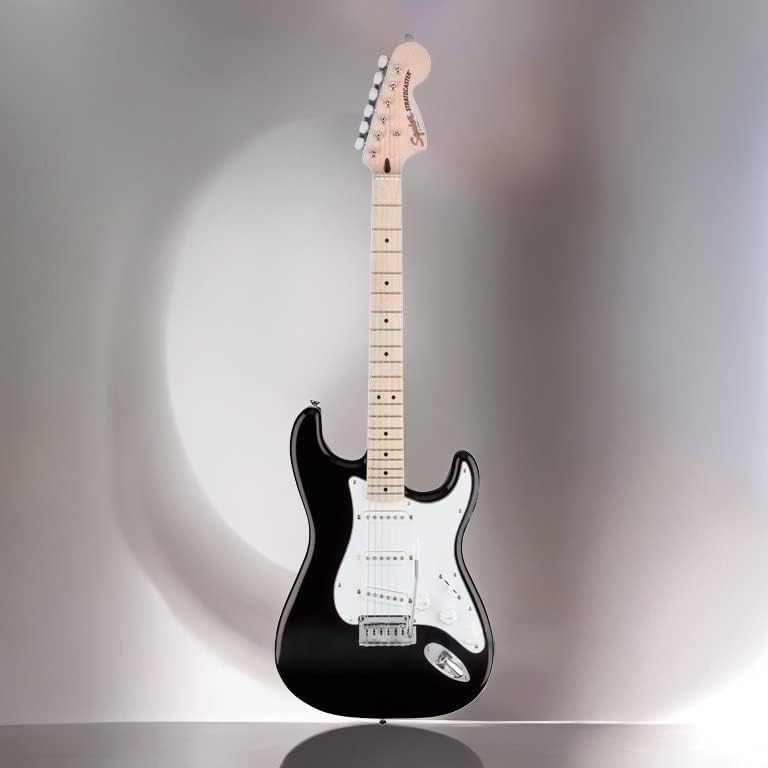
In that scenario, the Fender Player Series Stratocaster represents the next meaningful step — a Mexican-made instrument with noticeably better pickups, hardware, and finish quality that holds its value and remains relevant at intermediate and even advanced levels. Sweetwater Sound’s product documentation for the Player Series Stratocaster positions it explicitly as the bridge between the Squier line and the American-made instruments. The price difference is significant, but so is the long-term satisfaction delta. A player who is already past the beginner stage and buys an Affinity may find themselves replacing it within a year. A player at that same stage who stretches to a Player Series may play it for a decade.
Squier
$319.99
In stock on Amazon
Check price on AmazonThe Tuning Stability Question: Real Problem or Pre-Purchase Anxiety?
One concern that circulates heavily in pre-purchase research around both models is tuning key “slop” — the perception that the tuning pegs (the knobs used to tighten or loosen each string) are imprecise or prone to slipping. This concern appears frequently enough that it warrants direct address.
The actual owner experience, as aggregated in Sweetwater Sound’s Squier Debut Stratocaster product notes and reflected in Guitar World’s buyer guidance on beginner electrics, does not match the intensity of this concern at the research stage. Most owners of both models report that tuning stability is adequate for beginner-to-intermediate play once strings are properly stretched in. String stretching is a routine, tool-free process: tune the guitar, gently pull each string away from the fretboard several times, retune, repeat — the whole process takes about fifteen minutes and is necessary on virtually any new guitar regardless of price.
That said, tuning machines at this price tier are not precision instruments. A player who is performing live regularly or tracking recordings seriously would likely benefit from a locking tuner upgrade on either model — but this is true across virtually the entire beginner guitar market, not a Squier-specific limitation.
Frequently Asked Questions
Is the Squier Debut Stratocaster actually playable right out of the box?
Based on buyer aggregation notes published by Sweetwater Sound and Guitar World’s beginner electric guitar coverage, the Debut is consistently among the better out-of-box experiences in its price tier. Most buyers do not report needing an immediate professional setup, which distinguishes it from several competitors at similar prices. Serious players with higher standards may still prefer a shop setup, but a beginner picking up the guitar on day one should not be blocked by the instrument’s condition.
For a child aged 10–13, which model is more appropriate?
The Debut’s bundle format, shorter 24.75-inch scale option, and 2-year warranty make it the more thoughtful choice for younger players. The reduced string tension on the shorter scale is a real ergonomic advantage for smaller hands forming their first chords.
For an adult beginner, which model is the better investment?
The Affinity. Its standard 25.5-inch scale length, stronger upgrade compatibility, and the acoustic resonance quality noted in MusicRadar’s Affinity Stratocaster review make it the better long-term platform. The slightly higher entry price is offset by the longer runway before the player feels the need to replace the whole instrument.
Does the 2-year warranty on the Debut Series actually matter?
Yes. Per Fender Musical Instruments Corporation’s Squier Debut Series warranty documentation, the extra year of coverage beyond the Affinity’s standard 1-year warranty is a meaningful buffer for households buying for a child or a new owner who may not yet know how to identify or avoid conditions that stress instrument components.
Can either guitar grow with a player past the beginner stage?
The Affinity has the longer runway. Its standard dimensions and component compatibility mean a player can extend its relevance with part upgrades for years. The Debut is a legitimate instrument — owners with substantial playing experience have praised it as such — but it is optimized for the entry point, not for extended service. If a player knows they are serious from the start, the Affinity is the one worth buying.
The Decision Framework
The choice between these two is cleaner than it might appear once you frame it correctly:
- Buy the Debut bundle if the player is a child under 14, if you need everything in one purchase with no additional components, or if the 2-year warranty matters to your household.
- Buy the Affinity if the player is a teenager or adult, if you want a guitar that rewards future investment and part upgrades, or if you already own an amplifier and only need the guitar itself.
- Step up to the Fender Player Series if the player is already past the beginner stage and wants an instrument that will remain competitive through the intermediate and early-advanced levels without requiring replacement.
Both Squiers are built by the same company that produces the Stratocasters hanging on the walls of every serious player you have ever admired. The difference between them is not quality versus junk — it is about matching the right tool to the specific job. Get that alignment right, and either one can begin a relationship with the guitar that lasts a lifetime.