Silent Practice, Big Sound: Headphone Amps, Mini Smart Amps, and Modeling Combos for Playing Without Disturbing Anyone
Here’s a scenario that every guitar player eventually faces: it’s late, the walls are thin, and you still want to play. Maybe you live in an apartment. Maybe there’s a baby asleep down the hall. Maybe your roommates have early mornings and your patience for headphone-through-phone-speaker tone is completely gone. The good news is that a whole category of gear exists specifically to solve this problem — and it’s genuinely gotten impressive in the last few years.
A headphone amp is a small device — sometimes no bigger than a guitar plug — that goes between your guitar and a pair of headphones, letting you hear yourself play without making any external noise. A modeling amp (short for “amp modeler,” meaning it uses digital processing to simulate the sound of classic amplifiers) does the same thing but adds layers of tones, effects, and often Bluetooth connectivity. This guide is for players who already know what they’re looking for but need help choosing between real options, understanding the honest tradeoffs, and spending their money smartly.
The Real Decision Matrix: What Type of Player Are You Right Now?
Before looking at specific products, it helps to get clear on your actual use case. These four categories cover most buyers:
- Pure silent practice — you just want to hear yourself clearly, full stop
- Practice + play-along — you want to jam with YouTube lessons, backing tracks, or recorded songs
- Practice + occasional recording — you want a USB audio interface path to your DAW (digital audio workstation — the software you record into, like GarageBand or Reaper)
- Practice + gigging lightweight — you want something that doubles as a traveling rig
The products below map to those use cases differently, and the tradeoffs are real enough to matter.
The Contenders: What’s Worth Your Attention in 2026
Fender Mustang Micro Plus
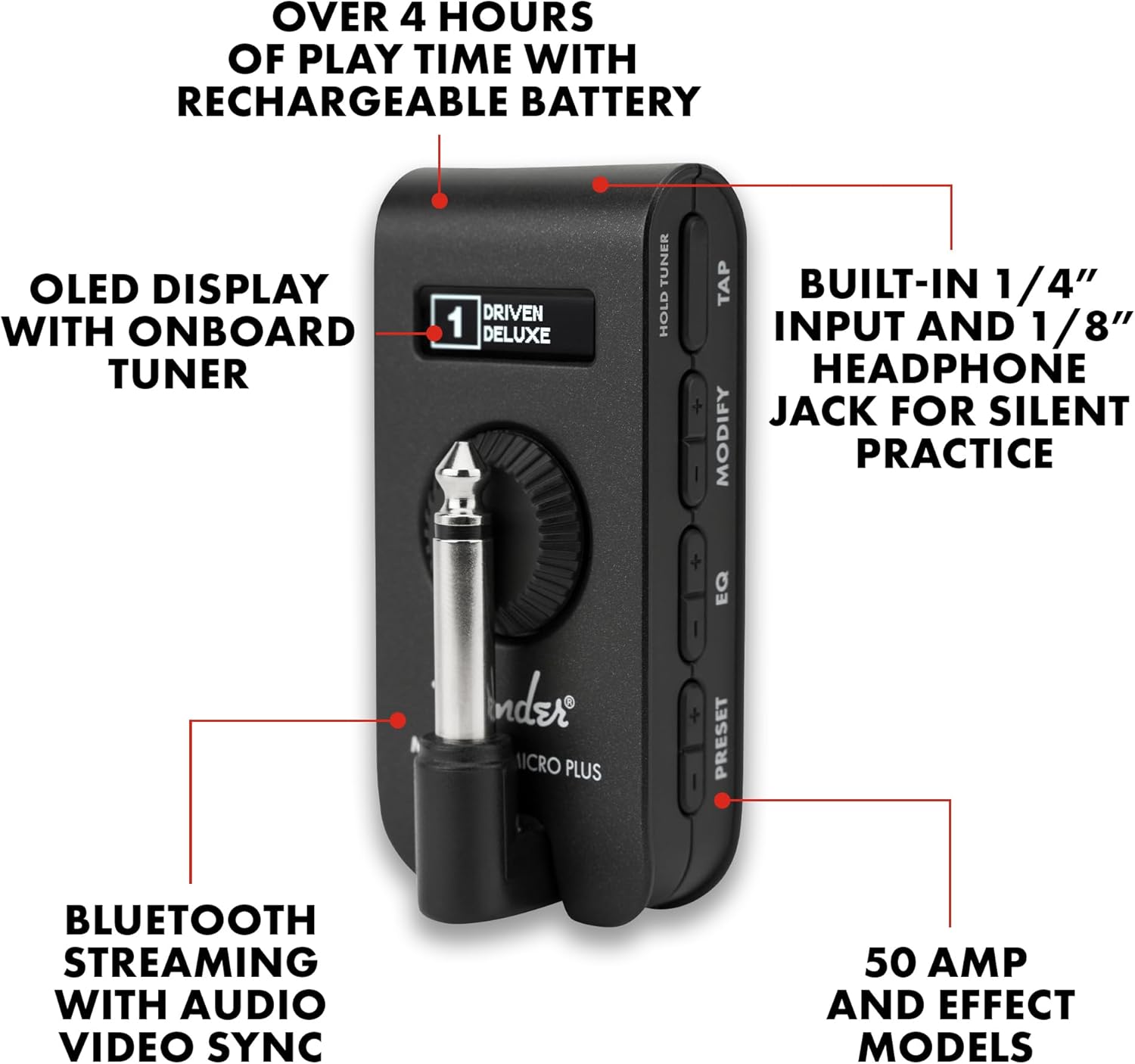
The Mustang Micro Plus plugs directly into your guitar’s output jack. That’s the whole form factor — no separate box, no cables except headphones. It runs on a built-in rechargeable battery and pairs via Bluetooth with your phone, which opens up the app-based features: tone editing, preset storage, and — the one reviewers keep calling out specifically — the ability to stream audio from YouTube directly into your headphones alongside your guitar signal.
Owners consistently describe it as a “game-changer” for practice motivation, and the Bluetooth play-along feature gets called out by name again and again as the thing that makes a daily practice session feel less like a chore and more like actually playing music. The 12 amp models cover Fender’s classic clean and drive tones, which suits a wide range of styles without feeling gimmicky.
The honest flag: Android users have recurring complaints about the companion app. The iOS experience is significantly more polished. If you’re on Android, this is not a minor caveat — reviewers flag it consistently, and you should factor it in before committing.
By the numbers:
- Weight: approximately 2.2 oz (lighter than most cable connectors)
- Battery life: rated for up to 4 hours continuous
- App platform support: iOS (strong), Android (limited, ongoing complaints as of 2026)
- Street price: approximately $79–$89
Buy this if: you’re an iPhone user who wants the most frictionless, most portable silent practice device available and you primarily play Fender-voiced tones.
Positive Grid Spark GO
The Spark GO is a small rectangular box — think deck-of-cards form factor — that functions as a standalone mini amp with a headphone output, a Bluetooth speaker, a USB recording interface, and an AI-powered “Smart Jam” feature that generates backing tracks based on your playing in real time.
The owner reviews collected by Guitar World and MusicRadar’s buyer roundups tell an interesting story: multiple buyers replaced several prior devices with a single Spark GO. One pattern that shows up repeatedly is buyers coming in with low expectations — replacing a basic budget amp or a collection of practice apps — and ending up genuinely surprised by the sound quality. The Positive Grid documentation confirms the Spark GO can function as a Bluetooth speaker even when no guitar is plugged in, which means it pulls double duty in a small room or workspace.
The Spark GO app handles variable-speed playback for learning songs, which is a feature the Mustang Micro Plus doesn’t offer natively. If you’re working through a solo that’s too fast to catch at full speed, being able to drop playback to 60% without changing pitch is a real learning tool, not a gimmick.
The honest flag: The Spark GO’s amp models, while diverse, won’t satisfy players deep into vintage British tones or complex high-gain sounds the way a full Kemper or Helix rig would. It’s optimized for approachability and breadth, not for depth of any single tone category.
Buy this if: you want one device that handles silent practice, play-along with slowed-down songs, USB recording, and doubles as a Bluetooth speaker — and you’re comfortable with a small-box form factor rather than a plug-in device.
Fender Mustang LT25
The LT25 is a real combo amp — meaning it has a speaker, a cabinet, and can fill a room if you need it to. But it also has a headphone output that defeats the speaker entirely when something is plugged in, making it a genuine dual-purpose option: quiet practice at midnight, actual amp at practice volume during the day.
Aggregated owner reviews at Sweetwater note that the 50 factory presets cover genuine stylistic range — clean country, classic rock crunch, high-gain metal, and everything between — rather than the token preset variety you find on budget modeling amps where 40 of the 50 presets are slight variations of the same distortion. At least one buyer specifically chose the LT25 because it was small enough for an apartment but still had the headphone output for late-night use: a clean swap for the “practice amp in the bedroom” use case without sacrificing flexibility.
The honest flag: At 25 watts into a real speaker, this isn’t truly a “silent” device when used as an amp. It solves the nighttime practice problem via headphones, but if you’re in a situation where even a quiet speaker isn’t an option at any time of day, the plug-in devices above are better fits.
Buy this if: you want a genuine combo amp that can cover rehearsals and bedroom playing at volume, but also has a serious headphone output for late-night sessions — and you have space for a small amp on a shelf or desk.
Zoom G1X FOUR Multi-Effects Pedal
The G1X FOUR is technically a multi-effects processor (a device that chains together many different effects — reverb, delay, chorus, distortion, etc. — in a single unit) rather than an amp or headphone amp in the traditional sense. But it has a dedicated headphone output with amp and cab simulations (cab simulation = digital modeling of speaker cabinet sound, which makes headphone output sound like a real amp rather than a dry guitar signal) built in.
The context that keeps showing up in owner reviews is interesting: the G1X FOUR gets used as a tone-shaping layer in front of a basic amp — MusicRadar’s roundup notes a reviewer who paired it with a Fender Frontman 10G and described a dramatic improvement in tone, essentially using the G1X FOUR to compensate for the amp’s limitations. But separately, it works perfectly well as a standalone headphone practice device.
The portability feature most buyers don’t expect: USB power bank compatibility. This means silent practice on a park bench, in a green room, or anywhere there’s no wall outlet. That’s genuinely uncommon in this class.
The honest flag: The G1X FOUR has a learning curve. The interface is menu-driven, and building a patch from scratch takes time. If you want to plug in and play immediately, this isn’t your device. If you enjoy dialing in sounds and have patience for a setup phase, the depth it offers is disproportionate to the price.
Buy this if: you want a device that can function as both a silent practice tool and a tone-shaping pedal in front of a real amp — and portability via power bank matters to you.
Quick Comparison: Who Should Buy What
| Device | Form Factor | Play-Along | USB Recording | Speed-Slow | Power Bank |
|---|---|---|---|---|---|
| Mustang Micro Plus | Plug-in | Yes (Bluetooth) | No | No | No (battery) |
| Spark GO | Mini box | Yes (Bluetooth) | Yes | Yes (app) | No |
| Mustang LT25 | Combo amp | Limited | No | No | No |
| Zoom G1X FOUR | Pedal | No | Yes (USB audio) | No | Yes |
Frequently Asked Questions
Can the Fender Mustang Micro Plus work with Android phones? Technically yes, but reviewers consistently flag the Android app as significantly less functional than the iOS version. Core playback and tone features work, but preset management and app stability have been recurring complaint points in owner reviews through early 2026. If Android is your platform, the Spark GO’s app has broader compatibility.
Does the Spark GO work as a Bluetooth speaker when you’re not playing guitar? Yes — Positive Grid’s official documentation confirms the Spark GO functions as a Bluetooth speaker independently of any guitar input. Owners report using it this way routinely. It’s not a high-end speaker, but for a small room it’s more than functional.
Is the headphone output on the Mustang LT25 good enough for serious late-night practice? Owner reviews at Sweetwater consistently describe the headphone output as genuinely usable — not an afterthought the way some combo amp headphone jacks are. The amp modeling stays active through the headphone path, so you’re hearing the same modeled tones, not a dry signal. For late-night practice at a serious level, it holds up.
Can I use the Zoom G1X FOUR to practice silently through headphones? Yes. The G1X FOUR has a dedicated headphone output with amp and cab simulation engaged, which means it sounds like a real amp in your headphones rather than a dry, thin guitar signal. This is one of its primary use cases and is well-documented in both Zoom’s specifications and owner reviews across MusicRadar’s coverage.
Do any of these devices let me slow down songs to learn them? The Spark GO app includes variable-speed playback — you can slow tracks down without changing pitch. This is the standout feature for learners working through fast passages. The Mustang Micro Plus doesn’t offer this natively; you’d need a separate app running alongside it. The G1X FOUR and LT25 don’t include this feature at all.
Which option is best if I want to also record directly to my computer? The Spark GO and the Zoom G1X FOUR both offer USB audio output, making them functional as audio interfaces (devices that connect your guitar signal to recording software). Between the two, the G1X FOUR gives you more granular control over tone shaping pre-recording; the Spark GO is faster to set up and has a more intuitive app. For home studio use where you’re already in a DAW regularly, the G1X FOUR’s depth may justify its learning curve. For occasional recording alongside daily practice, the Spark GO is the more seamless experience.
The Bottom Line
Silent practice gear in 2026 is genuinely good — good enough that the “this is a compromise” mindset that was reasonable five years ago doesn’t fully apply anymore. The decision is less about finding something acceptable and more about matching the right tool to your actual workflow.
- If you’re an iPhone user who wants zero friction: Mustang Micro Plus
- If you want one device for practice, play-along, slow-down learning, and recording: Spark GO
- If you want an amp that works at volume during the day and silently at night: Mustang LT25
- If you want portability, tone depth, and USB recording with power bank support: Zoom G1X FOUR
Every one of these is worth the money for the right player. The wrong one is only the one that doesn’t match how you actually play.