Fender Redondo Debut vs. CD-60S: Which Entry Acoustic Is Actually Worth Buying in 2025
If you’re just getting into acoustic guitar — or buying one for someone who is — the number of options at the under-$300 mark can feel genuinely overwhelming. An acoustic guitar is simply a hollow-bodied instrument that produces sound without any electrical amplification: no amp required, no cables, just strings and wood. At the entry level, two Fender models come up again and again in conversations about where to start: the CD-60S and the Redondo Debut. They’re in a similar price neighborhood, they’re both built for newer players, and they both carry that familiar Fender name. But they’re actually pretty different guitars — different shapes, different tonewoods (the specific types of wood used for the body and top), and different philosophies about who they’re for. This guide breaks down exactly what sets them apart, where each one shines, where each falls short, and which one makes more sense for your specific situation.
The Core Difference You Need to Understand First
Before comparing spec by spec, it helps to understand the fundamental design split between these two guitars.
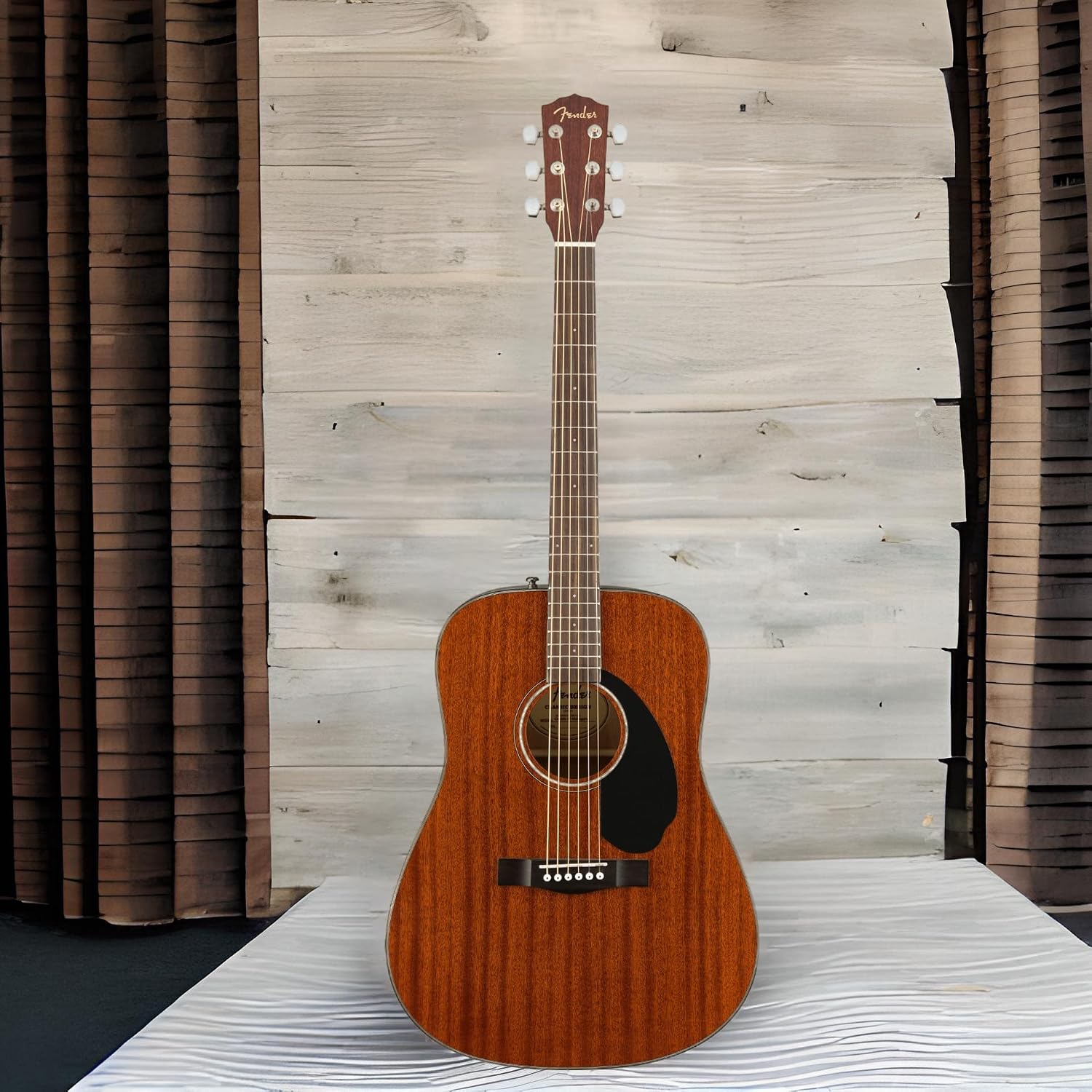
The Fender CD-60S is a dreadnought — that’s the most common acoustic guitar body shape in the world, wide-shouldered and deep-bodied, designed to project a full, loud, balanced sound. It has a solid spruce top, meaning the face of the guitar is made from a single piece of wood rather than layers pressed together (called laminate). Solid tops are widely considered to sound better and to improve with age as the wood vibrates and opens up over time. The CD-60S has been a staple recommendation in beginner roundups for years. MusicRadar’s “Best acoustic guitars for beginners in 2025” includes it as a top-tier entry-level option, and Guitar World’s “Best beginner acoustic guitars 2025: our top picks for new players” echoes that placement. It plays and feels like a traditional acoustic guitar, because that’s exactly what it is.
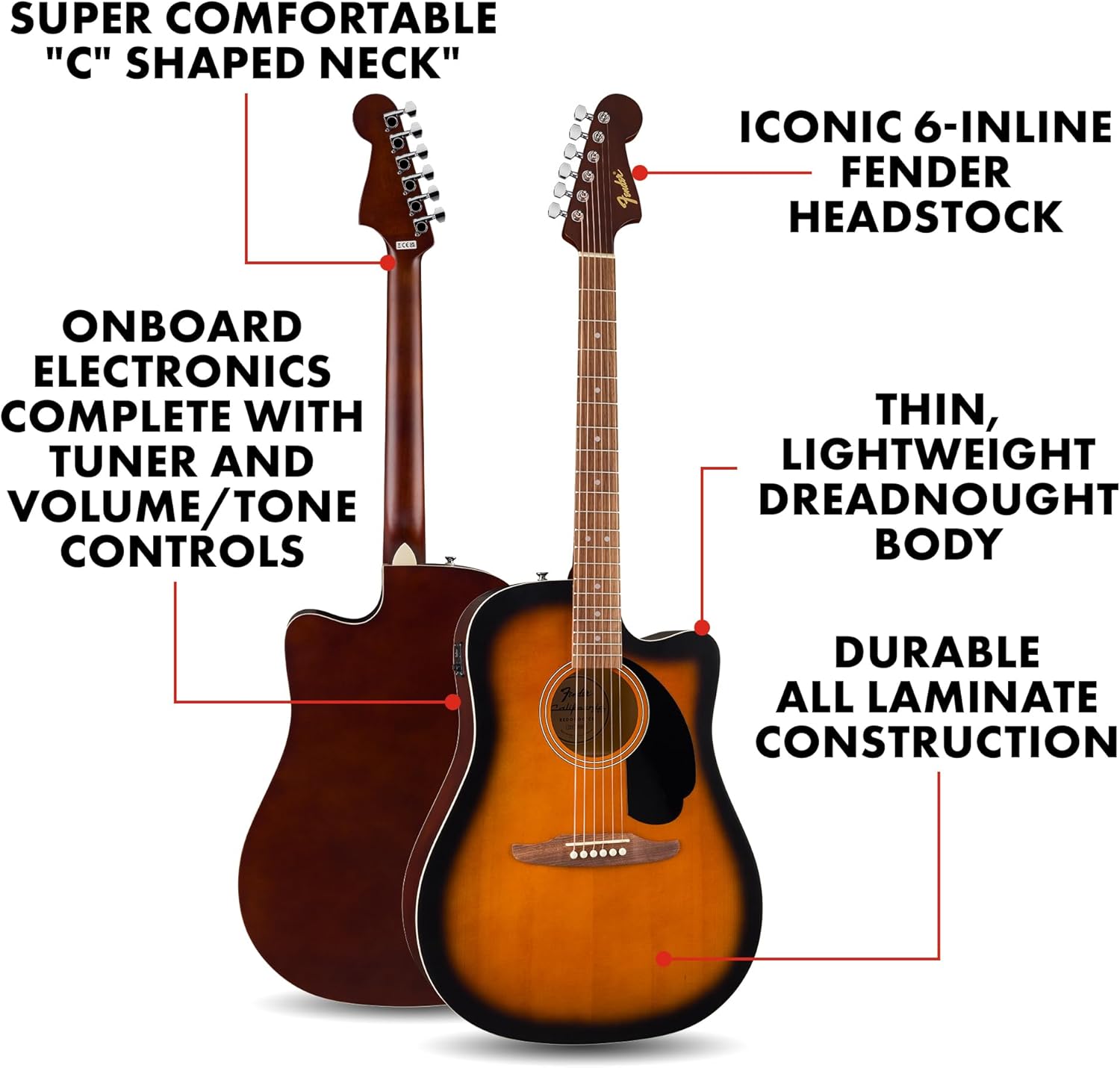
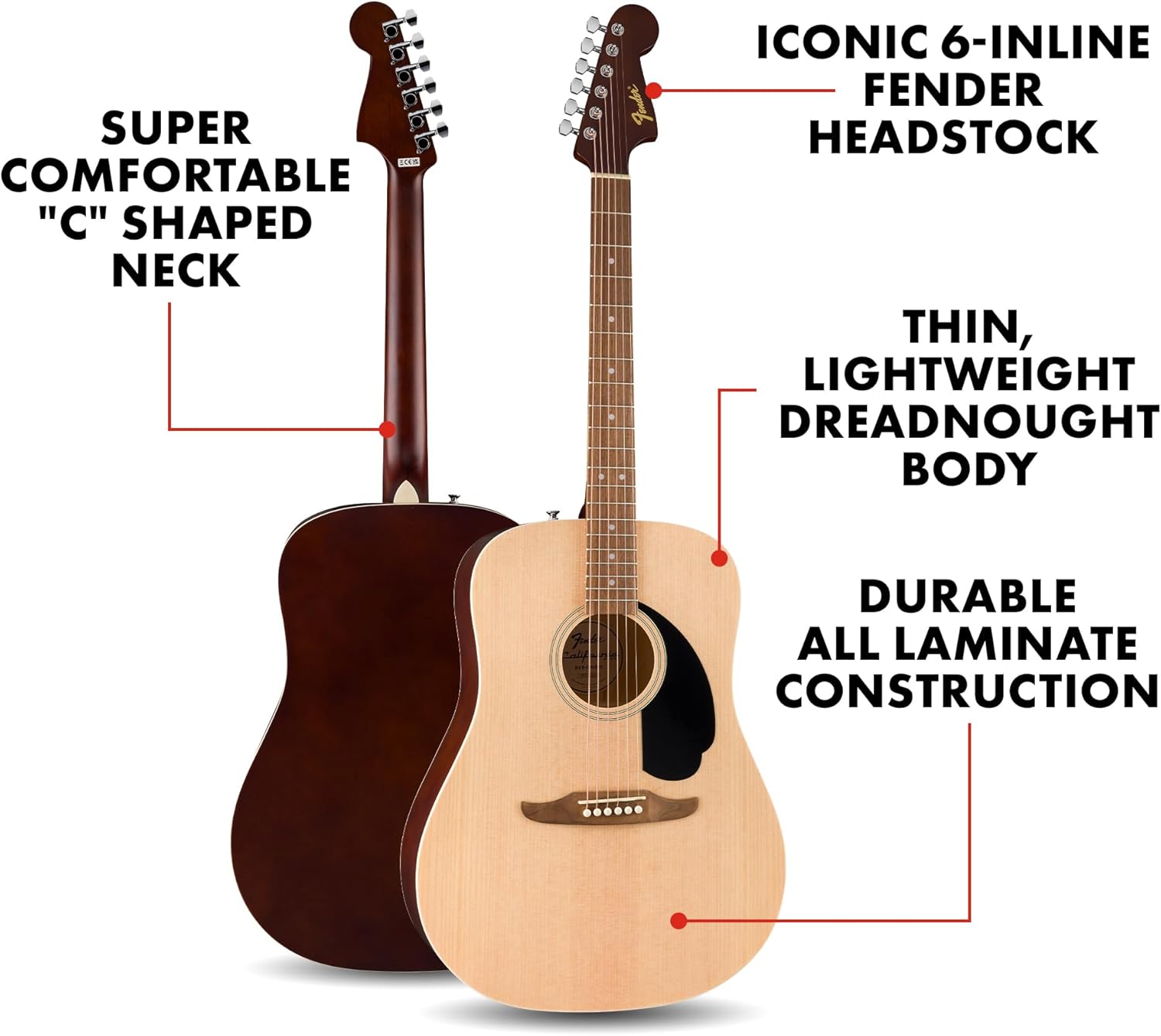
The Fender Redondo Debut takes a different approach. It’s built on a Grand Auditorium-style body — slightly smaller and more tapered than a dreadnought, which makes it more comfortable to hold for players with smaller frames or shorter arms. More notably, it uses an electric-guitar-style neck profile: slimmer, with a flatter radius (the subtle curve of the fretboard — a flatter radius means chord shapes feel more open and less taxing on smaller hands). The tradeoff is that the Redondo Debut uses fully laminate construction — both top and back/sides are layered wood — and does not carry a solid top.
That single difference — solid top versus laminate — is the axis around which most of this decision turns.
Head-to-Head: Three Key Categories
Sound Quality
Fender
$139.99
In stock on Amazon
Check price on AmazonThe CD-60S’s solid Sitka spruce top is where it earns its reputation. Sweetwater’s product overview for the Fender CD-60S describes the bracing pattern — the internal wooden framework that shapes resonance — as specifically tuned for low-action playability without unwanted string buzz, and owner accounts consistently describe a warm, full sound that punches above its price range. Multiple buyers note that factory setup quality is exceptional for this tier: instruments arrive close to in-tune and playable out of the box, which isn’t something you can take for granted at this price point.
The Redondo Debut’s sound picture is more nuanced. Sweetwater’s product overview for the Fender Redondo Debut notes its laminate spruce top and slim-taper neck as defining features aimed at comfort-first players. Owner accounts split roughly into two camps: players who compare it back-to-back against pricier instruments find it sounds clearly like a budget guitar, while players who evaluate it on its own terms consistently describe it as performing above its price. Both readings are honest — the Redondo Debut sounds fine for learning and casual playing, but its laminate construction means it’s less likely to reward you as your skills develop.
Laminate wood doesn’t open up and improve the way solid wood does, a point reinforced by Acoustic Guitar magazine’s buying guidance (Acoustic Guitar, “Buying Your First Acoustic: What the Specs Actually Mean”) — the guitar you buy is largely the guitar it will always be. For pure sound development over time, the CD-60S wins this category, and it’s not particularly close.
Fender
$229.99
In stock on Amazon
Check price on AmazonPlayability and Comfort
Fender
$139.99
In stock on Amazon
Check price on AmazonHere’s where context matters enormously. If you’re buying for a child, a teenager, a player with smaller hands, or someone migrating from electric guitar who finds acoustic neck profiles uncomfortable, the Redondo Debut’s slim-taper neck is a genuine feature, not just a marketing angle. Guitar World’s “Best beginner acoustic guitars 2025” specifically notes that electric-style neck profiles on acoustics can dramatically reduce the early-learning friction that causes new players to quit — the narrower nut width and flatter fretboard radius make open chord shapes feel less like a workout.
The CD-60S has a traditional dreadnought neck — comfortable for standard adult hands, but noticeably chunkier than what electric players are used to. Its bigger body can also feel unwieldy for smaller players sitting casually at home. Neither of these is a dealbreaker for the right buyer, but they’re worth naming honestly.
One practical heads-up on the Redondo Debut: tuning stability on the stock hardware is worth checking once the guitar arrives. Entry-level tuning machines at this price tier can sometimes struggle to hold pitch reliably under regular playing and temperature changes. If you notice tuning slippage after a few weeks, aftermarket locking tuners — sets from brands like Grover run $20–$30 — are a straightforward fix. This isn’t unique to Fender at this price, but it’s worth knowing before you assume any tuning issue is player error.
The Redondo Debut does include a soundhole-mounted chromatic tuner (a small electronic device that reads string pitch), which the CD-60S does not. For a beginner who doesn’t want to manage a separate clip-on tuner, that’s a genuine quality-of-life advantage. A clip-on tuner is an inexpensive fix — most run $10–$15 — but it’s an additional purchase to factor in.
Fender
$229.99
In stock on Amazon
Check price on AmazonValue, Bundling, and Long-Term Cost
Fender
$139.99
In stock on Amazon
Check price on AmazonFender sells the CD-60S in a bundle that includes a hard-shell case, and this is worth discussing explicitly. A hard case — a rigid, structured enclosure — protects a guitar from drops, bumps, and temperature swings in ways that soft gig bags simply cannot. A soft gig bag offers minimal protection against impact; a hard case genuinely prevents the kind of damage that would cost more to repair than the guitar itself.
Reviewers who purchased the CD-60S bundle consistently note that the case alone justifies a meaningful portion of the premium over the guitar-only version. Hard cases at retail typically run $40–$80 on their own, which makes the bundle math favorable. The Redondo Debut does not offer a comparable hard-case bundle at this price tier.
On street pricing in 2025: the CD-60S runs approximately $200–$250 guitar-only, or $280–$330 in the hard-case bundle. The Redondo Debut runs approximately $180–$220. The price gap narrows considerably when you factor in the case — and widens in the CD-60S’s favor when you account for the solid-top construction that retains and grows in value as a playing instrument over years.
MusicRadar’s “Best acoustic guitars for beginners in 2025” frames this clearly: the question at this tier isn’t just what sounds best today, but what serves the player best across the first two or three years of playing. On that framing, the CD-60S’s solid top and bundle optionality give it the stronger long-term value argument.
Fender
$229.99
In stock on Amazon
Check price on AmazonSpec Comparison at a Glance
| Feature | Fender CD-60S | Fender Redondo Debut |
|---|---|---|
| Body style | Dreadnought | Grand Auditorium |
| Top construction | Solid Sitka spruce | Laminate spruce |
| Back & sides | Laminate mahogany | Laminate mahogany |
| Neck profile | Traditional C-shape | Slim-taper electric-style |
| Built-in tuner | No | Yes (soundhole-mounted) |
| Hard-case bundle available | Yes | No |
| Street price (2025) | ~$200–$250 / ~$280–$330 (bundle) | ~$180–$220 |
The Decision Framework: If X, Then Y
After absorbing the spec comparison and category-by-category analysis, here’s the clearest way to think about which guitar belongs in your situation:
Buy the Fender CD-60S if:
- You want the best sound quality for the money, full stop
- You’re buying for an adult with average or larger hands
- You want an instrument that will reward developing technique — the solid top genuinely improves with years of playing
- You’re buying for a student who will transport the guitar regularly, and the hard-case bundle makes practical sense
- You plan to keep this guitar for more than a year before considering an upgrade
Buy the Fender Redondo Debut if:
- You’re buying for a smaller player — a younger teenager, a player with smaller hands, or someone with a petite frame
- The buyer plays electric guitar and will find a slim-taper acoustic neck dramatically more accessible
- A built-in tuner removes one barrier to actually picking up the guitar and practicing
- Budget is genuinely tight and the price difference is meaningful in your situation
If you’re a total beginner buying your only guitar and you can only afford one, the CD-60S is the stronger long-term instrument for most players. But the Redondo Debut isn’t a compromise pick — it’s a well-designed guitar for a specific player profile, and for that profile it’s the right answer.
Frequently Asked Questions
Is a solid top really worth it on a beginner guitar?
Yes, with context. A solid top vibrates more freely than laminate and continues to improve over years of playing as the wood’s cellular structure responds to vibration — a process Acoustic Guitar magazine describes as the guitar “opening up” (Acoustic Guitar, “Buying Your First Acoustic: What the Specs Actually Mean”). The instrument gets warmer, more resonant, and more responsive over time. If you expect to upgrade within a year regardless, the difference is less urgent. If you plan to play the same guitar for several years, it matters substantially.
Does the Redondo Debut’s built-in tuner actually work well?
Owner accounts describe it as functional and convenient for beginners who don’t want to track a separate accessory. It’s a chromatic soundhole tuner — it reads pitch from inside the guitar rather than clipping to the headstock. It isn’t a professional-grade tuner, but for learning and casual playing it does the job reliably.
How different does the Grand Auditorium body feel compared to a dreadnought?
Noticeably different for smaller players. The Grand Auditorium has a tighter waist and slightly narrower lower bout, which makes reaching around the body easier for players under roughly 5’4” or players with shorter arms. MusicRadar’s “Best acoustic guitars for beginners in 2025” specifically recommends auditorium-style bodies as a comfort-first choice for younger or smaller players — it’s not a marginal difference for that audience.
Is the CD-60S bundle with a hard case worth the extra cost?
For most buyers who plan to transport the guitar, yes. Hard cases at retail run $40–$80 on their own, so the bundle pricing is favorable. If the guitar will live on a stand in one room and never leave, the guitar-only purchase is fine. If it’s going in a car or to lessons regularly, the bundle is the smarter purchase.
Which guitar is better for a complete beginner who has never played before?
The CD-60S is the stronger recommendation for most beginners — the solid top, proven sound quality, and long-term improvement with playing make it a better investment. That said, if the beginner is a smaller player or comes from electric guitar, the Redondo Debut’s comfort advantages are real enough to justify choosing it. Know your player, then choose accordingly.