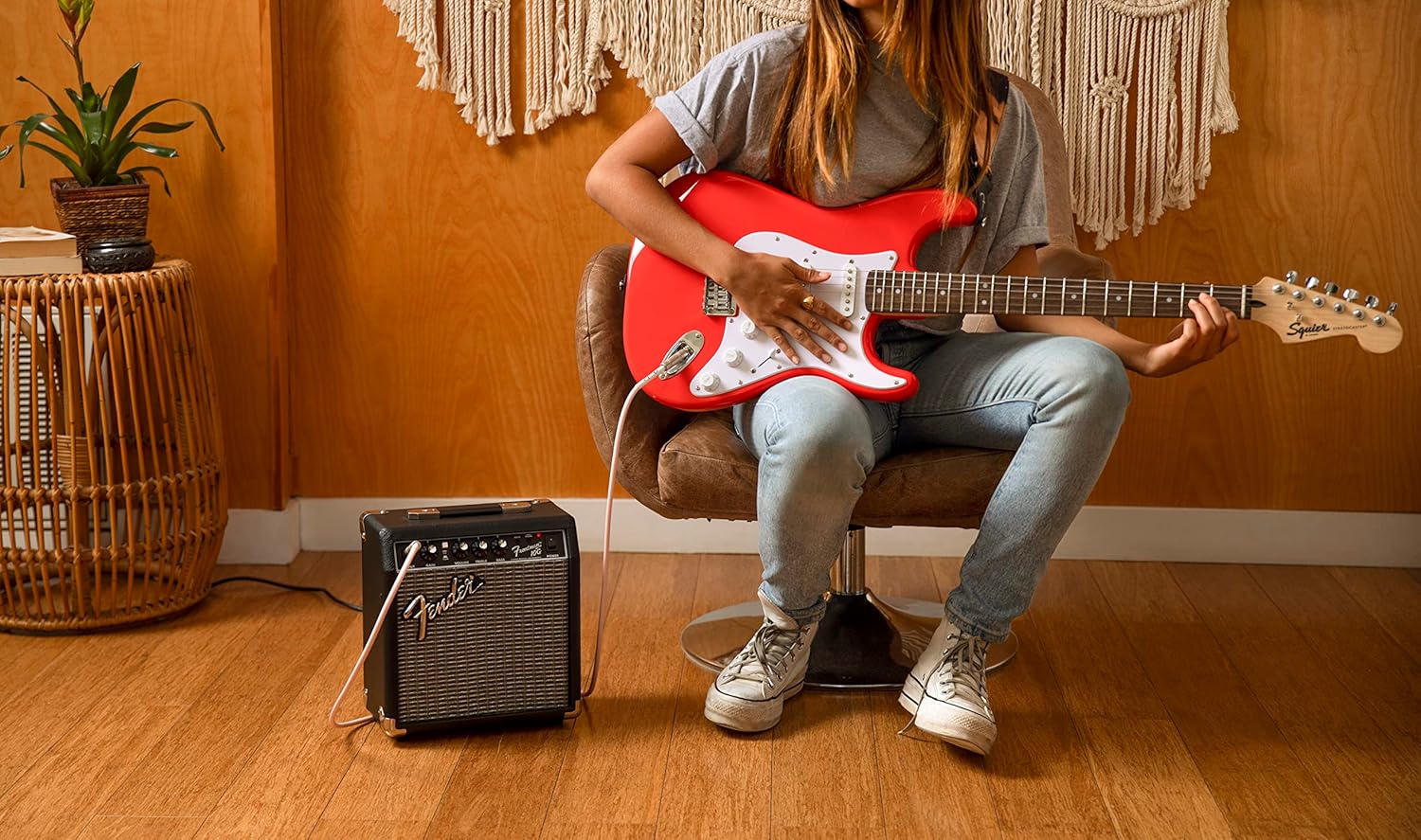
If you’ve ever stood in a guitar shop staring at a wall of amplifiers — the boxes with knobs and speakers that make your guitar actually loud — and felt completely lost, you’re not alone. A practice amp is simply a small, lower-powered amplifier designed for personal use: bedroom playing, apartment sessions, or small rehearsal spaces where you don’t need to shake the walls. At its most basic, it takes the quiet electrical signal from your guitar and turns it into sound you can actually hear and enjoy. The difference between a $79 starter amp and a $400 intermediate amp isn’t just volume — it’s tone quality, usable features, and whether the amp can follow you from your bedroom into a small venue without embarrassing you. This guide breaks all of that down in plain language, matched to your real-world situation, budget, and where you’re headed next.
If you already know your way around wattage ratings and speaker sizes, the decision framework sections below are where you want to spend your time. If you’re newer to this, keep reading — the language stays plain throughout.
| EDITOR'S PICK[BOSS Katana-50 Gen 3 Guitar Amp](https://www.amazon.com/dp/B0D1Z6VHD8?tag=greenflower20-20)… | Mid-tier[Vox Pathfinder 10 1x6.5 inch 10](https://www.amazon.com/dp/B0000WS0RI?tag=greenflower20-20)… | Budget pick[Fender Frontman 10G Electric Gu](https://www.amazon.com/dp/B09SVGMMPB?tag=greenflower20-20)… | |
|---|---|---|---|
| Wattage | 50W | 10W | 10W |
| Speaker size | 12" | 6.5" | 6" |
| Channels | — | 1 | — |
| Effects | ✓ | — | — |
| Amp characters | 12 | — | — |
| Headphone jack | — | — | ✓ |
| Aux input | — | — | ✓ |
| Price | $343.37 | $129.99 | $89.99 |
| See on Amazon → | See on Amazon → | See on Amazon → |
The Wattage Myth (and What Actually Matters in a Practice Amp)
Here’s the thing that surprises almost every newer player: wattage — the number followed by a “W” on an amp’s spec sheet — measures power output, but it does not scale linearly with perceived loudness. As Premier Guitar’s piece on wattage myths explains, a 15-watt amp is not half as loud as a 30-watt amp to your ears. In practice, the volume difference between 15W and 30W is roughly 3 decibels — barely perceptible in a live room. You’d need ten times the wattage to double perceived loudness.
What this means for your buying decision:
- 1–5 watts: True bedroom-only territory. Quiet enough for apartment living, neighbors intact. Think Fender Champion 20 or Boss Katana Mini.
- 10–20 watts: The sweet spot for practice that can handle a quiet rehearsal or a very small unplugged acoustic-adjacent gig (open mic with a PA, for instance).
- 30–40 watts: You can start to hold your own in a small-band rehearsal without a PA boost, and these amps can cover small-venue gigs if mic’d through the house system.
- 50+ watts: You’re moving into gigging amp territory. At that point, this guide hands you off to a different conversation.
The real variables that separate a $100 amp from a $350 amp in the practice range aren’t watts — they’re speaker quality, preamp circuit design (which shapes your core tone before it hits the speaker), and onboard effects quality.
Matching the Amp to Your Situation: The Decision Framework
Before you look at a single product, answer these four questions. Your answers will narrow the field faster than any spec comparison.
1. Where will you play 90% of the time? Apartment bedroom at night → prioritize a headphone output (a jack that lets you plug in headphones and play silently) and low-volume tone. House with a dedicated music room → you have more flexibility on wattage. Garage rehearsal space → go 20W minimum.
2. What genre(s) are you playing? Clean tones (jazz, country, fingerpicking) → a simpler amp with a great clean channel rewards you more than loaded DSP (digital effects). Rock and heavier styles → built-in gain (distortion circuits) and at least a passable overdrive channel matter. If you’re running an external pedalboard, a transparent, clean platform is usually smarter than an amp trying to do everything.
3. Do you have a pedalboard already, or are you building one? If you own Strymon pedals, a Chase Bliss board, or any serious drive/modulation chain, you want an amp with a clean, honest front end — not one coloring your signal before your pedals even get a word in. Owners of effect-heavy rigs consistently report that amps with minimal onboard DSP let their pedalboard breathe. If you’re bare-bones (just guitar and cable), a modeling amp with built-in effects punches above its price.
4. Will this amp ever leave the house? If the answer is “maybe someday” — build in that flexibility now. A 20W combo (a combo is an amp and speaker in one cabinet, as opposed to a separate “head” and “cabinet”) with an XLR output or a direct-recording output gives you a path to PA systems and recording interfaces without buying a second piece of gear.
By the Numbers: Practice Amp Quick-Reference
| Wattage | Best For | Headphone Out? | Rough Price Range |
|---|---|---|---|
| 1–5W | Silent/apartment play | Usually yes | $60–$150 |
| 10–20W | Bedroom + quiet rehearsal | Often yes | $130–$300 |
| 30–40W | Rehearsal + small gigs | Sometimes | $250–$500 |
| 20W modeling | Versatile home/studio | Almost always | $200–$400 |
The Shortlist: Amps Worth Your Attention at Each Tier
These aren’t ranked by preference — they’re framed by situation. Use the “buy this if…” scenarios to find your match.
Under $150: The Honest Bedroom Amp
Fender Champion 20 ($99–$129 street price, widely available at Guitar Center and Sweetwater)
The Champion 20 is one of the most consistently recommended entry-level amps across Guitar World’s best practice amps roundup and Sweetwater’s buying guide alike. Owners report that the clean channel — the setting with no added distortion — genuinely sounds like a Fender, not a toy. It has a headphone out, a built-in tuner (a device that tells you if your guitar is in tune), and a selection of onboard effects including reverb (a subtle echo effect that makes notes bloom naturally) and delay (a repeating echo).
Buy this if: You’re playing in an apartment, you want something simple without a learning curve, and you’re not planning to gig in the next 12 months.
Skip it if: You own pedals or plan to build a board — its preamp colors the signal in ways that can muddy a pedalboard chain.
Boss Katana Mini ($99 street)
The Katana Mini is a battery-powered 7W amp that owners consistently describe as surprisingly full-sounding for its size. MusicRadar’s small amp roundup notes it as one of the few genuinely portable options that doesn’t sacrifice tone to get there. It has three character modes (clean, crunch, lead) and a headphone output.
Buy this if: You travel, you need to play unplugged in multiple rooms, or you just want something that fits on a desk without taking over the space.
Skip it if: You want to eventually mic it at a gig — at 7W with a small speaker, it won’t project in any meaningful live context.
$150–$350: The Workhorse Tier
Boss Katana 50 MkII ($229–$249 street)
This is the amp that reviewers keep coming back to as the default recommendation for players who want flexibility without complexity. It runs at 50W (switchable down to 0.5W for near-silent practice), has five amp characters, solid onboard effects, and a USB recording output that lets you plug directly into a computer interface. Sweetwater’s product team describes it as one of the cleanest modeling platforms at this price point.
Buy this if: You want one amp that handles bedroom practice, band rehearsals, and can be direct-recorded into a DAW (a digital audio workstation — recording software like GarageBand or Logic). It’s the rare amp that genuinely covers all three.
Skip it if: You’re a tone purist chasing a specific vintage tube sound. The Katana’s digital modeling is excellent for its class, but it won’t satisfy someone who’s already played through a tweed Deluxe or a brownface Princeton.
Fender Blues Junior IV ($399–$429 street)
The Blues Junior is a 15-watt all-tube amp — meaning it uses vacuum tubes (the older, warmer-sounding technology that many players feel produces a more musical, responsive tone compared to solid-state digital designs). It’s been a standard recommendation in guitar publications for over two decades. Premier Guitar has covered the Blues Junior series extensively as a benchmark for what real tube tone feels like at an accessible price.
Buy this if: You’ve already decided tone is the priority, you play blues, rock, or country, and you want an amp that will still sound great in five years when your playing outgrows everything else in this price range.
Skip it if: You need a headphone output (the Blues Junior doesn’t have one), you live in an apartment with noise restrictions, or you’re not ready to manage the quirks of a tube amp (they need occasional maintenance — tube replacement — that solid-state amps don’t).
The Modeling Platform Option: Line 6 Catalyst 60 ($299–$329)
Modeling amps use digital processing to simulate many different amp sounds — a Fender clean, a British Marshall crunch, an American high-gain voice — in one box. The Line 6 Catalyst 60 landed well in MusicRadar’s 2025 small amp coverage, with owners noting that the clean platform is transparent enough to use as a pedal platform without the amp’s own voice dominating.
Buy this if: You’re genre-agnostic, you’re building a pedalboard and want a clean slate to run it through, or you want the rehearsal-to-small-gig range without spending on multiple amps.
Skip it if: You’ve already fallen in love with a specific amp sound and you’re trying to chase that — modeling gets you close, but committed tone-chasers will always hear the gap.
The Tradeoffs Nobody Tells You About
Tube vs. solid-state vs. modeling: Tube amps respond dynamically — they get louder, warmer, and more complex as you dig in harder with your pick. Solid-state amps are consistent and reliable. Modeling amps are versatile and quiet-friendly. None is objectively better; all three serve different players. As Sweetwater’s amp guide notes, most players don’t need tube warmth until they’re on stage — at bedroom volumes, a good modeling amp competes.
Built-in effects vs. clean platform: If you own or plan to own external pedals, resist the temptation of amp features. Every effect your amp adds is one more variable between your guitar and a clean signal. Simplicity is a feature.
Headphone output: If you live with other people or in an apartment, this is non-negotiable. Don’t compromise on it. Playing through headphones at midnight without waking anyone up is one of the most underrated quality-of-life features in an amp.
The Decision Rule
Here’s the honest if/then map:
- If you’re apartment-based, early in your playing, and budget-conscious → Fender Champion 20. It’s proven, honest, and won’t fight your development.
- If you need the most flexibility in one box and you might gig someday → Boss Katana 50 MkII. It’s the safest long-run purchase in this guide.
- If tone is the priority and you can live without a headphone out → Fender Blues Junior IV. You’ll still be happy with it in a decade.
- If you run a pedalboard and want a transparent platform → Line 6 Catalyst 60. It gets out of your signal’s way.
None of these are wrong answers. The only wrong answer is buying wattage you’ll never use, or buying a feature set that fights the way you actually play. Match the amp to your real life — the one you have right now — and you’ll make the right call every time.
Prices reflect mid-2026 street pricing across major retailers. Check current availability and pricing at Sweetwater, Guitar Center, or Reverb before purchasing — stock and pricing shift regularly, especially on popular entry and mid-tier models.