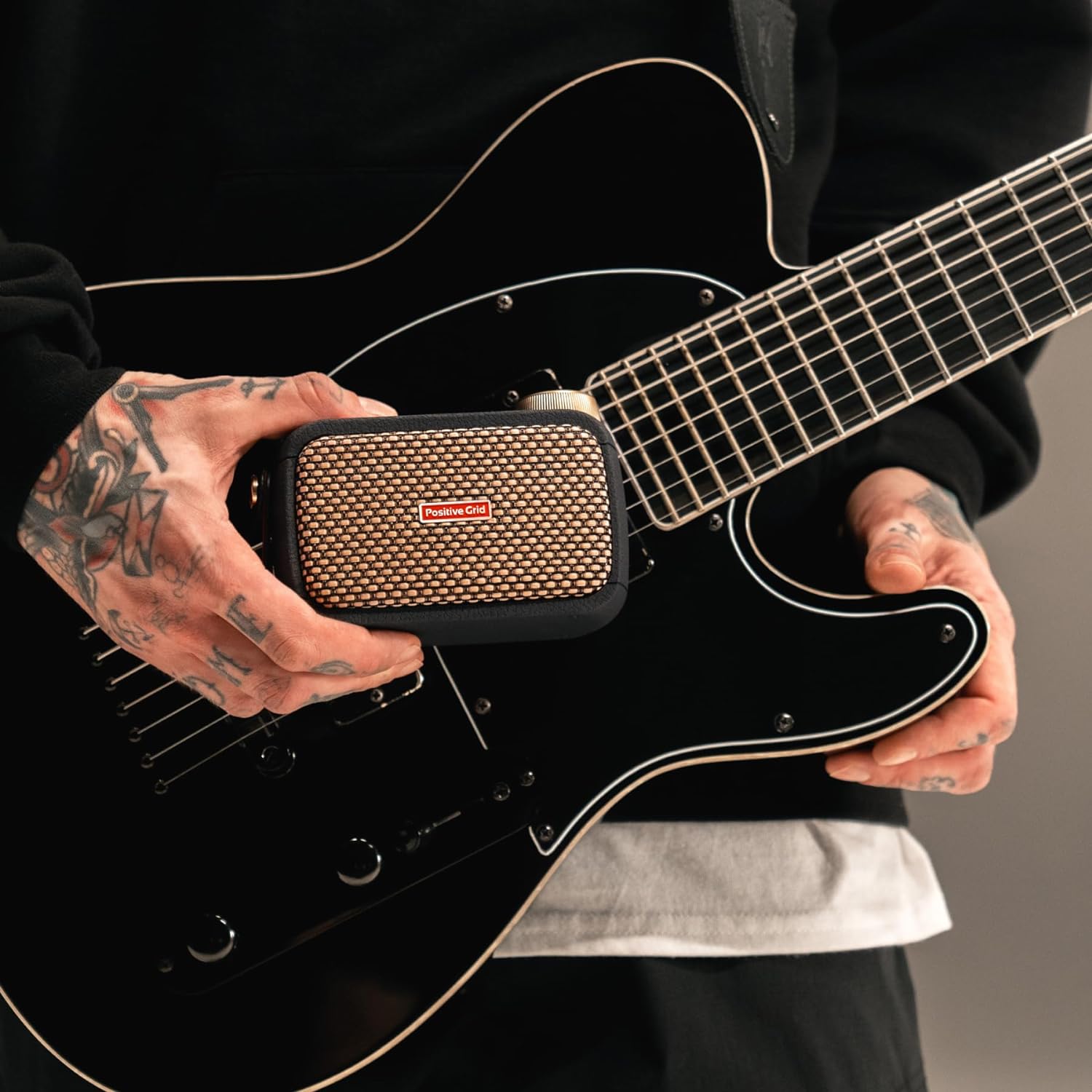
If you’ve been shopping for a practice amp lately, you’ve probably noticed a new category that didn’t really exist five years ago: the smart amp. That’s a guitar amplifier (the box that makes your guitar loud and shapes its tone) that also connects wirelessly to a smartphone app. The app can do things a traditional amp knob never could — like listen to any song you’re playing along with and automatically show you the chords on screen, or let you dial in hundreds of different tones without touching a single physical control. Positive Grid’s Spark line is the most talked-about player in this space, and the two models most players are weighing right now are the Spark 2 (a 40-watt desktop/stage-adjacent amp) and the Spark GO (a palm-sized, battery-powered unit). This article breaks down what each amp actually does well, who they’re built for, and — critically — where the marketing stops and real-world utility begins.
| EDITOR'S PICK[Positive Grid Spark 2](https://www.amazon.com/dp/B0DDW6VS45?tag=greenflower20-20) 50W Smart… | Mid-tier[Fender Mustang LT25](https://www.amazon.com/dp/B07N29M92M?tag=greenflower20-20) Guitar Ampl… | Budget pickPositive Grid Spark GO 5W Ultra… | |
|---|---|---|---|
| Wattage | 50W | 25W | 5W |
| Smart features | ✓ | ✗ | ✓ |
| Bluetooth | ✓ | ✗ | ✓ |
| Presets | — | 30 | — |
| Built-in looper | ✓ | — | — |
| Price | $345.00 | $179.99 | $147.00 |
| See on Amazon → | See on Amazon → | See on Amazon → |
What “Smart” Actually Means in Practice
Before we get into comparisons, it’s worth pinning down the features that separate a smart amp from a modeler (a digital amp that simulates classic amplifiers) with Bluetooth bolted on.
The Spark platform’s headline trick is AI chord detection — the app listens to a recorded track through your phone’s audio stream and identifies the chords in real time, displaying them on screen as the song plays. For a player who learns by ear, this is either transformative or a party trick, depending on how you use it. More on that in the FAQ below.
The other anchor feature is backing track integration: you can play a song from Spotify, Apple Music, or YouTube directly through the amp’s speaker, with your guitar mixed in at whatever level you choose. No aux cord, no separate Bluetooth speaker, no routing headache. That friction removal is, according to aggregated owner reviews on Sweetwater and Guitar World’s coverage of the Spark 2, the single feature most responsible for people actually practicing more. When the barrier to playing along with a song is “press one button,” it turns out people do it more often. Behavioral outcome, not a tone specification — and more useful for most buyers than knowing the amp’s signal-to-noise ratio.
Spark 2 vs. Spark GO: The Decision Frame
Here’s the honest split before we go deeper.
By the numbers:
- Spark 2: 40 watts, dual 2.5” tweeters + 4.5” woofer, ~12 lbs, AC power required
- Spark GO: 5 watts (manufacturer-rated), 2” full-range driver, ~0.5 lbs, internal battery (~8 hrs rated life)
Those specs tell a story about two completely different use cases pretending to be in the same product family.
The Spark 2: For Players Who Are Done Wrestling With Gear
Guitar World’s Spark 2 review positions it as a destination amp — a single box that handles practice, home recording, and low-volume jamming — rather than a stepping stone. That framing holds up when you look at who’s actually buying it. Owner patterns across Sweetwater’s review section reveal something meaningful: a disproportionate share of Spark 2 buyers describe themselves as players with 25 to 50 years of experience. Their stated purchase driver isn’t chasing new tones. It’s physical fatigue with traditional rigs — the cable management, the pedalboard logistics, the amp-on-a-stand setup that used to be fine and now feels like a production every time you want to play for 20 minutes after dinner.
One particularly instructive owner account, surfaced in aggregated Sweetwater reviews, describes buying a full pedalboard setup earlier in the same year — new pedals, cables, power supply — and then discovering the Spark 2 replaced most of it. That’s not a product failure story. It’s a cautionary tale about purchase sequencing: if you’re considering a traditional rig upgrade and you practice primarily at home, the Spark 2 conversation should happen before the pedalboard conversation, not after.
The Spark 2’s 40-watt rating and its ported enclosure design give it real low-end authority for a desktop amp. MusicRadar’s coverage of the broader Spark line notes that the speaker arrangement — separate tweeter and woofer rather than a single full-range driver — produces a stereo imaging effect with certain presets that single-speaker practice amps can’t touch. For players running ambient, reverb-heavy, or multi-voice presets, this matters. For a player running a clean country tone into a light drive, it matters less.
Buy the Spark 2 if: You practice at home most of the time, you’re currently managing a separate amp + pedalboard, you want direct USB recording output for home studio capture, and you’d genuinely use a phone-connected tone library instead of tweaking individual knobs. It’s also the answer if low-end frequency response (the way bass notes feel in the room) is important to you — the 4.5” woofer does real work.
Don’t buy the Spark 2 if: You need to play at any serious live volume, or you’re hoping it replaces a stage amp. It’s not designed for that. Premier Guitar’s broader coverage of the smart-amp category is consistent on this point: these are home/studio tools, and the Spark 2 is the largest one in this family.
The Spark GO: The Amp That Made Skeptics Into Converts
The Spark GO is a different kind of product entirely, and the owner sentiment around it is unusually strong in a specific direction. Across aggregated reviews, there’s a recurring pattern — call it the “convert” arc — where buyers describe ordering the GO with low expectations, primarily to solve the battery-life and inconvenience problems they had with previous portable micro-amps, and ending up genuinely surprised.
One owner account cited in MusicRadar’s GO coverage describes abandoning a travel-guitar practice habit entirely because earlier battery-powered practice amps were too fiddly and short-lived. The GO reversed that. Another pattern: multiple GO owners specifically cite the Bluetooth phone play-along feature — the ability to stream a song and play along without any wires — as the element that made them practice more consistently, not just more conveniently. That’s the behavioral outcome worth paying attention to.
At roughly half a pound and with a rated eight-hour battery life, the GO eliminates the “I have to set up to play” friction almost entirely. It lives on the couch. It goes in a carry-on bag. You pick it up and you’re playing in ten seconds.
Buy the Spark GO if: You want something that removes every barrier between you and picking up the guitar — no power outlet hunting, no cable, no amp-on-a-stand. It’s also the right answer for travel, apartment practice where volume matters, or headphone sessions where you still want the phone integration working. Owners consistently report that the GO’s headphone output, used with in-ear monitors or studio headphones, delivers a noticeably richer tone than basic headphone amps in the same size category.
Don’t buy the Spark GO if: You need to be heard over another person playing an acoustic guitar in the same room, or if full-frequency low-end response is important to your playing experience. At five watts through a two-inch driver, it cannot do that job. That’s not a criticism — it’s not designed to.
AI Chord Detection: Useful Tool or Expensive Gimmick?
This feature gets mentioned in almost every Spark review, and the honest answer is: it depends entirely on how you learn.
The app listens to the song playing through your phone, runs pitch detection on the audio, and displays chord names above the timeline in real time. It works better on tracks with clear harmonic movement and less well on dense arrangements or songs with significant distortion in the source recording. Premier Guitar’s coverage of smart-amp technology describes chord detection as a “practice accelerator” for players who are building their repertoire by ear — it shortens the time from “I want to learn this song” to “I’m playing along.”
For players who already read charts, use tabs reliably, or play primarily original material, it’s probably background noise. For the player who learns by listening and wants a faster path from a new song to actually playing it, it closes a real gap.
The key word is detection, not transcription. It won’t produce a full chart with voicings and fingerings. It identifies chords and displays them. Think of it as a smarter version of pausing a YouTube tutorial every few seconds — except it’s running in real time and you can keep playing while it catches up.
How the Spark Line Stacks Up Against Its Closest Rivals
The most common comparison in the small-amp category right now is the Fender Mustang Micro Plus — a headphone-only unit that draws USB power and offers preset-based amp modeling without the speaker component. Owners who discuss both products, as surfaced in Sweetwater and Guitar World review aggregates, describe a clear split: the Mustang Micro Plus rewards players who specifically want high-quality headphone tone and don’t need or want a speaker, while the Spark GO rewards players who want the behavioral integration — the play-along feature, the app, the physical amp presence — even at a smaller size.
The Mustang Micro Plus’s USB recording output is cleaner in owner-reported assessments for direct-to-DAW (digital audio workstation, meaning recording software) use, but the Spark GO’s app ecosystem provides something the Mustang doesn’t: an active tone community and regular preset updates that keep the library expanding.
Neither answer is wrong. They solve different problems.
Frequently Asked Questions
Can the Spark GO really replace a practice amp entirely for home use? For most home practice contexts — solo playing, headphone sessions, playing along with music — yes, owners consistently report it holds up. The caveat is volume ceiling: if you’re in a home setting where you need to fill a room or play alongside another instrument, the GO’s five-watt, two-inch driver will feel limiting. For personal practice? The recurring owner verdict is that it’s enough, and often more than expected.
Does the Spark 2’s app work on Android or only iPhone? The Spark app supports both iOS and Android. Positive Grid’s published platform documentation confirms Android compatibility, and owner reviews on multiple platforms describe consistent Android functionality, though some note that iOS updates have historically arrived slightly ahead of Android parity releases.
How does the Spark GO’s sound quality compare to the Fender Mustang Micro Plus for headphone practice? Based on aggregated owner comparisons, the GO’s headphone output is competitive, particularly for players who want to stay in the Spark app ecosystem. The Mustang Micro Plus is generally rated slightly higher for raw headphone tone fidelity among players who prioritize that channel exclusively. The GO wins when the phone integration — Bluetooth play-along, chord detection, app tone library — matters more than pure headphone output quality.
Is the Spark 2 loud enough to play with another acoustic guitarist in the room? Realistically, at moderate volumes in a quiet room, yes — owners describe being able to hold a conversation-level jam with an acoustic player. At louder acoustic volumes (someone playing with full strumming energy), the Spark 2 will be working at its ceiling. Guitar World’s review characterizes it as a home amp with some social-jam capability, not a rehearsal amp.
What does “AI chord detection” actually do in daily practice — is it useful or a gimmick? It’s a genuine tool with a specific use case: ear-learning players who want to decode a song quickly without pausing and rewinding a tutorial. For that player, multiple owners describe it as a meaningful time-saver. For players who use tabs, charts, or play primarily original music, it adds little to a daily practice session. The honest answer is that it’s a real feature with a real ceiling — it detects, it doesn’t transcribe.
The Spark 2 and Spark GO aren’t trying to be a boutique tube amp or a stage rig. They’re trying to make the space between “I want to play guitar” and “I’m playing guitar” as small as possible. Based on what owners consistently report, they largely succeed — and for players who’ve been fighting their own gear logistics, that might be the most valuable thing on the spec sheet.