If you’ve ever plugged your pedalboard into an amp and heard a whine, buzz, or hiss that wasn’t there before you added pedals, you’ve already experienced the pedalboard power problem firsthand — you just might not have known where it was coming from. A pedalboard is simply a flat board or case that holds your guitar effects pedals (the small boxes that change your tone — adding distortion, reverb, delay, and so on) organized and connected in one place. Most starter boards come with a built-in power supply — the unit that converts wall power into the lower DC voltage your pedals need to run. Sounds convenient. And it is, until that supply starts injecting noise into your signal chain (the path your guitar’s sound travels from instrument to amp). This guide will help you understand exactly why that happens, how to tell if your supply is the culprit, and which products actually solve the problem rather than just move it around.
Why Your Power Supply Is Probably Noisier Than You Think
Here’s the core issue: not all power supplies are created equal, and the design difference that matters most is isolation — or the lack of it.
A non-isolated power supply (sometimes called a “daisy chain” supply) shares a single power source across all your pedals simultaneously. Every pedal on that chain is electrically connected to every other pedal. That means noise generated by one pedal — or by the supply itself — bleeds across all of them. Digital pedals (which use microprocessors to process your sound) are especially problematic here because they generate high-frequency electrical noise as a byproduct of normal operation. When you daisy-chain a digital pedal with analog pedals (which process sound using traditional electronic components without a microprocessor), you’re essentially giving that noise a direct highway into everything else.
An isolated power supply gives each pedal its own separate power output, like individual electrical circuits in your house. Noise generated in one circuit cannot travel into another. Premier Guitar’s “Pedalboard Power 101” feature describes this as the single most important specification to check before buying any power supply — more important than wattage, form factor, or price.
The physics are unforgiving. Sweetwater Sound’s pedalboard power supply knowledge base explains that ground loops — one of the most common sources of hum — occur specifically when multiple pieces of gear share an electrical ground through a non-isolated supply. That 60Hz hum you’re hearing? That’s AC (alternating current) power frequency leaking directly into your audio signal.
The STRICH Problem: A Real-World Case Study in Non-Isolated Failure
The STRICH pedalboard is a useful example because it makes the stakes concrete. Multiple owners reviewing the STRICH report that the board construction itself is well-made and the included case is genuinely handy for transport. The problem isn’t the board. It’s the power supply.
Reviewers across aggregated feedback consistently describe the same symptom: a loud, high-pitched whine that several call “virtually unusable” in any real playing context. That language is significant. A low-level hiss you can manage. A high-pitched whine loud enough that multiple independent reviewers reach the same word — unusable — is a design failure, not a quirk.
What they’re almost certainly hearing is RF (radio frequency) interference from a non-isolated supply with poor filtering. The supply is doing its basic job — converting wall power to DC — but without the transformer isolation that keeps that conversion process acoustically invisible to your pedals.
This is exactly the pattern Guitar World’s buying guide for pedalboard power supplies warns about: all-in-one beginner boards often price the board itself competitively by economizing on the power supply, which is the component that most directly affects your tone.
By the Numbers
| Supply Type | Typical Noise Floor | Pedal Crosstalk Risk | Best For |
|---|---|---|---|
| Non-isolated daisy chain | High | High | Identical analog-only setups |
| Partially isolated | Medium | Medium | Budget all-analog boards |
| Fully isolated (per-output) | Low | None | Mixed digital/analog rigs |
MusicRadar’s 2024 roundup of pedalboard power supplies notes that fully isolated units dominate their top recommendations precisely because the performance gap over non-isolated supplies is audible even to listeners who aren’t players.
What the Boards That Work Actually Do Differently
The LEKATO board lands in an interesting spot. Reviewers report successfully fitting six standard-size pedals and describe the power supply as functional — working as expected, without the noise issues that plague the STRICH. One reviewer noted they were genuinely skeptical given the price point, then pleasantly surprised. That skepticism is healthy and well-earned given the category’s history. What likely accounts for the difference is better filtering on the supply side, even if it isn’t offering true per-output isolation. For a basic analog pedalboard — say, a tuner, a drive pedal, a chorus, and a delay — adequate filtering on a shared supply can be enough. The moment you add digital multi-effect units or processor-heavy pedals, the math changes.
The RVONE gets consistent praise specifically from players making the jump from floor-scattered pedals and individual power adapters (the individual wall-wart transformers that come with most pedals) to their first real board. Owners report that musician friends noticed and commented positively on the built-in supply — a telling detail. When players who aren’t even buying the gear notice an improvement, you’re solving a real problem. The RVONE’s supply appears to handle a mixed basic rig without the noise complaints that follow the STRICH everywhere. For players at the “getting organized” stage, that’s a meaningful win.
The SPB-14S takes a different approach entirely. Its steel construction (versus the aluminum used in most competing boards) and thumb-screw accessible power tray are consistently highlighted by owners as differentiators that feel like genuine quality decisions rather than spec-sheet padding. The accessible power tray matters more than it sounds: being able to swap or service your power supply without disassembling the entire board is a workflow feature that saves real time at a gig. Reviewers who’ve owned aluminum boards note that the steel build feels more substantial and road-ready, though it does add weight.
A recurring theme across all of these boards, regardless of power supply quality, is something worth pausing on: players consistently report that the act of organizing pedals onto a board — getting off the floor-scattered-adapter setup — changes how much they play. It lowers the friction of sitting down and making music. That’s not marketing language; it’s a consistent pattern in long-form owner reviews, and it’s worth weighing in your purchase decision even before you optimize every spec.
Dedicated Power Supply vs. Board-With-Built-In: The Decision Frame
This is where the tradeoffs get explicit. Here’s how to think through the decision:
Buy a board with a built-in supply if:
- You’re running four to six analog stompboxes (Boss DS-1, Ibanez Tube Screamer, MXR Phase 90 — classic analog pedals with simple power needs)
- You’re gigging small venues or rehearsal spaces where absolute noise floor isn’t mission-critical
- Budget is the primary constraint and the alternative is staying on the floor with individual adapters
- You’re still figuring out your rig and don’t want to over-invest before your signal chain stabilizes
Buy a board and add a separate, fully isolated power supply if:
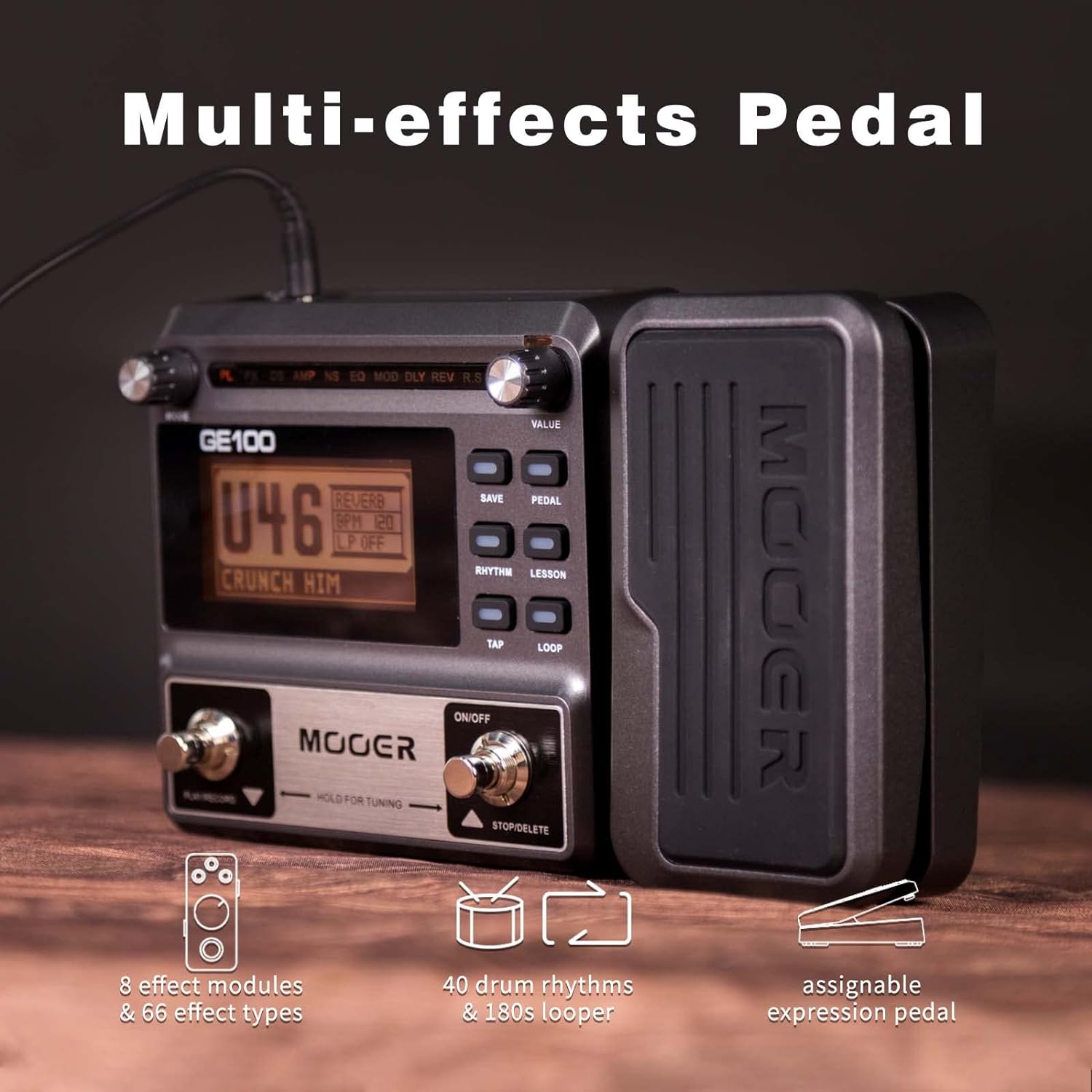
- You’re mixing digital pedals (multi-effects units, modelers, loopers) with analog pedals
- You’re recording directly to an interface where noise is preserved and amplified
- You’re playing venues with problematic electrical systems (older buildings, outdoor stages with shared power)
- You’ve already heard the hum and you’re done troubleshooting it
Sweetwater Sound’s buying guidance on pedalboard power supplies draws a similar line, noting that players running five or more pedals — especially any mix of digital and analog — almost always benefit from a standalone isolated supply over any built-in option at a comparable price point.
Frequently Asked Questions
How do I know if my pedalboard’s power supply is causing the hum or buzz I’m hearing?
The fastest diagnostic: bypass your board’s supply entirely and power each pedal with its original individual wall adapter. If the noise disappears or dramatically reduces, the board’s supply is your problem. If the noise persists, you may have a ground loop (a feedback loop in the electrical grounding) caused by something else in your chain, like a cable issue or a problem at the amp.
What does “isolated outputs” mean, and do I need it for Boss stompboxes?
Isolated outputs means each power output on the supply has its own internal transformer, completely separating it electrically from every other output. Classic Boss stompboxes like the DS-1 or BD-2 are analog pedals with modest power demands — they’ll generally run fine on a non-isolated supply without audible noise. However, Boss digital pedals (the DD-series delays, the RC loopers) benefit significantly from isolation. If your board is all classic analog Boss pedals, you have more flexibility. Mixed rigs need isolation.
Can I mix digital and analog pedals on the same power supply without noise issues?
Yes — but only on a fully isolated supply where digital pedals get their own dedicated outputs. On a non-isolated or daisy-chain supply, digital pedals will almost certainly contaminate the analog pedals’ signal with high-frequency interference. This is the single most common source of the “digital grunge” noise players attribute to cheap digital pedals when the supply is often the actual cause.
Is the LEKATO or RVONE power supply actually isolated or just a shared supply?
Based on published specs and aggregated owner reviews, neither the LEKATO nor the RVONE advertises true per-output transformer isolation in the same way that purpose-built standalone power supplies do. What owners report is that their filtering is adequate for basic mixed rigs at the price point — a meaningful step up from the STRICH’s supply in real-world noise performance, but not equivalent to a dedicated isolated unit. If your rig includes significant digital processing, treat these supplies as a good starting point, not a final solution.
What’s the minimum milliamp rating I need if I’m running a Zoom G1X FOUR or Boss GT-1 alongside stompboxes?
Multi-effects floor processors like the Zoom G1X FOUR and Boss GT-1 typically draw 500mA or more on their own (check your specific unit’s documentation — these ratings vary). Most stompboxes draw 50–100mA each. A rule of thumb per Premier Guitar’s power supply coverage: total your expected draw, then choose a supply rated for at least 20–30% more headroom. Running a GT-1 at 500mA plus four stompboxes at 75mA each (300mA) puts you at 800mA total — you’d want a supply rated for at least 1000mA, ideally with an isolated high-current output dedicated to the multi-effects unit.
Should I buy a board with a built-in supply or get a separate power unit?
If your rig is still evolving and you’re primarily playing analog stompboxes, a board with a decent built-in supply (the RVONE or LEKATO, based on owner reports, over the STRICH) gets you organized fast and cheaply. If you’re building a serious working rig — anything going into a recording interface or playing gigs where tone is the point — invest in the board you want and add a fully isolated standalone supply. The supply is a permanent piece of your chain; the board is furniture. Prioritize accordingly.