If you’ve ever wanted to plug your guitar in and play after everyone else in the house has gone to bed, you’ve probably bumped into the same problem: a traditional amplifier is too loud for late-night use, and headphones don’t plug directly into a guitar. That gap is exactly what a headphone amp — sometimes called a plug-in amp or pocket amp — solves. These small devices sit in your guitar’s output jack, handle all the amp modeling and effects processing internally, and send finished, amplified sound straight to your headphones or earbuds. No speaker cabinet, no cable run to a combo amp, no noise complaints from the next room.
The two devices drawing the most attention in this category right now are the Fender Mustang Micro Plus and the Positive Grid Spark GO. Both connect to companion apps on your phone, both let you play along to music from Spotify or Apple Music via Bluetooth, and both carry roughly the same street price. But they’re built around meaningfully different philosophies — and the wrong choice for your workflow will collect dust inside a month. This guide lays out the tradeoffs directly, drawing on owner feedback aggregated through Sweetwater Sound’s product pages and Q&A sections, MusicRadar’s “Best headphone amps for guitar 2025” roundup, Guitar World’s 2024 Spark GO review, and Premier Guitar’s 2024 Spark GO First Look, so you can match the right tool to how you actually practice.
What Each Device Actually Is (and Isn’t)
Before the comparison, a quick framing note: these are not mini amps in the traditional sense. They don’t replace a Fender Blues Junior or a Boss Katana 50 for playing in a room with other people. Think of them as headphone-first practice processors — the primary output is your ears, not a speaker cone.
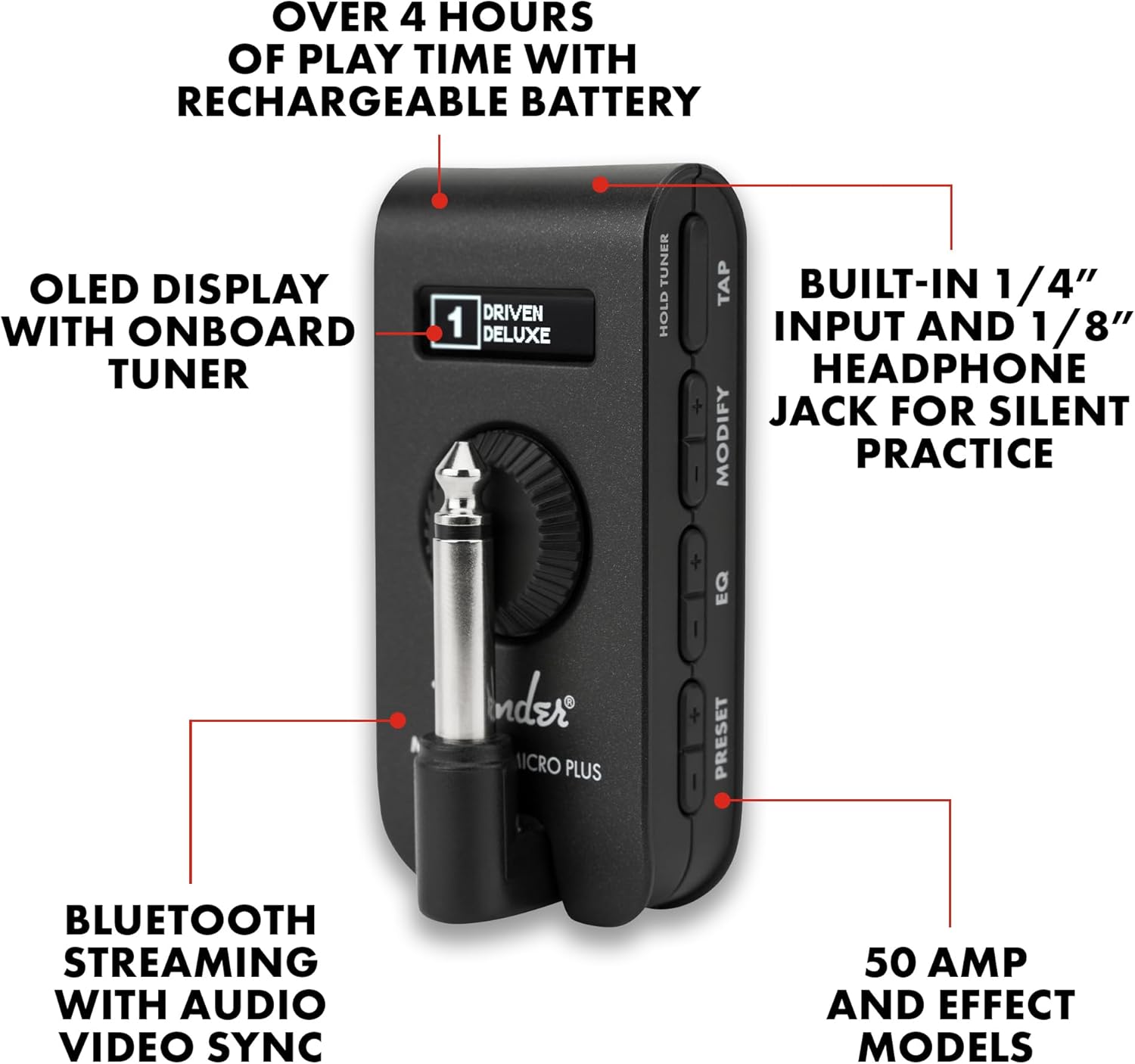
The Fender Mustang Micro Plus is the second-generation version of Fender’s original Micro. It plugs directly into your guitar’s output jack, dangling there like a small dongle, and gives you 12 amp models drawn from the full Mustang modeling lineage — Tweed, Blackface, British crunch, high-gain modern — plus 24 effects. You control it via the Fender Tone companion app or with the two physical knobs on the unit itself. It charges over USB-C and connects via Bluetooth to stream backing tracks from your phone.
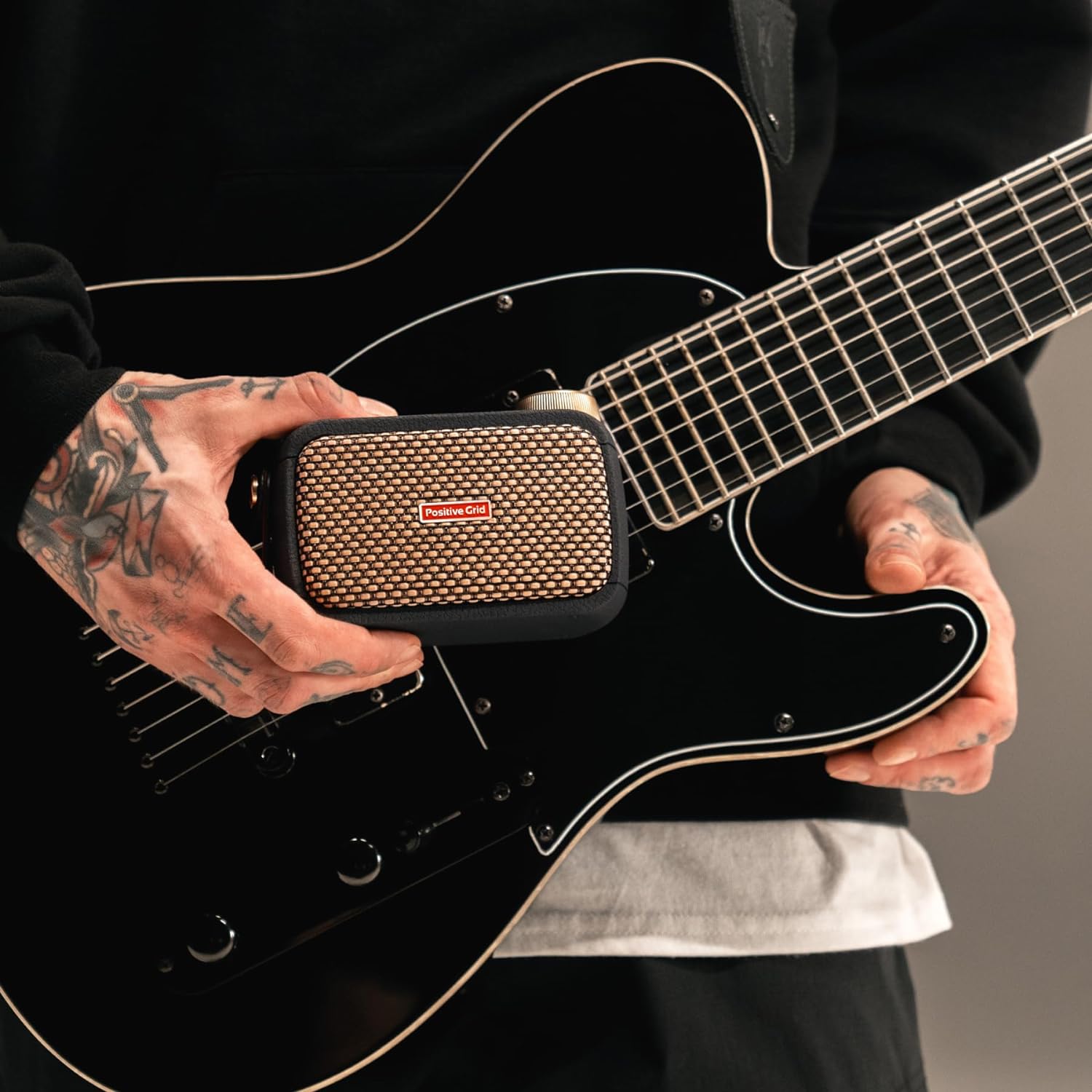
The Positive Grid Spark GO takes a slightly different physical approach. It is a compact, rectangular device with a small built-in speaker on one end and a headphone jack on the other. It connects to your guitar via a short cable included in the box and runs on a rechargeable internal battery. The Spark GO is explicitly designed to do double duty: headphone practice and low-volume room practice through its onboard speaker. The companion app is the full Positive Grid Spark ecosystem, which includes AI Chord Detection, variable-speed song playback for learning, and access to a large community preset library.
Tone Quality and the Amp Model Experience
Fender Mustang Micro Plus: Headphone Dynamics and Modeling Depth
This is where the Mustang Micro Plus earns its most enthusiastic responses. Owner feedback compiled through Sweetwater Sound’s Fender Mustang Micro Plus product page and Q&A section — accessed May 2026 — shows a consistent pattern: players describe the experience as “studio-quality jamming,” which is a meaningful compliment for a device that fits in a shirt pocket. The Fender Tone app’s deep preset editing gives intermediate players real control over the feel of each amp voice, and the Bluetooth play-along integration works smoothly rather than feeling like a workaround. MusicRadar’s “Best headphone amps for guitar 2025” roundup names the Mustang Micro Plus as a benchmark in the pocket-amp category specifically for tonal authenticity through headphones.
One specific real-world pairing worth noting: Squier Affinity Strat owners appear frequently in Sweetwater’s owner Q&A threads naming the Mustang Micro Plus as their chosen companion for silent morning practice. The pairing makes intuitive sense — Fender modeling on a Fender-scale guitar, a straightforward app, Bluetooth streaming already built in.
Positive
$147.00
In stock on Amazon
Check price on AmazonPositive Grid Spark GO: Ecosystem Tone and the Speaker Surprise
The Spark GO’s tone story is slightly different. Guitar World’s 2024 Spark GO review and Premier Guitar’s 2024 Spark GO First Look both note that the amp models are pulled directly from the full Spark product line — they are not a watered-down mobile version but the same models that gave the original Spark its reputation. Where the Spark GO surprises owners most is in replacing previous battery-powered mini amp setups entirely. Owner feedback aggregated through Sweetwater Sound’s Spark GO product page describes multiple players who replaced older “honey tone”-style mini amps with the Spark GO and describe the switch as a genuine upgrade rather than a sideways move. The satisfaction pattern here is: low expectations going in, enthusiastic recommendation coming out.
Positive
$147.00
In stock on Amazon
Check price on AmazonThe Honest Tradeoff Between the Two
Fender’s amp modeling in the Mustang Micro Plus skews toward authenticity and touch-responsive dynamics — players who care about how the amp reacts to picking attack tend to find it more satisfying through headphones. The Spark GO’s models are tuned for the full Spark product family and sound excellent, but the device’s real competitive advantage is its app ecosystem and the built-in speaker flexibility, not raw headphone tone alone. If your decision hinges purely on headphone feel, the Mustang Micro Plus has the edge. If you want a single device that covers both silent and low-volume room practice, that calculus shifts.
Positive
$147.00
In stock on Amazon
Check price on AmazonApp Features: Where the Real Difference Lives
This is the most consequential split for intermediate players who are actively using these devices to improve, not just noodle.
Fender Tone App (Mustang Micro Plus)
The Fender Tone app provides deep amp and effects editing, full preset library access, and Bluetooth streaming from any audio app on your phone. The editing depth is real — you can shape tone parameters that a physical two-knob interface wouldn’t expose, and saved presets sync across sessions without friction.
The Android caveat is significant. Owner feedback on Sweetwater Sound’s Mustang Micro Plus product page flags this explicitly as a real limitation rather than a minor footnote. As of mid-2026, the full Fender Tone experience is optimized for iOS. Android users report inconsistent Bluetooth connectivity and feature gaps that iOS users do not encounter. If you are on Android, treat this as a dealbreaker-level consideration before purchasing, not a known issue that will resolve itself quickly.
Positive Grid Spark App (Spark GO)
The Positive Grid Spark app offers a meaningfully different set of practice tools:
- AI Chord Detection — point your phone at a song playing and receive a chord chart in real time
- Variable-speed song playback — slow a passage down to 60% or 70% of original tempo without changing pitch, then build back up as you learn it. MusicRadar’s “Best headphone amps for guitar 2025” roundup specifically highlights this feature as a differentiator for players working through complex material. Owner feedback on Sweetwater’s Spark GO product page singles it out repeatedly as a genuine practice tool rather than a novelty.
- Full cross-compatibility with other Spark devices, so the app scales if you later invest in a full Spark amplifier
- Android and iOS both receive full feature support
The variable-speed playback feature alone shifts the value calculation for anyone actively learning songs or transcribing solos. If your practice sessions involve working through parts slowly before bringing them up to tempo, the Spark GO’s app provides a built-in practice workflow that the Fender Tone app does not replicate.
Feature Comparison at a Glance
| Feature | Fender Mustang Micro Plus | Positive Grid Spark GO |
|---|---|---|
| Amp models | 12 | 33 |
| Effects | 24 | 30+ |
| Built-in speaker | No | Yes (1W) |
| Charging | USB-C | USB-C |
| Android app support | Limited / inconsistent | Full |
| Variable-speed playback | No | Yes |
| Physical connection | Plugs directly into jack | Short cable |
| Line output for interface | Yes | No |
The Built-In Speaker Question and Room-Volume Reality
The Spark GO’s 1W built-in speaker is real, and owners confirm it functions — but managing expectations here matters. Feedback aggregated through Sweetwater Sound’s Spark GO product page and Guitar World’s 2024 review both describe it as adequate for a small bedroom or home office at modest volumes, not loud enough for a band rehearsal or a living room with ambient noise. Its value is in the moments when you want to noodle without putting headphones on: keeping a guitar in your lap while watching something, running through chord shapes without fully setting up, showing someone a riff without hunting for earbuds. For that use case, owners consistently report it delivers.
The Mustang Micro Plus has no speaker at all. It is a headphone-first device, though it does include a line output that can feed an external amp or audio interface. That output makes it a flexible practice-to-recording bridge — a use case that several home-studio owners describe finding genuinely useful when feeding directly into an audio interface.
The Direct Decision Frame
Buy the Fender Mustang Micro Plus if:
- You are on iOS and the Fender Tone app will be a regular part of your routine
- Authentic-feeling amp dynamics through headphones are your primary metric
- You are pairing it with a Fender-scale guitar — Stratocaster, Telecaster, or Squier equivalent — and want the modeling to complement that voice
- Your practice sessions are primarily headphone-based with Bluetooth backing tracks
Buy the Positive Grid Spark GO if:
- You are on Android — the full app experience on Android is dramatically better than what Fender Tone currently offers
- You want variable-speed song playback for active learning and transcription work
- You want the flexibility of a small built-in speaker for occasional room use without headphones
- You care about ecosystem continuity — the Spark app and preset library scale with you if you later move to a full Spark amplifier
One scenario where neither replaces a practice amp: If you regularly play alongside a drummer, another guitarist, or in any teaching situation where other people need to hear you, both of these devices are supplementary tools, not substitutes. A 1W speaker in the Spark GO and a headphone output on the Mustang Micro Plus both max out well below “audible in a room with a live drummer.” For that context, a full modeling amplifier — even a mid-range combo — remains the right tool. Think of either device as something that complements a practice amp setup rather than replaces it, unless your entire practice life happens through headphones.
Frequently Asked Questions
Does the Fender Mustang Micro Plus work with Android phones? The Fender Tone app has an Android version, but owner reports aggregated on Sweetwater Sound’s Mustang Micro Plus product page — accessed May 2026 — consistently flag limited functionality and inconsistent Bluetooth behavior on Android. iOS users receive the full experience. If Android is your platform, treat this as a significant limitation before purchasing.
Can the Positive Grid Spark GO be used as a Bluetooth speaker without a guitar plugged in? Yes. The Spark GO functions as a standalone Bluetooth speaker for music playback without any instrument connected. Owners on Sweetwater’s Spark GO product page confirm this works as expected, though the 1W speaker is best suited for personal listening at close range rather than filling a room.
How does the Mustang Micro Plus headphone output compare to a modeling amp’s headphone jack? MusicRadar’s “Best headphone amps for guitar 2025” roundup rates the Mustang Micro Plus headphone output as a benchmark in the pocket-amp category for tonal authenticity — comparable to what you would expect from the headphone output on a mid-range modeling combo, which is a genuine compliment given the size difference.
Is the Spark GO loud enough to play without headphones in a small room? Owner feedback on Sweetwater’s Spark GO product page describes the built-in speaker as adequate for personal practice in a small bedroom or office at modest volumes — appropriate for noodling while watching television rather than rehearsing. It is not a replacement for a practice amp in any context where projection or volume matters.
Do you still need a full practice amp if you own one of these devices? For late-night or apartment-silent practice, either device is self-sufficient. For playing along with recordings at real volume, for teaching situations, or for any context where other people need to hear your guitar, a full-range practice amp still serves a role that neither device covers. These tools complement a practice amp setup — they do not replace it unless your practice life happens entirely through headphones.