If you’ve ever stood in a guitar store staring at a wall of individual pedals — distortion, chorus, delay, reverb, wah — and done the math on what it would cost to buy all of them, you already understand the appeal of a multi-effects unit. A multi-effects pedal (sometimes called a “multi-FX” or “multi-effects processor”) is a single box that packs dozens, sometimes hundreds, of those individual effects into one piece of gear. You plug your guitar into one end, your amplifier, headphones, or computer into the other, and you have access to an entire sonic toolkit. For under $200, that’s a compelling proposition. The real question — the one this article is going to answer — is which of the three most-discussed units at this price point actually delivers on that promise, and which one fits your specific situation.
We’re looking at three units that keep appearing at the top of buyer conversations in 2026: the Zoom G1X FOUR (street price around $60–$70), the Boss GT-1 (street price around $150–$170), and the Mooer GE100 (street price around $80–$100). These aren’t the same pedal at three different price points — they represent meaningfully different philosophies about what a budget multi-FX should be. By the end of this piece you’ll know exactly which one belongs in your signal chain.
The Landscape: What $60–$170 Actually Buys You Now
The budget multi-FX category has matured dramatically over the past decade. As Guitar World noted in its “Best multi-effects pedals” buyer’s guide, units at this price tier now routinely include USB audio interface functionality, patch-based preset storage, and amp modeling — features that cost several hundred dollars more not long ago.
Here’s a quick baseline before we go deeper:
| Unit | Street Price | Effects Count | Expression Pedal | USB Audio Interface |
|---|---|---|---|---|
| Zoom G1X FOUR | ~$65 | 70+ | Yes (built-in) | Yes |
| Boss GT-1 | ~$160 | 100+ | No (optional add-on) | Yes |
| Mooer GE100 | ~$90 | 150+ (claimed) | No | No |
That table is useful, but it’s also slightly misleading — because the effect count is rarely the deciding factor. What matters is how the unit sounds, how quickly you can edit it under real-world conditions, and whether the workflow fits how you actually play.
Head-to-Head: Three Pedals, Three Philosophies
The Zoom G1X FOUR — Value Benchmark
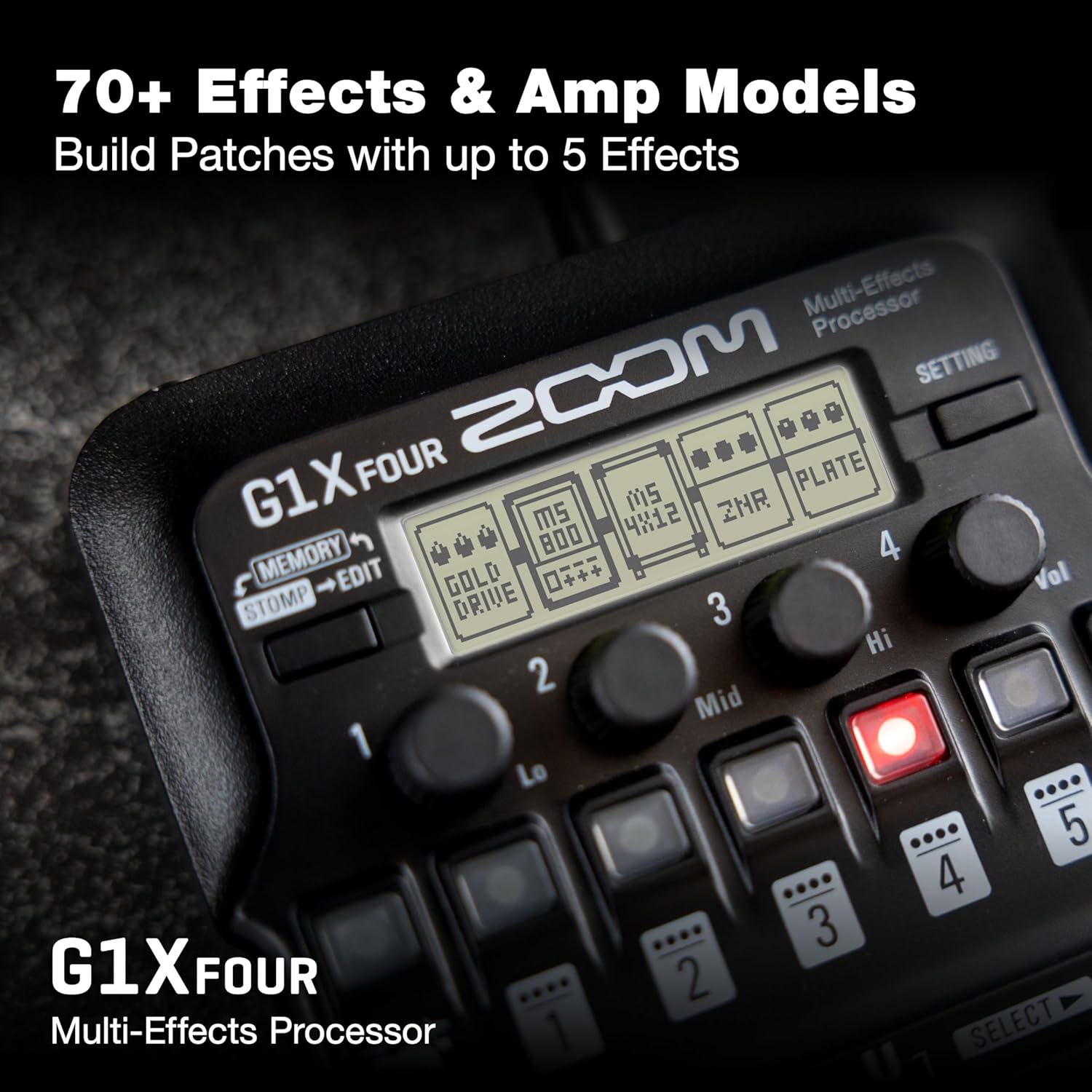
The Zoom G1X FOUR is the runaway value leader at this price. The Sweetwater product page and owner Q&A section for the G1X FOUR shows a consistent pattern: owners are repeatedly surprised by how much usable tone is available for the money. The built-in expression pedal — a rocking pedal attached to the unit itself, which you control with your foot to sweep parameters like wah intensity or volume — is the feature that separates this unit from its peers at the price. For beginners and intermediate players, having that physical foot control without buying a separate add-on is a meaningful advantage.
Owners also highlight the unit’s power flexibility. The Zoom G1X FOUR runs on four AA batteries or USB power, and because it draws modest current, a standard USB power bank of the kind you’d use to charge a phone can power it for hours of practice. Zoom’s published specifications rate battery life at approximately 6 hours on alkaline AAs. Multiple player reports describe this as a genuine game-changer for busking, open mics, and practice sessions where wall outlets aren’t available.
The workflow is more menu-driven than button-heavy, which rewards patience. Players who invest time learning the interface consistently report finding what they need quickly once familiar with the architecture. For the price, the sonic range — clean tones, overdrive, modulation, delay, reverb, and usable amp modeling — punches well above its weight class, as reflected in owner community responses documented on Sweetwater’s product page for this model.
Best for: Players on a firm budget under $100, buskers and open-mic performers who need battery or USB power bank operation, anyone who wants wah or volume sweep without purchasing a separate expression pedal.
FLAMMA
$37.99
In stock on Amazon
Check price on AmazonThe Boss GT-1 — Working Player’s Tool
The Boss GT-1 plays in a different register. MusicRadar’s review of the GT-1 describes it as a “serious working tool” rather than a practice-room toy — and aggregated owner reports reinforce that framing. The consistent theme across long-term user accounts is consolidation: players who previously owned multiple individual Boss pedals — an overdrive, a distortion, a compressor, a chorus, a noise gate — report that the GT-1 rendered all of them redundant without sacrificing the core character of those tones. That’s a meaningful statement from players who valued each of those individual pedals enough to purchase them separately.
The GT-1’s workflow is more intuitive for experienced players who already think in terms of signal chain — the order in which your guitar signal passes through effects, typically tuner, then compressor, then overdrive, then modulation, then delay, then reverb. The onboard controls map naturally to that mental model, and the preset architecture is well-documented enough that gigging players can rely on it under pressure.
The tradeoff is real: no expression pedal is built in. Boss’s EV-30 expression pedal is the commonly recommended add-on, which pushes your total cost to $200–$220. Whether that’s worth it depends on whether you need wah or continuous parameter control. For players consolidating a pedalboard or stepping up from a purely bedroom rig, MusicRadar’s assessment holds up: the GT-1 behaves like a tool designed for live use, not just home exploration. As MusicRadar’s Boss GT-1 review concludes, it earns its price premium most clearly in live performance and pedalboard-consolidation scenarios.
Best for: Players who run multiple individual pedals and want to consolidate without losing familiar tones, gigging musicians who need consistent and predictable live performance, players whose budget can stretch to the $150–$170 range.
Zoom
$119.99
In stock on Amazon
Check price on AmazonThe Mooer GE100 — Explorer’s Pedal
The Mooer GE100 is the outlier in this comparison, and it deserves honest framing. Across aggregated owner reports and coverage reflected in Guitar World’s multi-effects buying coverage, the consistent pattern is that the GE100 is described as “fun” and “deep” rather than “polished” or “immediately gig-ready.” The effects count — Mooer claims over 150 — is impressive on paper, and players who enjoy exploring menus and discovering unexpected sounds find genuine value in that breadth.
The honest caveats: the documentation is frequently cited as underdeveloped, and the learning curve is steeper than either the Zoom or the Boss. The GE100 does not include USB audio interface functionality, which is a significant omission at this price point — more on that below. For home-studio experimenters and players building a practice rig without recording intentions, it can return a lot. For anyone who needs to be gig-ready quickly or wants to record direct to a computer, it’s a harder recommendation.
Premier Guitar’s coverage of budget multi-effects processing identifies a broader truth that applies here: at this price tier, the unit that sounds best to you is largely a function of which amp models and effects algorithms happen to align with the tones you’re chasing. There’s no universally “best” budget multi-FX — there’s a best fit for your genre, workflow, and patience for learning new gear.
Best for: Home-studio experimenters who prioritize breadth over workflow speed, players who enjoy exploring gear without a deadline to be performance-ready, those who don’t need USB audio interface functionality.
FLAMMA
$37.99
In stock on Amazon
Check price on AmazonHow These Units Interact With Modest Practice Amps
One of the most consistent findings across owner accounts of all three units is how dramatically a multi-effects processor can improve the perceived sound of an inexpensive practice amp. The mechanism isn’t mysterious — practice amps at the $50–$100 level typically have limited or no built-in effects, relatively flat frequency response, and no amp modeling. Running a multi-FX into the clean channel of a modest practice amp and using the unit’s own amp models, cabinet simulations (digital recreations of speaker cabinet character), and reverb essentially transforms the amp into a neutral playback device, with the tone living in the pedal rather than the amp itself.
This matters for your buying decision in a specific way: if your amp is already modest, the GT-1’s more sophisticated amp modeling may return more audible value than it would in a higher-end rig. Sweetwater’s product documentation for the GT-1 specifically notes its amp modeling depth as a selling point for players who don’t own a premium amp. For the Zoom G1X FOUR, owners running it into basic practice amps consistently describe a significant perceived quality upgrade — more so than they expected from a unit at this price. The Mooer GE100 performs similarly in this context, though owners note that finding the right amp model requires more menu exploration.
Direct Recording: A Real Advantage for Two of Three
Both the Zoom G1X FOUR and the Boss GT-1 function as USB audio interfaces — meaning you can plug them directly into your computer via a USB cable and record guitar tracks in your recording software (called a DAW, or digital audio workstation — programs like GarageBand, Reaper, or Audacity) without purchasing a separate audio interface box. The Mooer GE100 does not offer this feature.
For players with any home recording intentions, this is a meaningful cost offset. A standalone audio interface typically runs $50–$150. If you’re choosing between the Zoom G1X FOUR and the Mooer GE100 and you have any interest in recording, the Zoom’s USB interface functionality makes up the price difference several times over. Guitar World’s “Best multi-effects pedals” buyer’s guide specifically flags USB audio interface integration as a key value-add to look for in this price category.
The recording quality through both the Zoom and the GT-1 is described in owner accounts as workable and clean for demo and practice purposes — not a replacement for a dedicated interface in a professional studio context, but genuinely useful for capturing ideas and home demos.
Frequently Asked Questions
Can a multi-effects pedal make a cheap practice amp sound significantly better?
Yes — and this is one of the most consistent findings across all three units. When you run a multi-effects unit into a practice amp’s clean channel, you’re using the amp as a speaker and bypassing its own limited tone controls. The multi-FX provides amp modeling, cabinet simulation, and effects, which can transform a flat-sounding practice amp into something considerably more dimensional. The improvement is real regardless of which unit you choose.
Does the Zoom G1X FOUR work on batteries alone, and how long do they last?
Yes. The Zoom G1X FOUR runs on four AA batteries with a manufacturer-rated runtime of approximately 6 hours on alkaline batteries. It also accepts USB power, which means a standard USB power bank can significantly extend that runtime — one of the most frequently cited real-world advantages of this unit among owners, as reflected in the Sweetwater owner Q&A for this model.
Is the Boss GT-1 worth the extra cost over the Zoom if I already have a decent amp?
This is the most context-dependent question in the comparison. If your amp is already voiced well and you’re relying on it for core tone, the GT-1’s more refined workflow, more consistent live behavior, and better-documented preset architecture justify the premium for gigging players. For primarily home practice and experimentation, the Zoom closes most of that gap for considerably less money. The GT-1 earns its price most clearly in live performance and pedalboard-consolidation scenarios, as MusicRadar’s Boss GT-1 review concludes.
What does an expression pedal actually do, and do I need one as a beginner?
An expression pedal is a rocking pedal you control with your foot to sweep a parameter continuously — most commonly wah (a filter effect that creates a vocal, vowel-like sweep), volume, or pitch. It’s the difference between an effect being on or off (a stomp switch) and an effect being continuously variable under foot control. The Zoom G1X FOUR has one built in; the Boss GT-1 does not include one. As a beginner, you don’t strictly need one immediately, but wah and volume swells open up a lot of playing styles. If you anticipate wanting to explore those sounds, the Zoom’s built-in expression pedal is a meaningful advantage at the price.
Can I record guitar directly into my computer through any of these units?
Only two of the three. The Zoom G1X FOUR and the Boss GT-1 both include USB audio interface functionality — connect them via USB and your recording software recognizes them as an audio input. The Mooer GE100 does not offer this. For home recording purposes, this makes the Zoom in particular an exceptional value: a multi-effects unit and a recording interface in one box for around $65, as Sweetwater’s product page for the G1X FOUR documents.
Prices cited reflect May 2026 street pricing. Check current availability and pricing at Sweetwater, Guitar Center, or Reverb before purchasing — inventory and promotions shift frequently in this category.