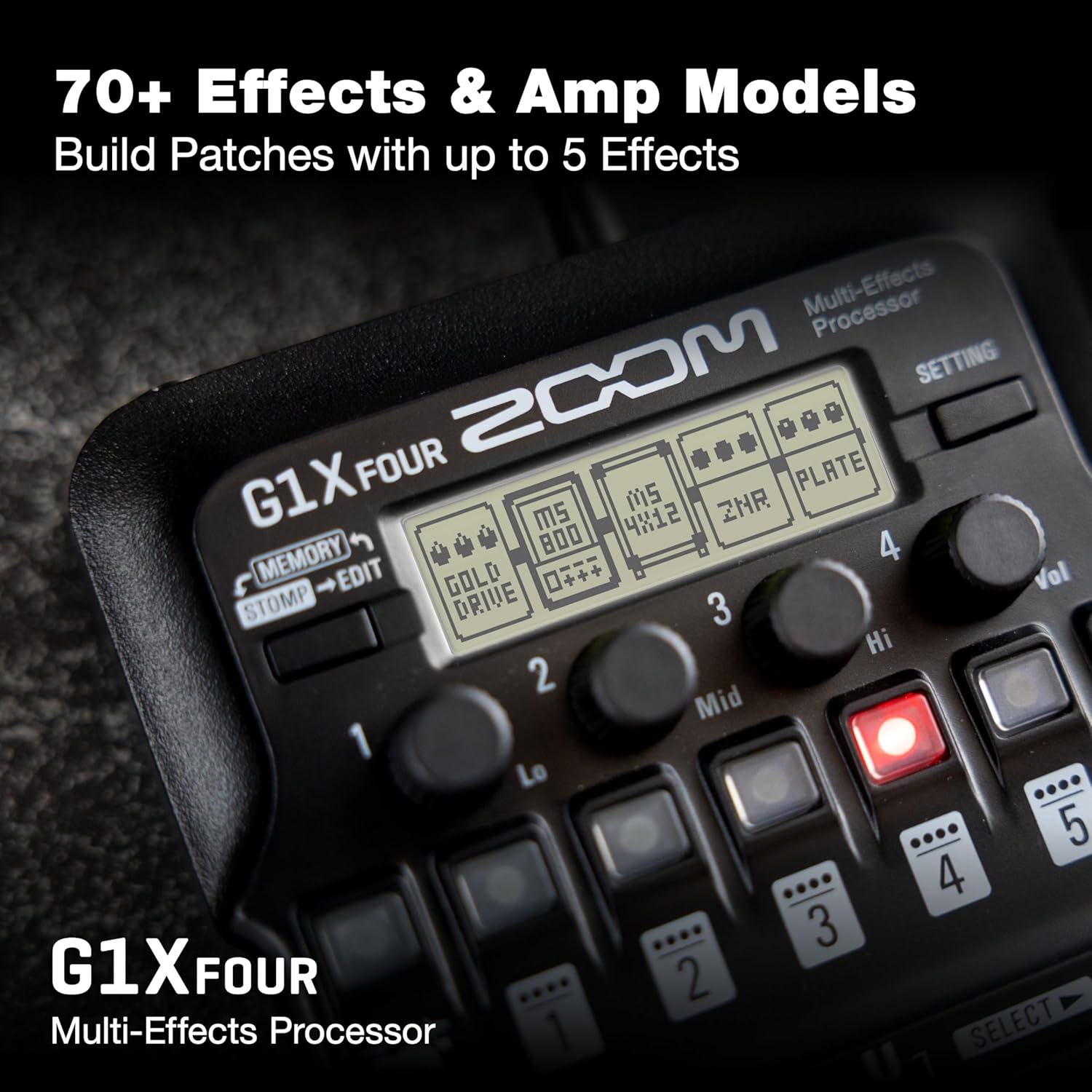
If you’ve ever looked at a professional guitarist’s pedalboard — that crowded row of little boxes on the floor, each one doing something different to the sound — and thought, “There has to be a simpler way,” you’re already thinking about multi-effects pedals. A multi-effects pedal (sometimes called a floor processor) is a single unit that combines many of those individual effects — reverb (the room-like echo around a note), delay (a repeating echo), distortion (that crunchy or saturated tone), chorus (a shimmery doubling effect), and more — into one piece of hardware. Instead of buying, wiring, and powering twelve separate boxes, you get most of the same sounds from one device with one power cable. That’s the pitch.
But “multi-effects” covers an enormous range of products — from a $100 beginner unit that feels like a toy to a $500+ professional rig used on major tours. The difference between them matters a lot, and buying the wrong tier can mean either overspending on features you’ll never use or buying something you’ll outgrow in six months. This guide breaks down the real decision points: what the categories actually mean, where the quality gaps live, and which unit makes sense depending on what you’re actually trying to do.
| EDITOR'S PICK[VALETON GP-200 Multi-Effects Gu…](https://www.amazon.com/dp/B0GFHF5XMZ?tag=greenflower20-20) | Mid-tier[BOSS GT-1](https://www.amazon.com/dp/B01M03W1HD?tag=greenflower20-20) | Budget pick[FLAMMA FX100 Guitar Multi-effec…](https://www.amazon.com/dp/B08977J7HR?tag=greenflower20-20) | |
|---|---|---|---|
| Amp Models | — | — | 55 |
| Built-in Effects | — | — | 151 |
| Looper | — | — | 80' |
| Expression | ✓ | — | — |
| FX Loop | ✓ | — | — |
| MIDI | ✓ | — | — |
| Price | $328.90 | $189.98 | $109.99 |
| See on Amazon → | See on Amazon → | See on Amazon → |
What You’re Really Comparing When You Shop Multi-Effects
Before naming specific units, it’s worth understanding what separates a $100 processor from a $450 one — because the price gap isn’t just marketing.
Processing quality (DSP) is the biggest internal factor. DSP stands for Digital Signal Processing — it’s the computing chip that runs the effects. Higher-end units use more powerful chips, which allow more simultaneous effects running at once, higher audio resolution (think of it like image resolution, but for sound), and lower latency (the tiny delay between when you play a note and when the effect responds). At the entry level, you’ll occasionally hear a slight “digital” quality to the sound — a certain stiffness — that experienced players find off-putting. Premium processors have closed that gap significantly. MusicRadar’s 2025 multi-effects roundup notes that units in the $350–$500 range have largely erased the sonic ceiling that once made digital effects sound inferior to analog pedals in live settings.
Routing flexibility is the second differentiator. A basic unit runs your signal in a straight line: guitar in, effects applied in sequence, out to amp. More advanced units let you run effects in parallel (splitting the signal into two paths and blending them) or switch between 4-cable method (4CM) wiring, which lets you insert the processor into your amplifier’s effects loop — a specific jack on the back of most modern amps that allows some effects to be applied after the amp’s preamp stage rather than before it. If you’re using a nice tube amp and want to keep the amp’s own character while adding reverb and delay, 4CM matters. If you’re plugging into a PA speaker at rehearsal, it doesn’t.
Preset organization and footswitch layout affect whether the unit works live. A great-sounding processor with confusing navigation can lock you out of your sounds mid-song. Look at how many footswitches are included, whether they’re labeled clearly, and whether switching between presets causes an audible gap in sound (preset lag — a known frustration with cheaper units, and one that Premier Guitar’s 2024 floor processor feature specifically called out as a persistent issue in the sub-$150 category).
The Three Budget Tiers — and What You Actually Get
Entry Level: $80–$180
The Boss ME-90 and the Zoom G3Xn are the most commonly recommended units in this range, and they represent two different philosophies. The ME-90 is designed to feel like a traditional pedalboard — each section has its own physical knob, so there’s almost no menu-diving. Owners consistently report that it sounds usable right out of the box without programming, which matters enormously if you’re a beginner who doesn’t want to spend three evenings reading a manual. The Zoom G3Xn takes the opposite approach: more digital in feel, with deep editing options and a built-in expression pedal (a foot-rocking pedal for volume swells or wah effects), but a steeper learning curve.
Buy in this tier if: You’re in your first two years of playing, you’re rehearsing at home or in a practice space, and you want to explore different sounds without committing to a specific direction yet. Also appropriate for working musicians who need a cheap, lightweight backup unit for gigs where losing your main rig would be catastrophic.
Be honest about the ceiling: Sweetwater’s multi-effects buying guide notes that entry-level units typically cap out at 4–5 simultaneous effects, and the amp simulation models (digital recreations of specific amplifiers) in this range are functional but not convincing at high volume. If you’re recording or playing with a band that has strong opinions about tone, you’ll feel the limitation.
Mid-Range: $200–$400
This is where the market gets genuinely competitive and where most intermediate players should be focused. The three units that dominate discussion at this tier — the Boss GX-100, the Line 6 HX Stomp, and the Headrush MX5 — each approach the problem differently.
The Line 6 HX Stomp is frequently cited by Guitar World’s buyer’s guide as the most tonally authentic unit in its price class. It runs the same core processing engine as Line 6’s flagship Helix unit, just with fewer footswitches and a smaller footprint. Owners report that the amp simulations are convincing enough to replace a physical amp entirely for home recording and direct-to-PA live performance. The trade-off: six footswitches is tight for complex live rigs, and the editing interface rewards patience with a learning curve.
The Boss GX-100 takes the opposite approach — more footswitches, more onboard controls, less menu-diving. Reviewers consistently note it as the friendlier live performance tool of the two, though some players feel the amp simulations have a slightly more “Boss” character rather than a neutral, transparent quality.
The Headrush MX5 leads with its large touchscreen interface, which makes preset editing intuitive compared to button-and-knob navigation. For players who spend time shaping sounds at home and then deploying them live, this matters.
By the numbers — mid-range comparison:
| Unit | Footswitches | Simultaneous Effects | Street Price (2026) |
|---|---|---|---|
| Line 6 HX Stomp | 6 | Up to 8 blocks | ~$299 |
| Boss GX-100 | 13 | Up to 32 blocks | ~$349 |
| Headrush MX5 | 6 + expression | Unlimited (hardware limited) | ~$299 |
Premium: $450–$700+
At this tier, the Line 6 Helix (the full floor unit, not the Stomp) and the Neural DSP Quad Cortex are the two units worth discussing seriously. The Helix has been the professional standard for several years — it’s on major tours, in recording studios, and in the rigs of session players who can’t afford sonic compromises. The footswitch layout is generous enough for complex live rigs, the 4CM routing is seamless, and the amp simulation library is deep.
The Quad Cortex from Neural DSP is newer and takes a different angle: it includes onboard neural-network-based amp capture technology, which means you can run a microphone in front of your own physical amplifier, play through it, and the unit will create a digital model of that specific amp’s sound. For players who own a boutique amp — say, a Two-Rock or a Friedman BE-100 — and want that exact character in a floor unit, this is a genuinely compelling feature. Premier Guitar’s 2024 feature noted that the Quad Cortex’s captured models are audibly closer to the source than traditional static simulations, though the process requires some time investment to do well.
Buy the Helix if: You want a mature, well-supported ecosystem with extensive third-party preset communities, proven live reliability, and a deep manual. The support documentation alone — Sweetwater and Line 6 both maintain extensive knowledge bases for it — is worth something.
Buy the Quad Cortex if: You’re a tone-chaser who owns or has access to physical amps worth capturing, you want to stay on the leading edge of modeling technology, and you don’t mind being on a slightly more cutting-edge (and occasionally buggier) platform.
Signal Chain Decisions That Change the Math
One factor that’s underweighted in most buying guides: how you’re going to use the unit with your existing amp.
If you’re playing through a quality tube amp — a Fender Blues Junior, a PRS MT 15, anything with an effects loop you care about — the way you integrate a multi-effects unit changes which features matter. Running a floor processor in front of a tube amp means the amp’s preamp is still doing the heavy lifting for your core tone. In that case, you might not care about amp simulation quality at all — you’re using the processor purely for time-based effects (reverb, delay) and modulation (chorus, tremolo). A Boss ME-90 or even a strong dedicated reverb/delay unit could serve you better than a $500 modeler.
If you’re running direct — into a PA speaker at gigs, into an interface for home recording, or into a powered FRFR speaker (Full Range Flat Response — a neutral speaker designed to reproduce amp simulations accurately) — then amp simulation quality is everything, and you should spend toward the HX Stomp tier or above.
MusicRadar’s 2025 roundup makes this point directly: “The players most frequently disappointed by multi-effects purchases are those who bought for amp simulation quality but were already running a tube amp they loved — they’d have been better served by a dedicated effects unit at half the price.”
How to Decide: The Clear If/Then Rules
After reviewing the landscape honestly, here’s how to frame the decision:
If you’re exploring your first effects and playing at home or rehearsal: Start at the Boss ME-90 tier. Don’t overspend for features you won’t use for another year.
If you’re gigging and running direct to PA or into a powered speaker: The Line 6 HX Stomp is the strongest value in 2026. The amp simulations hold up live, the form factor is small, and the upgrade path into the broader Helix ecosystem is clear.
If you’re gigging with a tube amp you love and want to keep its core character: Reconsider whether a multi-effects unit is the right tool at all. A quality reverb and delay unit in the $150–$250 range might serve you better than a $400 modeler running into the front of an amp that already sounds right.
If you’re a session player, home-recording enthusiast, or boutique-amp owner who wants to document your tone digitally: The Neural DSP Quad Cortex earns serious consideration — but only if amp capture is a feature you’ll actually use. If you’re buying it for the presets alone, the Helix covers that ground at a lower price.
If budget is the binding constraint: Buy used. The HX Stomp in particular holds its value cleanly in the secondary market, and a used unit at $180–$220 on Reverb gives you mid-range performance at entry-level cost. The platform is mature enough that software updates are stabilized rather than ongoing experiments.
The honest truth about multi-effects is that there’s no universally correct answer — only the right answer for your amp, your gig, and your willingness to spend time with the editing interface. Know which of those variables is most important to you before you walk into the store or click the buy button.
Shop current pricing on multi-effects pedals at Sweetwater, Guitar Center, and Reverb — prices and availability shift, and comparing across all three takes about four minutes and can save you $30–$60 on mid-range units.