If you’ve ever plugged your guitar into a drive pedal, set a little reverb at the end of your chain, and thought something still sounds thin — you’re not imagining it. Most players building their first or second pedalboard nail the fundamentals: overdrive (a pedal that pushes your amp’s gain for a crunchy, distorted sound), maybe a tuner, maybe a reverb (which adds a sense of space, like playing in a room). What’s almost always missing is an entire category of effects called modulation — pedals that add movement, shimmer, or rhythmic pulse to your guitar’s raw signal. Chorus thickens your sound by layering a slightly pitch-shifted copy of your signal against the original. Phaser sweeps a series of filters up and down through your signal for a swirling, organic feel. Flanger creates a jet-plane whoosh. Tremolo pulses your volume in a rhythmic wave. None of these are exotic or expensive, but nearly every budget rig skips the whole category. This guide explains why that’s a mistake — and exactly which modulation pedals are worth adding at every price point.
| EDITOR'S PICKJasmine S35 Dreadnought Acousti… | Mid-tierBOSS SD-1 SUPER Overdrive | Budget pickDonner Guitar Delay Pedal for P… | |
|---|---|---|---|
| Product type | Acoustic guitar | Overdrive pedal | Delay pedal |
| Fingerboard | Rosewood | — | — |
| Body size | Full-size | — | — |
| Finish | Natural | — | — |
| Bypass | — | — | True bypass |
| Price | $119.00 | $69.99 | $39.99 |
| See on Amazon → | See on Amazon → | See on Amazon → |
Why Modulation Gets Left Off Budget Boards (And Why That’s a Mistake)
The short answer: new players learn that overdrive, tuner, and reverb solve the most audible problems first. Drive gives you grit. Reverb fills the room. A tuner keeps you from embarrassing yourself. Modulation feels optional by comparison — a luxury for tone nerds, not a necessity.
But here’s the tradeoff that doesn’t get named enough: modulation is what makes static sounds feel alive. A clean Stratocaster into a chorus pedal sounds like a completely different instrument — richer, wider, almost three-dimensional. That same country-rock drive tone you’ve been chasing on a Boss BD-2 Blues Driver? Reviewers who pair the BD-2 with even light phaser or tremolo consistently report that the combination transforms an already capable drive pedal into something that sounds genuinely studio-ready. The modulation fills in the space that overdrive alone can’t touch.
One audio engineer reviewing budget multi-effects units in the early 2020s made the point plainly: the old mindset that “you must spend a lot for quality effects” has effectively collapsed. The floor on usable modulation — as documented in aggregated reviews across MusicRadar and Guitar World — is now somewhere around $40 to $70 for a dedicated single-effect pedal, and even lower for multi-modulation units. That’s not a consolation prize. That’s genuinely useful gear.
The Honest Breakdown: What Each Modulation Type Actually Does
Before recommending anything, it’s worth naming the effects clearly, because “modulation” is a catch-all that confuses even intermediate players.
Chorus: Blends a slightly detuned, slightly delayed copy of your signal with the original. The result is a lush, shimmering thickness — think clean 1980s guitar tones, or that wide acoustic-electric sound that fills a stage without extra players. Owners of the MXR Chorus consistently describe it as the most immediately usable modulation effect for players who’ve never tried any of them.
Phaser: Routes your signal through circuits called all-pass filters, which shift the phase of certain frequencies and create a sweeping, comb-filter effect. At slower settings it’s subtle and organic — Eddie Van Halen’s iconic “Eruption” tone is built on a phase pedal. At faster settings it gets woozy and psychedelic. The MXR EVH Phase 90 is one of the most reviewed and discussed examples in this category.
Flanger: Similar to chorus in concept, but with a shorter delay time and stronger feedback. The result is that distinctive jet-engine whoosh or metallic shimmer. Works beautifully in small doses; can overwhelm a mix quickly.
Tremolo: The simplest of the group — just a rhythmic rise and fall of your volume, like a vintage amp’s built-in effect. Easy to dial in, and genuinely useful for country, soul, and surf rock.
Ring Modulator / Stutter: These are outliers. Ring mod creates atonal, bell-like harmonics by multiplying your signal against a second frequency. Stutter chops your signal in jarring, rhythmic bursts. Both have specific creative applications — but for most players, they’re rarely usable in a real song context.
By the Numbers: Modulation Modes and Their Usability for Most Players
| Effect Type | Usability (General Players) | Best Genre Fit |
|---|---|---|
| Chorus | High | Clean tones, pop, rock, country |
| Phaser | High | Rock, blues, funk |
| Tremolo | High | Country, surf, soul |
| Flanger | Medium | Rock, shoegaze, in small doses |
| Ring Mod | Low | Experimental only |
| Stutter | Low | Experimental only |
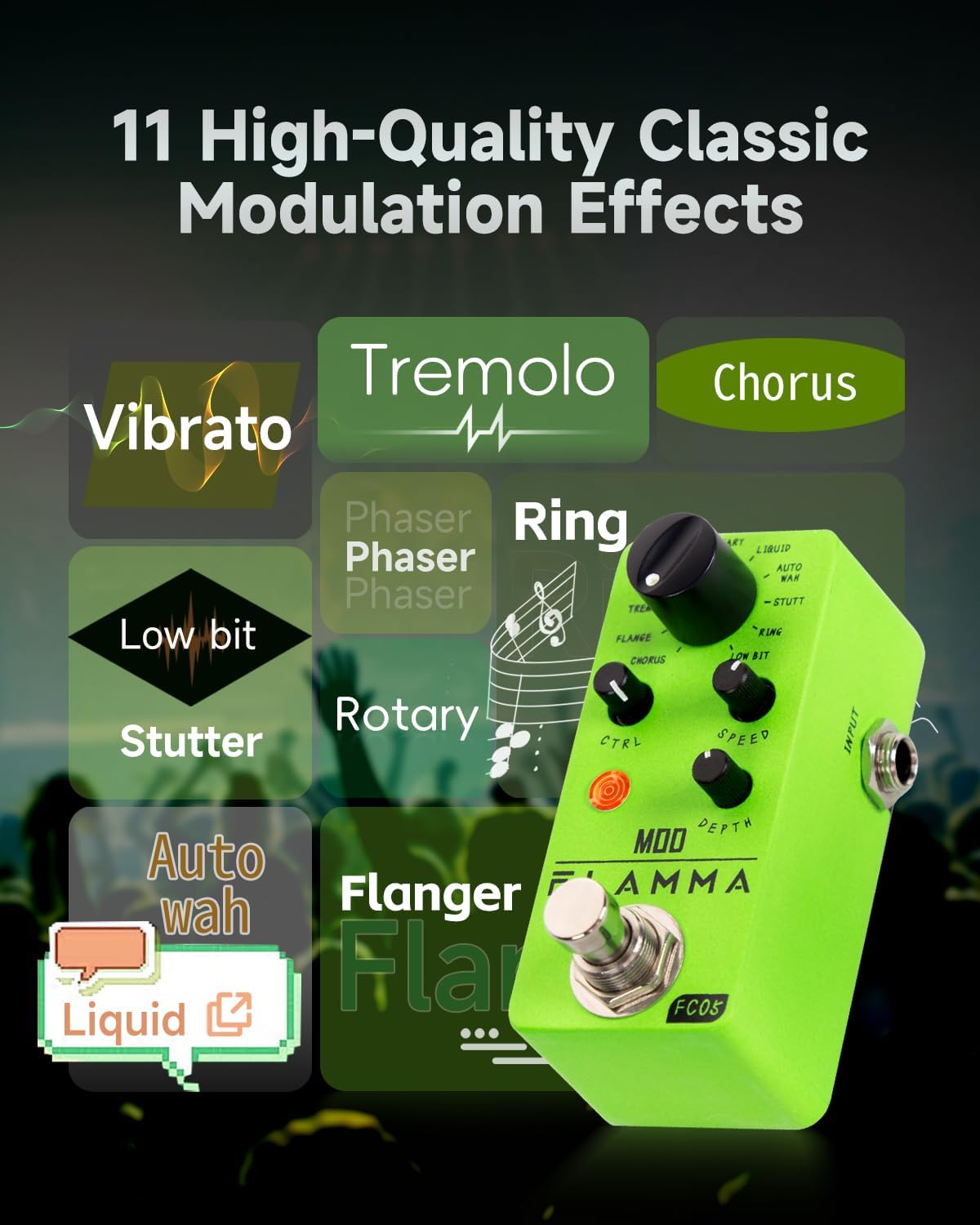
This breakdown tracks directly with what MusicRadar’s review of the Flamma FC05 multi-modulation pedal surfaces: reviewers praised the unit’s chorus, flanger, tremolo, and phaser modes as genuinely usable and musical, while explicitly flagging the ring modulator and stutter modes as effects that most players will find unusable in a normal musical context. That’s an honest and useful data point. Not every mode in a multi-effect unit deserves equal weight, and the Flamma FC05 review community essentially agrees on where the value lives.
The Modulation Pedal Tier You Should Actually Think About
Budget Tier: The Flamma FC05
For players building their first modulation layer onto a $200–$400 pedalboard, the Flamma FC05 is a genuinely credible starting point — not because it does everything, but because it does the right things well. Owners consistently report that the chorus, phaser, tremolo, and flanger modes hold up at rehearsal volumes and in home-recording contexts. The ring mod and stutter modes? Per aggregated reviews, skip them — they’re novelties, not tools.
The honest tradeoff here: the FC05 is not boutique. Players upgrading from it to a dedicated Strymon Mobius or an EHX Small Clone will notice a difference in depth and warmth. But for the player who just wants to stop leaving the modulation gap empty? It closes the gap.
Buy this if: You’re under $75, you want to explore what modulation does before committing to a specific effect type, and you’re okay with accepting that two of the eleven modes aren’t useful to most players.
Mid-Tier: The MXR EVH Phase 90
If you’ve decided phaser is your entry point — and for a lot of rock and blues players, it should be — the MXR EVH Phase 90 is one of the most consistently praised pedals in its price range. Premier Guitar’s coverage of the EVH Phase 90 describes its Script/Block toggle (two different circuit voicings that replicate the original 1970s Phase 90 sound versus a more modern, higher-output version) as what separates it from generic phase pedals.
Critical safety note: Reviewers across multiple platforms have documented a specific and costly mistake — using a 12V power supply adapter with the EVH Phase 90, which is a 9V pedal. One reviewer documented destroying the pedal this way. The EVH Phase 90 requires a standard 9V negative-tip power supply. This matters doubly on a pedalboard: if you’re running a daisy-chain power supply or a multi-output brick, verify the voltage on every output before plugging in. Center power supply voltage requirements prominently in your board-building checklist. A $30 power supply mistake can ruin a $100 pedal in seconds.
Buy this if: You play rock, blues, or any style where a swirling, musical phase effect fits naturally, you want a single dedicated pedal rather than a multi-effect unit, and you’re ready to commit to phaser as your first modulation voice.
Premium / Complement: Adding Wah as Modulation’s Wild Card
The Dunlop Cry Baby wah is technically a filter effect — but it occupies a similar sonic space as modulation and often gets left off boards for the same reason (“I’ll add it later”). Reviewers who’ve specifically evaluated the Cry Baby across different pickup styles — including Telecaster single-coils, Stratocaster single-coils, and humbucker-equipped Les Pauls — consistently report that the pedal responds well regardless of which guitar you’re using. It’s not pickup-dependent in any meaningful way. That’s a genuine advantage for players who rotate between guitars.
Signal Chain Order: Where Modulation Lives on Your Board
Getting signal chain order right is the practical piece most guides gloss over. Per Sweetwater’s Signal Chain Basics documentation, the standard ordering is:
- Tuner → 2. Filters / Wah → 3. Overdrive / Distortion → 4. Modulation → 5. Delay → 6. Reverb
Modulation goes after your drive pedals, not before. This matters because modulation applied to a drive signal produces a lush, moving texture. Modulation applied before drive gets distorted along with the rest of your signal, which creates a muddier, less defined sound. There are exceptions — some players deliberately run phaser before drive for a specific compressed, squashed quality — but as a default starting point, keep modulation post-drive.
Reverb and delay belong at the end of the chain, after modulation, so that the “room” effect is applied to the full, processed signal.
Frequently Asked Questions
What is the correct signal chain order for modulation pedals relative to overdrive and reverb?
Place modulation effects after your overdrive or distortion pedals, and before your delay and reverb. The standard order is: Tuner → Wah/Filter → Drive → Modulation → Delay → Reverb. This produces the clearest, most musical result for most styles. Some players intentionally break this rule for specific tonal reasons, but start here.
What voltage power supply does the MXR EVH Phase 90 require and why does it matter?
The MXR EVH Phase 90 runs on 9V DC with a standard negative-tip connector — the same as most Boss and MXR pedals. It does not accept 12V or 18V. Using the wrong voltage adapter has been documented by reviewers as causing immediate and irreversible pedal damage. Always check the voltage rating printed on the pedal’s label before connecting a power supply, especially on a shared pedalboard power brick.
Is the Flamma FC05 worth buying, or is modulation better handled by a multi-effects unit?
The FC05 is worth buying as an entry point if your budget is tight and you want to explore modulation before committing to individual pedals. Based on aggregated user reviews, four of its eleven modes — chorus, phaser, tremolo, and flanger — are genuinely musical and usable. Ring mod and stutter are widely considered non-starters for most players. If you already know you want chorus specifically and your budget allows, a dedicated single-effect chorus pedal will give you more depth and control. The FC05 is a tool for discovery; dedicated pedals are tools for commitment.
What’s the difference between chorus, flanger, and phaser for someone who has never used any of them?
Think of it on a spectrum from subtle to dramatic. Chorus is the most transparent — it thickens and enriches your tone without calling too much attention to itself. Phaser is more active and swirling, with that signature “vowel-like” movement. Flanger is the most aggressive of the three — the jet-plane whoosh, the metallic shimmer. If you’ve never used any of them, start with chorus. It’s the most immediately useful across the widest range of styles and least likely to feel like “too much” in a band context.
Can I use the Dunlop Cry Baby as my only modulation pedal, or do I need chorus or phaser too?
The Cry Baby is a filter/wah pedal — it’s expressive and useful, but it occupies a different sonic role than chorus, phaser, or tremolo. Wah creates a vocal, sweeping filter that you control with your foot in real time. Chorus, phaser, and tremolo run continuously in the background, adding texture to everything you play. Most players want both eventually: the Cry Baby for dynamic, expressive moments, and at least one background-modulation pedal for ambient texture. That said, if budget forces a choice, the Cry Baby is arguably the higher-impact single purchase — it’s more noticeable and more dramatic. Add a chorus or phaser when the budget allows.
The Decision Rule
If your pedalboard has drive and reverb but zero modulation: start with one effect, not a multi-unit. Pick the type that fits your style — chorus for clean players, phaser for rock and blues, tremolo for country and soul — and spend $50–$100 on a pedal that does that one thing well. The modulation gap on most budget boards isn’t a budget problem. It’s a prioritization problem. Fill it deliberately, and your rig will sound more finished than most boards costing twice as much.