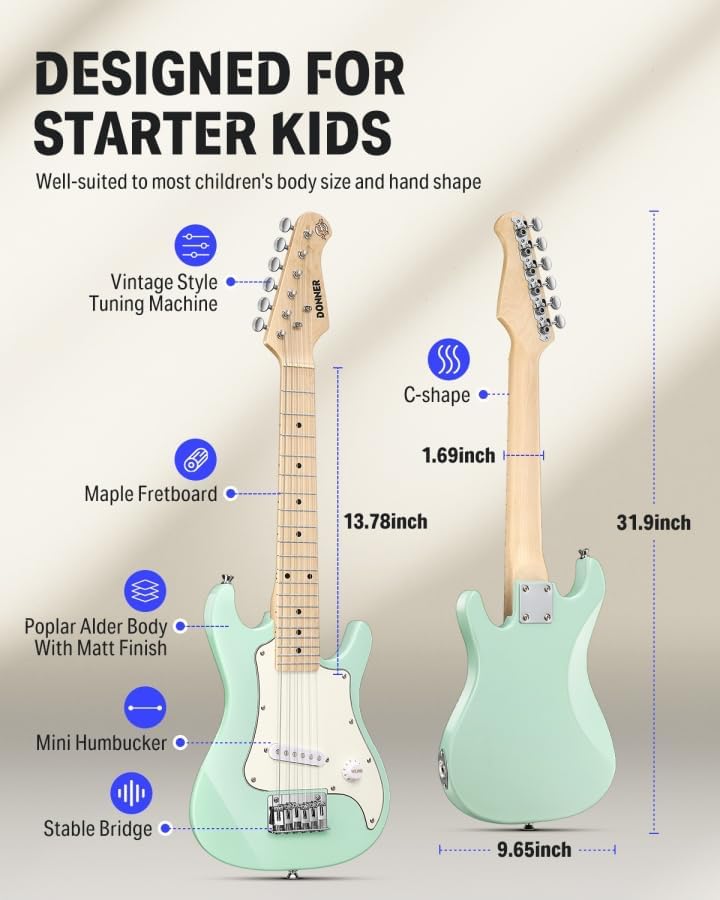
If you’ve ever stood in a music store — or scrolled through a product page at midnight — trying to figure out whether a little kid needs a “30-inch guitar” or whether that’s just marketing language for a toy, you’re not alone. Guitar sizes are measured by the scale length (the distance from the nut — that small slotted piece at the top of the neck — to the bridge at the body), and those numbers matter more than the box art. A 30-inch guitar is a genuinely smaller instrument, not a shrunken prop, and for the right child it can be the difference between a kid who sticks with lessons and one who quits because their hands hurt. This guide will walk you through exactly who needs which size, what the kit bundles actually include (and what they quietly leave out), and how to spend your money without buying the wrong thing twice.
Who Actually Needs a 30-Inch Guitar Kit?
The short answer is: children roughly ages 4–7, or kids up to about 4’0”–4’4” in height. But the physical fit matters more than the birthday.
A full-size electric guitar has a scale length of 25.5 inches (a Fender-style “long scale”) or 24.75 inches (a Gibson-style “short scale”). A 30-inch guitar refers to the total instrument length, not the scale length — the actual playing scale on these instruments is typically around 20–22 inches. That’s a meaningful reduction. Smaller hands, shorter arms, and narrower shoulder spans all benefit from the reduced reach between frets, and the lighter body weight keeps a 5-year-old from wearing out their arm trying to hold the instrument up.
Acoustic Guitar Magazine’s sizing guide recommends that parents measure the child’s arm span and evaluate whether they can comfortably reach the first three frets without straining their wrist. If they’re straining, size down. If they can reach without issue, a 3/4-size or full-size instrument may already fit.
Here’s the pattern that shows up consistently in long-form buyer reviews of the Donner 30-inch kids kit: at least one reviewer per product-page cohort is a veteran player — sometimes with 20–30 years of experience — who bought the mini guitar for a toddler and ended up picking it up themselves. The recurring description of “crazy overtones” through the included mini amp isn’t audiophile fantasy; it reflects the genuinely bright, compressed resonance that a shorter scale and smaller body produces. It’s a legitimate tonal character, not a defect.
Buy the 30-inch if: Your child is between 3 and 7 years old, under roughly 4’4”, or clearly struggling to wrap their hand around a full-size neck. Also buy it if you want a travel or novelty instrument that a skilled player can actually use — because these things are more playable than their price suggests.
What Full-Size Beginner Kits Actually Deliver (And Where They Cut Corners)
Full-size beginner electric guitar kits — think the LyxPro full-size bundle, the Squier Debut Strat pack, or the Donner DST-100 kit — are targeted at players roughly 11 years old and up, or anyone with adult-proportioned hands. For a child transitioning out of a 30-inch guitar, the move to full-size usually happens somewhere between ages 8 and 11, depending on physical growth rather than any fixed schedule.
What these kits promise: guitar, amplifier, cable, strap, picks, gig bag, tuner, and sometimes an instructional resource. What they actually deliver varies enormously by brand.
The Squier Debut Kit: The Honest Overachiever
Reviewers of the Squier Debut Strat pack — Squier being Fender’s entry-level sub-brand — consistently note that the accessory bundle is unusually complete and usable. MusicRadar’s beginner kit roundup flags the Squier Debut as a standout partly because of accessory quality, with reviewers explicitly calling out the included strap, tuner, picks, and instructional materials as genuinely functional rather than token add-ins. The stand (where included) is reported as stable, not wobbly plastic. For a parent trying to set up a functional learning station without a follow-up Amazon run, this matters.
The guitar itself is a legitimate Fender-family instrument with real adjustability — truss rod access, saddle adjustment at the bridge, and proper tuning machines. It’s not a toy that happens to look like a guitar.
The LyxPro Full-Size Kit: One Warning You Should Know Before You Buy
The LyxPro kit surfaces a very specific, recurring complaint across aggregated buyer reviews: the included gig bag is undersized for the guitar it ships with. Multiple reviewers describe having to force the instrument in, which creates real risk of neck joint stress and finish scratches over time. This is not a one-off defect report — it’s a consistent pattern, which makes it a design decision rather than a quality-control miss.
One reviewer documented purchasing a used LyxPro kit for $75 against a then-typical new price around $110, which is useful context if you’re price-tracking this category: used units circulate and the street price has a real floor. If you buy this kit, budget for a properly fitting gig bag as a near-immediate add-on purchase.
The guitar itself reviews reasonably well for the price point. The problem is almost entirely the bag.
The Donner DST-100 Kit: The Mod-Friendly Budget Platform
The Donner DST-100 generates an interesting subset of reviews from buyers who treat it as a modding platform rather than a finished instrument. One reviewer documented installing a titanium neck plate and roller string tree (the small guide piece near the tuners that keeps strings aligned) as aftermarket upgrades — the kind of first-mod workflow that a mechanically inclined parent or teen player might enjoy.
This speaks to something real about the DST-100: it’s built on a Strat-style platform with standard hardware spacing, which means most Fender-compatible aftermarket parts fit. If a young player is interested in how guitars work — not just how to play them — this kit opens a learning path that a more finished instrument doesn’t.
Guitar World’s buyer coverage of budget electric kits notes that Strat-style beginner guitars with standard hardware spec are consistently the easiest to upgrade incrementally, which is why they dominate the entry-level category.
By the Numbers: Size and Age Reference
| Guitar Size | Typical Total Length | Scale Length | Recommended Age | Height Range |
|---|---|---|---|---|
| 30-inch / Mini | ~30 in | ~20–22 in | 3–7 years | Under 4’4” |
| 3/4-size | ~36 in | ~22–24 in | 6–10 years | 4’0”–4’9” |
| Full-size | ~39–40 in | 24.75–25.5 in | 10+ / adult | 4’9” and up |
Age ranges are approximations. Physical fit — arm reach and hand span — should always override the birthday.
What’s Always Missing From Budget Kits (And What to Buy Before the First Lesson)
This is the part kit marketing quietly elides. Across every price tier and brand, there are consistent gaps between what’s in the box and what a beginner actually needs to get started cleanly.
A clip-on tuner that works. Some kits include one; many don’t, or they include a tuner that’s slow to read and frustrating for a child to use. A snappy, color-display clip-on tuner is a $10–$15 add-on that dramatically reduces first-week frustration. Sweetwater’s buyer’s guide for beginner setups consistently flags tuning accuracy as the single biggest friction point for new players — a child who can’t easily tune their guitar will stop playing it.
A proper setup. Budget guitars at any size — 30-inch included — typically ship with the action (the height of the strings above the fretboard) set too high from the factory. High action makes fretting harder and causes finger pain, which beginners interpret as “I’m not good at this” rather than “this guitar needs adjustment.” A basic setup at a local shop — truss rod, bridge saddle, nut — runs $40–$60 and transforms playability. If a shop isn’t accessible, a parent with basic mechanical confidence can lower the bridge saddle height on most Strat-style guitars with a hex key (Allen wrench), following guidance from Sweetwater’s setup tutorials.
A real cable. The cables included in budget kits tend to be thin, prone to crackling, and short. A 10-foot instrument cable of any reputable brand is a worthwhile early upgrade.
What’s usually fine as-is: The picks included in most kits are standard medium-gauge and perfectly usable. The strap is functional. The amp — even the small 3-watt practice amps in kids’ kits — is adequate for bedroom volume.
Frequently Asked Questions
What age and physical size is a 30-inch guitar actually right for? Ages 3–7 is the most common fit, but the physical test matters more than the number. If a child can’t comfortably reach the third fret without bending their wrist at a painful angle, they need the smaller instrument. Acoustic Guitar Magazine’s sizing recommendations use arm span as the primary measurement: sit the child down, rest the guitar on their leg, and check whether their strumming arm can clear the body naturally. If it can’t, size down.
Is the gig bag in budget kits like LyxPro genuinely usable or just decorative packaging? For the LyxPro specifically, buyer review patterns are clear: the gig bag included with the full-size kit is too small for the guitar. It functions as temporary protection during shipping but creates fit problems in regular use. Treat it as packaging, not gear. Plan to purchase a properly sized gig bag — 1/4-inch or padded — as a near-immediate add-on.
What is always missing from cheap all-in-one guitar kits that buyers have to buy separately? The most consistent gaps are: a reliable clip-on tuner (when not included, or when the included one is slow/inaccurate), a proper setup (factory action is almost always too high on budget guitars), and a decent instrument cable of adequate length. None of these are expensive, but they’re all friction points that cause beginners to give up unnecessarily.
What is the first adjustment or setup fix a parent should make after unboxing a budget kids’ electric guitar kit? Check and adjust the action at the bridge. On most budget Strat-style guitars — including 30-inch kids’ models — the saddles (the small metal pieces at the bridge that the strings rest on) can be lowered with a 1.5mm or 2mm hex key. Lower action means less force required to press down a string, which directly reduces finger fatigue for small hands. If the adjustment feels beyond your comfort level, a local music shop tech can do it in under 30 minutes for a modest fee. The Donner 30-inch kit, per buyer review documentation, is genuinely adjustable at both the bridge and intonation points — reviewers have performed full setups on these instruments, which confirms real hardware rather than cosmetic parts.
At what point should a growing child move from a 30-inch guitar to a full-size instrument? The transition usually becomes appropriate between ages 8 and 11, but watch for physical signals rather than waiting for a birthday: if the child’s fretting hand has to compress rather than stretch to reach chord shapes, if they’re playing at or past the 12th fret comfortably, or if the guitar simply looks visually tiny in proportion to their torso when seated. A 3/4-size instrument is a legitimate intermediate step for kids who are ready to move up from 30-inch but not quite ready for full adult scale. Many families skip this step entirely — the 30-inch to full-size jump is workable with proper setup.
The Decision Rule
If your child is 7 or under, or under 4’4”, and you’re not sure: Start with the 30-inch kit. The Donner option in this category earns consistent respect from serious players, not just parents buying a toy. Budget $15–$20 for a clip-on tuner and a follow-up setup visit if needed.
If your child is 8–11 and physically average for their age: A 3/4-size guitar is the honest fit, but many families jump to full-size and set the action low enough to be manageable. The Squier Debut kit is the most complete accessory bundle in the full-size category based on aggregated reviewer reports — the extras are genuinely usable.
If you’re buying for a teen or adult beginner: Full-size, no question. The Donner DST-100 is a legitimate mod platform if the buyer has mechanical curiosity. If they want a finished, play-out-of-the-box experience with better accessory quality, the Squier Debut consistently earns that role.
The goal isn’t to buy the most guitar for the money. It’s to buy the right guitar for the hands holding it.