Solid Body Shape Showdown: Ibanez GRX70QA, GRG131DX, and Jackson JS22 for Rock and Metal Players
If you’ve been playing guitar for a year or two — or if you’re returning after a long break — you’re probably past the point of buying whatever’s cheapest and hoping for the best. You know what a solid body electric guitar is (a guitar carved from a single slab or pieces of wood, with no hollow resonating chamber, designed to be amplified), and you know that not every guitar under $300 is created equal. What you might not know yet is where these three specific models fall on the spectrum between “tolerable starter” and “genuinely good instrument.”
This comparison is built for the player who has a decision in front of them right now. Maybe you’re upgrading from a kit guitar. Maybe you’re buying a beater to leave at a rehearsal space. Maybe you’re a returning player with wrist fatigue who needs something lighter. Whoever you are: by the end of this article, you’ll have a clear sense of which of these three — the Ibanez GRX70QA, the Ibanez GRG131DX, or the Jackson JS22 Dinky — is the right call for your specific situation.
What You’re Actually Choosing Between
Before diving into the individual guitars, it helps to understand what separates these instruments at a structural level.
All three are solid body electric guitars designed with rock and metal players in mind. That means they prioritize lower action (the distance between the strings and the fretboard — lower action means faster, easier playing), higher-output pickups (the magnetic sensors that convert string vibration into signal — higher output drives amplifiers harder for a more aggressive tone), and body shapes borrowed from the genre’s visual vocabulary: double cutaways, aggressive headstock designs, and contoured bodies.
Where they diverge is in pickup configuration, tremolo systems, and neck profiles — and those differences matter more than the cosmetic stuff.
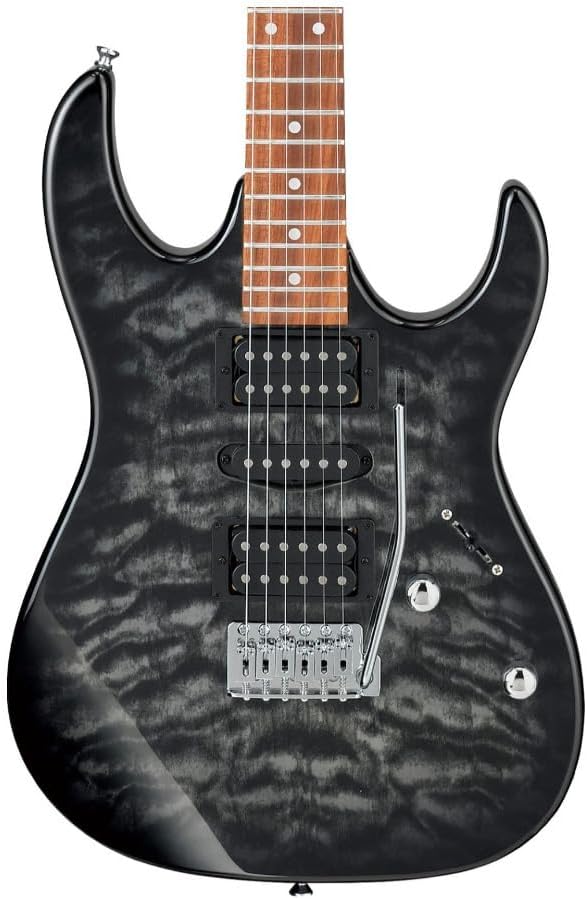
The Ibanez GRX70QA is the most visually distinctive of the three, featuring a quilted finish top that looks far more expensive than its price point. More meaningfully, it carries an HSH pickup layout — one humbucker (a dual-coil pickup that cancels electrical hum and produces a thicker, fuller sound) at the bridge, a single-coil in the middle (brighter, thinner, snappier), and another humbucker at the neck. This three-pickup arrangement gives you a wide tonal palette across the five-way pickup selector.
The Ibanez GRG131DX is the stripped-down sibling: a single humbucker at the bridge, one at the neck, no middle pickup. Fewer moving parts, a fixed bridge (no whammy bar), and a finish that owners consistently describe as clean for the price. It’s the “plug in and play hard” option without the complexity of a tremolo system.
The Jackson JS22 Dinky brings Jackson’s iconic pointed headstock, a faster neck profile, and a reputation for out-of-box feel that punches above its weight. Available with either a fixed hardtail bridge or a licensed tremolo system depending on the variant, it’s the most overtly “metal” of the three in both look and character.
Side-by-Side Specs
| Guitar | Pickups | Bridge | Body Wood |
|---|---|---|---|
| Ibanez GRX70QA | HSH | GRX tremolo | Poplar |
| Ibanez GRG131DX | HH | Fixed | Mahogany |
| Jackson JS22 Dinky | HH | Fixed or tremolo | Poplar/Basswood |
Where Each Guitar Actually Shines
Ibanez GRX70QA: The Tonal Swiss Army Knife
The GRX70QA’s clearest advantage is versatility. That HSH configuration — humbucker, single-coil, humbucker — gives you five distinct sounds when you work through the pickup selector. Positions one and five are full humbuckers: thick, loud, good for hard rock and metal rhythm playing. Positions two and four engage a humbucker and the single-coil together, producing a quicker, cleaner attack suited to melodic passages or classic rock leads. Position three is the middle single-coil alone, useful for cleaner picking or blues-inflected work.
Customer review aggregation on the Sweetwater GRX70QA product page consistently cites this pickup range as the standout value proposition at the price point. Reviewers include players who own considerably more expensive instruments and describe being genuinely surprised by the GRX70QA’s tonal breadth — not as a definitive benchmark claim, but as a recurring pattern across multiple owner accounts.
The quilted finish top is laminate rather than carved solid wood — that’s how Ibanez hits this price — but it photographs and plays in a way that doesn’t feel budget. The tremolo system is functional but best suited to subtle pitch modulation rather than extreme dive-bombing; this is not a Floyd Rose and shouldn’t be used like one.
Ibanez
$219.99
In stock on Amazon
Check price on AmazonIbanez GRG131DX: The “Just Works” Workhorse
The GRG131DX trades versatility for simplicity and focused playability. Two humbuckers, a fixed bridge, and a neck profile that owners consistently describe as fast and comfortable — this is the guitar you buy when you want to plug in, play hard, and not think about anything else.
The out-of-box setup story on this model is notably positive compared to its price tier. Per aggregated owner accounts on the Sweetwater GRG131DX product page, the recurring theme is that the factory setup arrives in good enough condition that only a minor truss rod adjustment — a routine tweak to the long metal rod inside the neck that keeps it straight — was needed before the guitar felt fully dialed in. For a guitar at this price, that’s not guaranteed; many budget instruments arrive with action so high that playing them is a workout.
The HH configuration means you’re optimized for high-gain playing: metal rhythms, hard rock leads, drop-tuned riffing. If your primary references are Black Sabbath, Metallica, or Pantera, you don’t need a middle single-coil pickup. You need fat, quiet, high-output humbuckers — and that’s what you get here.
Per Ibanez’s published product specifications, the mahogany body adds warmth and midrange density that poplar-bodied guitars at this price can sometimes lack. It’s a tonal difference that players who’ve moved between instruments at this tier consistently notice and describe in owner accounts on the Sweetwater GRG131DX product page.
Ibanez
$219.99
In stock on Amazon
Check price on AmazonJackson JS22 Dinky: The Comeback Player’s Guitar
The JS22 has developed a specific reputation among returning players — people who set down the guitar for years due to family, work, or injury, and are picking it back up now. The reason surfaces consistently in customer reviews aggregated on the Sweetwater JS22 Dinky product page: the neck is thinner front-to-back than most guitars at this price, and the body is lighter than it looks.
For smaller frames, smaller hands, or players managing any kind of wrist or shoulder fatigue, that combination is meaningful. Multiple reviewers in Sweetwater’s JS22 aggregation specifically chose it after returning to guitar post-hiatus, citing the reduced physical load as a deciding factor. Guitar World’s “Best Budget Electric Guitars” buyer’s guide identifies the JS22’s neck profile as one of its signature differentiators at this price tier — a characterization consistent with the pattern of player accounts describing neck feel as the primary reason for choosing it over comparably priced alternatives.
The JS22 also brings the most overtly metal aesthetic of the three: the sharp Jackson headstock design, angular body curves, and a bolt-on maple neck. Tonally, the HH configuration covers the same hard rock and metal territory as the GRG131DX, though players who’ve compared them directly tend to describe the JS22 as slightly brighter — which tracks with the maple neck and poplar body combination versus the GRG131DX’s mahogany construction.
Tremolo-equipped JS22 variants use a licensed system that holds tune adequately for moderate use — light vibrato and gentle pitch dips — but is not suited to aggressive dive-bombing. MusicRadar’s “Best Budget Electric Guitars” buyer’s guide addresses this limitation for licensed tremolo systems in this price range generally, noting that players requiring extreme whammy bar technique should budget for a higher-specification bridge. That applies equally here.
Ibanez
$219.99
In stock on Amazon
Check price on AmazonAre These Guitars Worth Keeping as You Improve?
This is the question experienced players buying these as secondaries are already answering with their wallets — and the answer is yes, more often than you’d expect.
MusicRadar’s “Best Budget Electric Guitars” buyer’s guide notes that instruments in the $200–$350 range have crossed a meaningful quality threshold in recent years, with factory specs and hardware quality improving to the point where they’re viable for gigging and recording, not just practice. Owners of all three guitars who also own significantly more expensive instruments describe keeping these as dedicated drop-tuned guitars, travel instruments, or rehearsal-space guitars where they’d rather not risk a more expensive piece.
Guitar World’s “Best Budget Electric Guitars” buyer’s guide echoes this assessment, pointing out that the budget electric category at this price tier now produces instruments capable of surviving real-world playing environments — not just bedroom practice sessions.
The upgrades that matter most at this price tier — if you want to incrementally improve what you have — are a proper setup from a qualified local technician, a tuner upgrade, and possibly a pickup swap, roughly in that order of priority and cost.
Frequently Asked Questions
Is the Ibanez GRX70QA a meaningful upgrade over a generic starter kit guitar? Yes — particularly in neck feel, pickup quality, and out-of-box setup consistency. Players who’ve come from generic starter bundles consistently describe the GRX70QA as a tangible step forward in both playability and tone. It’s not a different category of instrument, but it’s noticeably better hardware and electronics.
Does the GRG131DX need a setup out of the box? Based on aggregated owner accounts on the Sweetwater GRG131DX product page, the GRG131DX has some of the best factory setup consistency in this price range. Many players report only a minor truss rod tweak was needed, and some played it straight out of the box. That said, guitars can shift during shipping, so a quick check of neck relief and string action is always worth doing before a serious session.
Is the Jackson JS22 tremolo system reliable for regular playing? For moderate use — light vibrato, gentle pitch shifts — yes. For aggressive dive-bombing, no. The licensed tremolo system holds tune acceptably well for typical playing but isn’t engineered for extreme technique. If heavy tremolo use is central to your style, plan for an upgrade or a different guitar entirely.
Which of these is best for smaller hands or a smaller frame? The Jackson JS22 Dinky is the consistent answer. Its thinner neck profile and lighter body are specifically cited by returning players with smaller builds as primary reasons for choosing it, per the Sweetwater JS22 Dinky product page review aggregation. The Ibanez GRX neck is comfortable but slightly fuller; the GRG131DX is similarly accessible. If physical comfort is your top priority, start with the JS22.
How much does the HSH layout on the GRX70QA actually expand tonal range? Significantly, depending on your genre. The HH guitars — GRG131DX and JS22 — give you two primary sounds: bridge humbucker (aggressive, cutting, optimized for rock and metal) and neck humbucker (warmer, rounder, good for leads and cleaner passages). The GRX70QA’s HSH layout adds three more tonal positions via the middle single-coil, which are useful for bright clean rhythm playing, classic rock, and melodic work. If you play exclusively high-gain metal, the extra positions may be irrelevant. If you cross genres or use a clean channel regularly, they’ll matter.
Are these guitars good enough to keep as you reach intermediate level? Yes. All three have been cited by intermediate and advanced players as guitars they’ve kept alongside much more expensive instruments. A proper setup and possibly a pickup upgrade down the road will extend their useful life well past the beginner stage.
The Decision Rule
If you want tonal range and a guitar that can cover multiple genres — GRX70QA.
If you want the cleanest out-of-box experience, a mahogany-bodied tone, and a pure hard rock and metal focus — GRG131DX.
If you’re returning after time away, have a smaller frame or hands, or want the most metal-forward aesthetic and fastest neck feel — Jackson JS22 Dinky.
All three are real guitars. All three represent a meaningful step up from generic starter packs. The choice is about fit — your hands, your genre, and your workflow — not about which one is objectively superior.