You’ve been playing guitar for decades — or maybe you’re just getting started later in life — and something has changed. Your fingers don’t move the way they used to. A full-size acoustic that once felt like an old friend now leaves your strumming arm aching after twenty minutes. Maybe a doctor has mentioned arthritis (joint inflammation that causes stiffness and pain, especially in the fingers, wrists, and shoulders), or maybe you haven’t put a name to it yet. Either way, you’re wondering if there’s a smarter way to keep playing. There is. This guide is built around real patterns from real players — people who tried different guitars, made mistakes, and found what actually works. If you’re over 50 and your gear choices are starting to feel like physical decisions as much as musical ones, you’re in exactly the right place.
Why the “Just Play Through It” Advice Misses the Point
There’s a persistent myth in guitar culture that discomfort is a beginner problem — that once you’ve built up enough calluses and technique, pain goes away. For players over 50, that framing causes real harm. Arthritis, tendinitis (inflammation in the tendons that connect muscle to bone), and general joint wear don’t respond to “playing through it.” They respond to smarter gear decisions.
The good news is that the guitar market in 2026 offers more playability-focused options than at any point in history. Body contours have gotten more ergonomic, action (the height of the strings above the fretboard — lower action means less force needed to press a note) has become a more central part of how dealers and reviewers evaluate instruments, and the multi-effects category (single units that combine many effects pedals in one box) has made amp-and-pedalboard management dramatically simpler. The challenge is knowing which changes actually move the needle and which ones are marketing noise.
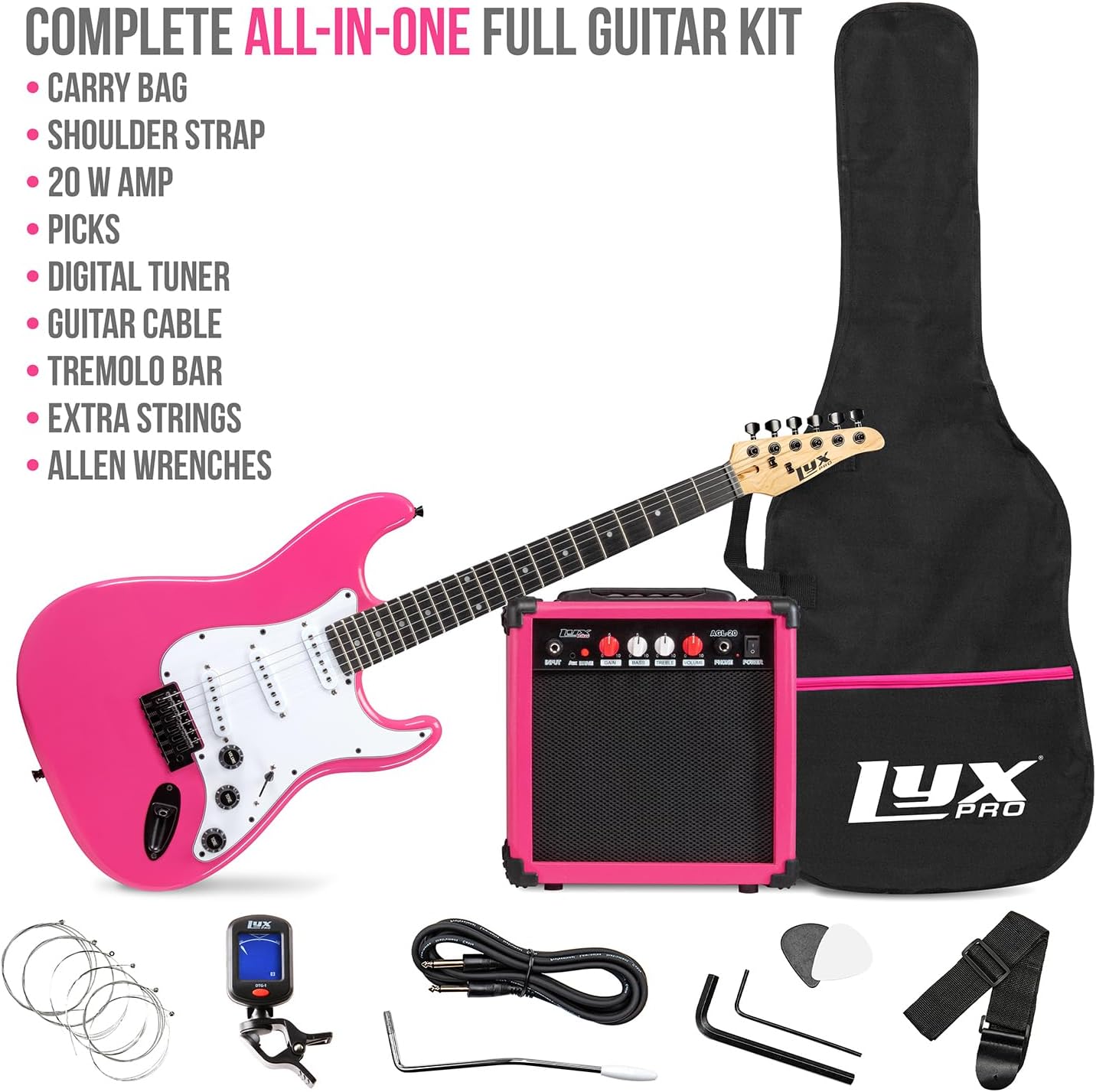
One of the most instructive stories in this space comes from reviewers of the LyxPro electric guitar kit. A player described giving away a beloved Alvarez acoustic due to arthritis, then trying a classical guitar — the wide-bodied, nylon-string style many people assume is the gentler option — and finding it wasn’t the answer. The real solution turned out to be an inexpensive electric. That narrative arc — acoustic pain, wrong detour, electric guitar as the actual fix — shows up repeatedly across aggregated reviews, and it’s worth understanding why.
Electric vs. Acoustic: The Honest Tradeoff for Joint Pain
The question “is electric guitar easier to play than acoustic if you have arthritis?” deserves a direct answer: yes, typically, and not for the reasons most people assume.
It’s not just that electric strings are thinner (though they are — a standard electric set runs .009”–.042”, while most acoustics ship with .012”–.053” or heavier). It’s the combination of factors:
By the numbers:
- Acoustic strings: typically .012”–.053” gauge, requiring 20–30% more fretting force than light electric strings
- Acoustic action (nut to string): often 3/32”–7/64” at the first fret on factory setups
- Electric action: commonly set to 4/64”–5/64” on a quality setup
- Classical nylon strings: lower tension than steel acoustic, but guitar neck width averages 2”+ vs. 1.65”–1.75” on most electrics
That wider neck on a classical guitar is exactly why the “just switch to nylon strings” advice can backfire. Players with arthritis in the fingers or reduced grip strength often find the wider classical neck harder to navigate, not easier, even though the string tension is lower.
Sweetwater’s string gauge explainer reinforces this directly: lighter string gauge reduces the force needed to fret notes and bend strings, which translates to real relief for players with inflamed joints. The recommendation for players managing hand pain is typically to start with 9s or even 8s on an electric, and to have the guitar professionally set up (adjusted at the nut and bridge to optimize string height and playability) rather than relying on factory defaults.
Body Shape and Physical Comfort: What Actually Changes
Here’s the tradeoff that doesn’t get enough coverage in gear guides: the guitar body shape affects your back, shoulder, and strumming arm just as much as your fretting hand.
A reviewer of the Yamaha APX600 — a thin-body acoustic-electric (a guitar that can be plugged into an amplifier but plays and sounds like an acoustic) — described a specific issue: their strumming arm got sore from hitting the sharp edge of wider acoustic bodies. The APX600’s slim profile and contoured edge addressed that directly.
That’s a real ergonomic variable, and it’s worth naming explicitly:
- Dreadnought acoustics (the big, square-shouldered shape that defines most steel-string guitars) measure roughly 4.75” deep at the body. For players with shorter arms, barrel chests, or back issues, that depth pushes the fretting arm out at an awkward angle.
- Slim-body acoustics like the APX600 typically measure around 3.5” or shallower. The strumming arm sits closer to the body naturally, reducing shoulder rotation.
- Electric guitar bodies are generally shallower still — a Telecaster or Stratocaster body is around 1.75” deep — and many feature a forearm contour on the top edge that removes exactly the pressure point the APX600 reviewer described.
For players with back pain or reduced mobility, semi-hollow electrics (guitars with partial internal chambers that add acoustic resonance) deserve attention. They’re typically lighter than solid-body electrics, and instruments like the Epiphone ES-335 and similar designs allow a seated playing position that puts less strain on the back than a heavy Les Paul-style guitar.
Acoustic Guitar Magazine’s coverage of hand health for guitarists consistently points back to posture and guitar fit as first-order variables — before any conversation about technique or treatment.
Amplification and Effects: The Case for Simpler Rigs
One of the clearest patterns in the over-50 guitarist’s gear journey involves amplification. A 62-year-old reviewer of the Positive Grid Spark 2 — a modeling amp that combines built-in effects, Bluetooth connectivity, and a companion app — was explicit: the motivation for buying wasn’t tone. It was wanting to stop dealing with cables and pedals physically. That’s a legitimate purchase driver, and the market has caught up to it.
Modeling amps (amplifiers that use digital processing to simulate the sound of many different vintage and boutique amps in a single unit) and multi-effects units eliminate the cable-management overhead that makes a traditional pedalboard setup physically demanding. Crouching down to adjust stomps, managing power supplies, carrying a pedalboard in and out of a car — all of it adds up.
The Zoom G1X FOUR is a multi-effects unit that surfaces a specific and instructive user story: a player in the 55–65 age range who nearly returned the unit due to the learning curve, then worked through it, and found the interface manageable. Importantly, multiple reviewers across the Mooer GE100 and GE150 multi-effects units have independently recommended using ChatGPT as a support tool for learning complex interfaces — a genuinely useful pattern worth knowing about. If you’re staring at a multi-effects unit that feels overwhelming, asking a large language model (AI chat tool) to walk you through specific workflows step by step has become a real and practical support strategy in 2026.
MusicRadar’s multi-effects roundup notes that the main learning curve on these units isn’t the sound quality — it’s the menu navigation. Players who approach multi-effects units as “one-time setup” tools (spend a weekend dialing in your core sounds, then leave them alone) report much higher satisfaction than players who expect to tweak live.
Getting a Proper Setup: The Highest-Value Move You Can Make
If you take one action item from this guide, make it this: get your guitar professionally set up by a qualified luthier or guitar tech, with low action and a lighter string gauge, before concluding that a guitar doesn’t work for your hands.
Factory setups are conservative. Manufacturers ship guitars with action that plays safely across a range of string tensions and playing styles, not action optimized for minimum fretting force. Premier Guitar’s setup guides note that a quality setup — nut filing, saddle adjustment, truss rod (the metal rod inside the neck that controls its curve) optimization — can transform a guitar that feels stiff and unresponsive into something dramatically easier to play.
What to ask for specifically:
- String gauge reduction: Drop to .009s on electric, or .011s if you want a little more resonance. On acoustic, try .011s (sometimes called “custom light”).
- Low action target: Ask for the lowest action that doesn’t cause fret buzz (unwanted string vibration against the frets) in your normal playing style.
- Nut slot depth: Factory nuts are often cut too high at the first position, where most chords live. A luthier can deepen the nut slots at minimal cost and enormous playability benefit.
A full setup typically runs $50–$80 at an independent shop and $75–$100 at a chain music retailer. On a guitar you already own, that’s almost always the highest-ROI move available.
Frequently Asked Questions
Is an electric guitar actually easier to play than an acoustic if you have arthritis or joint pain?
In most cases, yes. Electric guitars typically have lower action, lighter string gauges, and narrower neck profiles than acoustic guitars. The combination reduces the fretting force required significantly. The key exception is if you need acoustic sound specifically — in that case, a properly set-up slim-body acoustic with light strings can work well.
What guitar body styles are most comfortable for players with back pain or limited mobility?
Slim-body acoustics (like the Yamaha APX600 or similar thin-body acoustic-electrics), contoured solid-body electrics (Stratocaster-style guitars with forearm and ribcage bevels), and lightweight semi-hollow electrics are the most commonly cited options. Heavy solid-body guitars can strain the shoulder and back during extended seated playing.
How do I get a guitar set up specifically for low action and lighter strings?
Bring it to a guitar tech or luthier and ask explicitly for a “low-action setup with [your target string gauge].” Mention that you’re managing hand fatigue or joint pain — any competent tech will understand the goal. Budget $50–$100 for the service and expect a meaningful difference in playability.
Are modeling amps or multi-effects units easier for older players to learn quickly?
They can be, especially once your core sounds are dialed in. The initial learning curve — particularly with multi-effects units — can be steep. Reviewers have found success using AI chat tools like ChatGPT to navigate complex menus step by step. Modeling combo amps (single units with amp simulation built in, like the Positive Grid Spark 2) tend to have friendlier interfaces than floor-based multi-effects units.
What does a “slim body” acoustic like the Yamaha APX600 actually feel different from a dreadnought when playing?
The most immediately noticeable difference is how your strumming arm rests. On a dreadnought, the body’s depth and width push your arm outward; the edge of the body can press into your forearm during extended strumming. A slim-body acoustic sits closer to your torso, reducing shoulder rotation and eliminating the sharp-edge pressure point. The tradeoff is slightly less bass resonance — the thinner body produces a somewhat brighter, more focused acoustic tone than a full-depth dreadnought.
The Decision Framework
The core tradeoff in this entire conversation comes down to three variables: sound priority, physical comfort, and setup investment.
- If acoustic tone is non-negotiable: Start with a slim-body acoustic-electric, get a professional low-action setup with light strings, and evaluate after thirty days of regular playing.
- If you’re flexible on tone: A properly set-up electric guitar with 9s or 8s, paired with a modeling amp that handles your cable management overhead, is likely to be the most physically sustainable path.
- If you already own a guitar that hurts to play: Before replacing it, invest in a professional setup. The instrument may be fine; the factory configuration may not be.
Playing guitar past 50 — past 60, past 70 — is entirely realistic. The players doing it successfully aren’t toughing it out. They’re making smarter equipment decisions.