Floor Processor or Stompbox Stack? How to Choose Before You Buy Anything Else
If you’re standing at the gear crossroads — one hand pointing toward a single all-in-one floor unit that does everything, the other toward a growing collection of individual pedals — you’re in good company. This is one of the most common and genuinely consequential decisions a guitar player makes, and it’s easy to get it wrong by following the wrong person’s advice for your situation. A “floor processor” (sometimes called a multi-effects unit) is a single piece of hardware that digitally simulates dozens of different effects — distortion, reverb, delay, chorus, and more — all in one box you control with your feet. A “stompbox stack” is a collection of individual analog or digital pedals, each doing one job, chained together on a board. Neither is universally better. But one of them is almost certainly better for you right now, and this guide is built to help you figure out which one before you spend a dollar.
Whether you’re playing your first open mic or building a serious live rig, the decision comes down to four honest questions: How much do you want to spend upfront? How much time do you want to put into learning your gear? How often does your sound need to change? And — this one matters more than people admit — how much does the feel of a pedal under your boot matter to your playing? Let’s work through it.
The Real Cost Comparison: It’s Not Just the Sticker Price
Here’s where most gear conversations go sideways — people compare the cost of a single multi-effects unit against a single stompbox, when the real comparison is an entire rig against another entire rig.
By the numbers — entry-level floor processor vs. functional stompbox rig:
| Rig Type | Typical Entry Cost (2026 market) | What You’re Getting |
|---|---|---|
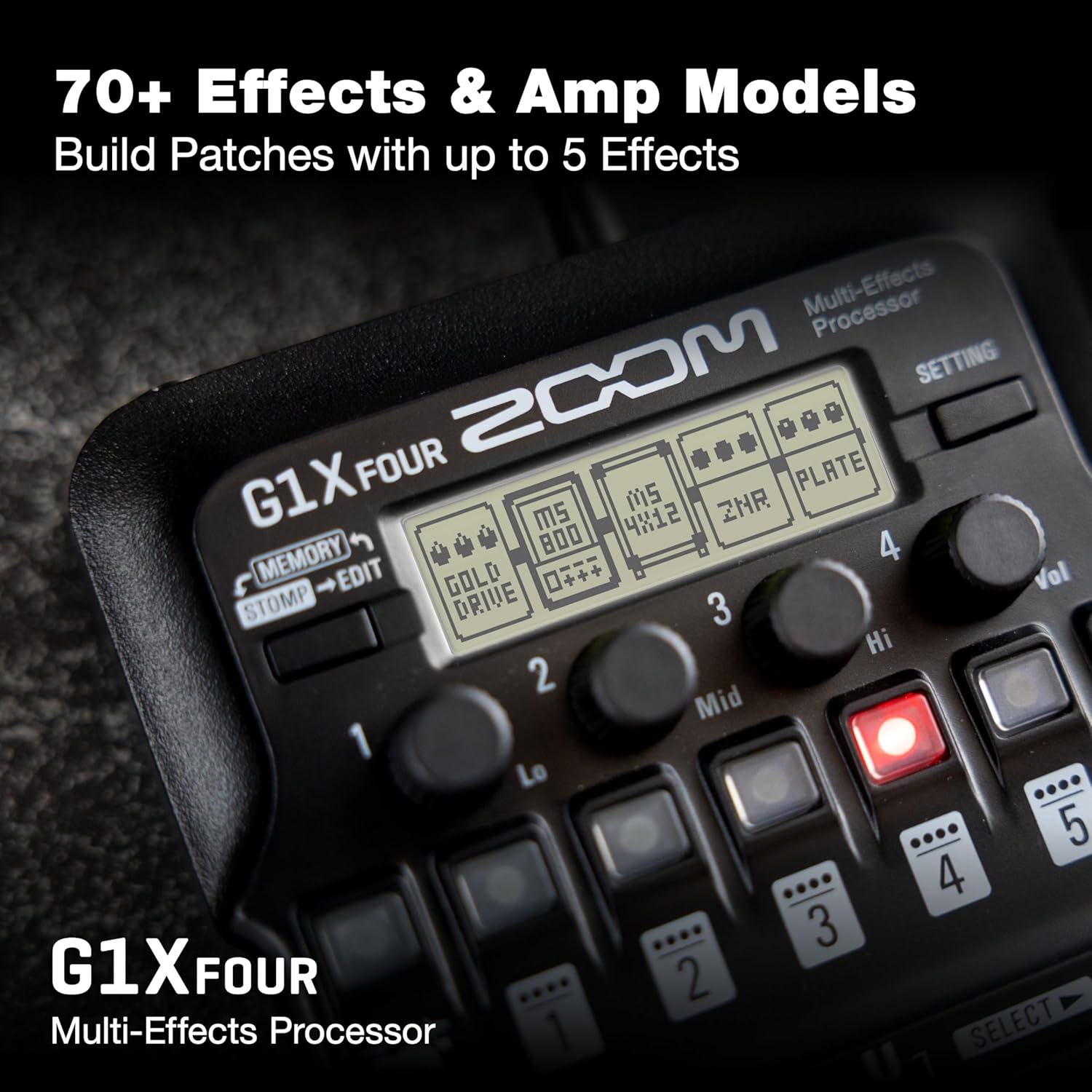
| Floor processor (e.g., Zoom G1X FOUR or Boss GT-1) | $70–$200 | 60–100+ effects, amp sims, tuner, looper |
| Basic stompbox rig (OD + reverb + delay + tuner) | $200–$400 | 3–4 effects, discrete analog/digital signal |
| Stompbox rig + pedalboard + power supply | $350–$600+ | Same 3–4 effects, fully mounted and powered |
The math is clear: for a first-time setup or a player on a budget, a floor processor gives you a working, gig-ready signal chain at a fraction of the cost of even a modest analog board. Boss GT-1 reviewers on MusicRadar and Guitar World consistently report that the unit replaced physical stompbox collections entirely — with owners naming specific pedals like overdrive, compressor, chorus, and noise gate that are now sitting in a drawer. That’s not a knock on those pedals; it’s a signal that for certain players and use cases, the processor fully handles the job.
The calculus shifts as budgets rise. Once you’re spending $150–$200 per individual pedal on quality analog units — a Boss SD-1 Super Overdrive, a quality reverb, a delay — the gap between “one box” and “a curated board” narrows on value and widens on character.
Where Floor Processors Win: Flexibility, Portability, and Getting Started Fast
If any of these describe you, a floor processor is almost certainly the smarter first move.
You play multiple genres or settings. Floor processors shine when your Friday night is a worship set, your Saturday is an open mic, and your Sunday is a practice session in an apartment. The Zoom G1X FOUR is a case study in this pattern — owners across aggregated reviews on Sweetwater and Guitar World describe using it in worship settings, at open mics, and even for silent practice powered by a USB power bank (yes, it actually runs off one; more on that in the FAQ). Switching between a clean country twang and a saturated lead sound is a preset recall, not a board rebuild.
You’re building intuition about which effects you actually use. This is underappreciated advice: if you don’t yet know whether you’re a delay person or a reverb person, or whether you actually need a compressor in your chain, a processor lets you experiment with dozens of effects before you commit real money to individual pedals. Premier Guitar’s editorial coverage of multi-effects units repeatedly surfaces this use case — the processor as a diagnostic tool for your own taste.
You’re gigging in tough conditions. One box, one cable, done. The Valeton GP-200 has drawn comparisons to larger, more expensive units, and players migrating from older platforms like the Line 6 POD X3 Live report being up and running in under ten minutes — a meaningful data point if you’re setting up in a green room or a church hallway. Per MusicRadar’s roundup coverage, the interface on units like the GP-200 rewards patience but doesn’t punish beginners the way older rack gear did.
You want amp simulation for direct recording. If you’re running direct into a DAW (digital audio workstation — recording software) without a microphone and amplifier in the chain, a floor processor with amp modeling is your cleanest solution. The Donner Arena 2000 sits in an interesting position here: owners who also own boutique gear describe it less as a realistic amp emulator and more as a “creative sandbox” — a meaningful distinction. If you want to sound exactly like your Fender Deluxe Reverb mic’d up in a studio, a processor approximates it. If you want to explore textures and layered sounds for recording, a processor excels on its own terms.
Where Stompboxes Win: Feel, Character, and the Long Game
Here’s where the conversation gets harder to quantify — and where budget analog stompbox reviewers consistently use language that processors haven’t closed the gap on: warmth, feel, response.
When players who own and use analog delays like the Donner Yellow Fall write about their experience, the language is consistently sensory. They’re not describing a setting or a spec; they’re describing how the pedal feels when they play into it. That’s a real thing. Analog circuits interact with your guitar’s pickups and your amp’s input stage in ways that are genuinely different from digital modeling, and for some players in some genres — blues, roots, vintage rock — that character is non-negotiable.
The stompbox path also wins on modularity. Your board grows with you. A great reverb pedal you buy today can still be the anchor of a serious live rig in five years. You can buy used, sell used, and iterate without starting over. That’s not true of a $150 processor you’ve outgrown — it has a resale ceiling.
Buy individual stompboxes if:
- Tone feel and tactile response are central to your playing identity, not just your sound.
- You’re settled into one or two genres and know exactly which effects you use every night.
- You want to build a rig you can upgrade incrementally — one great pedal at a time.
- Your budget per pedal is $100+ and you’d rather have three excellent tools than thirty adequate simulations.
Buy a floor processor if:
- You’re still discovering your sound, your genre, or your role in a band.
- Budget is a real constraint right now and you need a functional rig, not a perfect one.
- You play in multiple settings with different sound requirements.
- Portability, ease of setup, or travel are factors in your playing life.
The Middle Path: Hybrid Rigs and When They Make Sense
This is where intermediate players often end up, and it’s a legitimate setup rather than a compromise. A hybrid rig uses a floor processor for amp simulation and routing — essentially treating it as the “brain” — while running one or two favorite analog stompboxes in front of it or in its effects loop.
A player might run a beloved analog overdrive into a Valeton GP-200 set to a clean amp simulation, using the processor for modulation and ambient effects while keeping the dirt stage analog. Or they might use a Zoom G1X FOUR for everything on rehearsal nights and swap in a dedicated pedalboard for real gigs. Sweetwater’s feature coverage on multi-effects vs. single pedals notes that this hybrid approach is increasingly common among gigging players who want the insurance of a full-featured backup unit alongside a curated analog signal chain.
The honest cost of the hybrid path: two signal chains to learn, two chains to troubleshoot.
Frequently Asked Questions
Can the Zoom G1X FOUR really run off a USB power bank?
Yes — and this is one of the more genuinely useful real-world features in this price range. The G1X FOUR runs on four AA batteries or USB power, and owners confirm in aggregated reviews across Guitar World and Sweetwater that a standard USB power bank keeps it running for practice sessions, open mics, and situations where a wall outlet isn’t practical. It’s not a gimmick; it’s a legitimate use case that owners keep coming back to.
Does the Boss GT-1 truly replace the need for individual stompboxes like an OD and reverb?
For many players, yes — and this comes directly from owner testimony rather than spec sheets. Reviewers on MusicRadar and Guitar World consistently report retiring specific named pedals after adopting the GT-1. That said, “replace” depends on what you’re replacing them for. If you need a studio-grade, character-driven analog overdrive for a session, the GT-1’s OD simulations are excellent approximations, not the original article. For live work and practice, the replacement is real.
How steep is the learning curve on the Valeton GP-200 compared to simpler units?
Steeper than a Zoom G1X FOUR, but more manageable than its feature set suggests. Players migrating from older platforms describe the interface as more intuitive than expected and report being up and running quickly. The caveat is that getting deep into the GP-200 — building custom patches from scratch, understanding the signal routing — takes real time investment. If you want something you can profile in an hour, the simpler Zoom platform is friendlier. If you’re willing to sit with the manual, the GP-200 rewards that patience.
Is there a real tonal difference between the Donner Yellow Fall analog delay and a digital processor’s delay setting?
Yes, and it’s not subtle to players who care about it. The Yellow Fall is a bucket-brigade analog delay (BBD — a type of circuit that passes your signal through a chain of capacitors, introducing natural warmth and slight degradation with longer repeats). Digital delays on processors are cleaner, more precise, and more feature-rich. Neither is objectively better — they’re different tools. Reviewers who use analog delays consistently reach for sensory language (warmth, bloom, feel) that implies the difference is experiential, not just measurable. If that language resonates with you, it’s worth taking seriously.
What’s the minimum budget for a “real” stompbox rig with power supply and board?
A functional, gig-ready analog stompbox rig — three to four quality pedals, a proper isolated power supply (which prevents noise and hum between pedals), and a pedalboard to mount them — realistically starts around $350–$450 in 2026 market conditions, assuming smart used-market buying. A brand-new rig with quality pedals and a respected power supply like a Truetone 1 Spot Pro crosses $500–$600 quickly. Below that number, a floor processor almost always delivers more usable signal chain per dollar spent.
The Decision Rule
If you’re still holding both options in your hands: buy the floor processor if your primary need is versatility, budget efficiency, or discovery — and buy into individual stompboxes if you know your sound, your genre, and your non-negotiable tones. The processor is the smarter first move for most players reading this. The stompbox is the smarter long-term investment once you know exactly what you’re building toward. Neither decision is permanent — great gear has a resale market, and your rig will evolve either way.