Pickup Height, Tuner Pedals, and the Five-Minute Tweaks That Make Budget Guitars Actually Play
Here’s something the box doesn’t tell you when a new guitar shows up at your door: the instrument inside almost certainly isn’t set up to play its best. Setup just means adjusting the physical variables that control how a guitar feels and sounds — things like string height, the angle of the nut and saddle (the small plastic or bone pieces at each end of the strings that hold them in position), and how close the pickups sit to the strings. Factories building $150–$300 guitars are working fast and shipping globally, and as Donner’s own customer service confirmed to a buyer in writing, shipping alone can undo a factory setup. That’s not a knock on any brand — it’s just physics. The good news is that most of the gap between a frustrating budget guitar and a genuinely satisfying one can be closed with a screwdriver, a $15 pocket ruler, and about 45 minutes of patient attention. This guide walks you through exactly where to start, what to expect, and when to hand it off to a professional.
If you’re already past the “what is a truss rod” stage, stay with us — the middle sections get into pickup height specifics, intonation, and the real-world case for a dedicated tuner pedal that goes deeper than most beginner content bothers to go.
Why Budget Guitars Arrive Underperforming (And Why That’s Fixable)
The single most consistent finding across aggregated owner reviews of entry-level instruments — Squiers, Donners, Jasmines, Yamahas, Epiphones — is a split verdict that tracks almost perfectly with one variable: whether the buyer understood basic setup. One-star reviews describe buzzing, intonation problems (more on that word in a moment), and strings that feel like barbed wire. Five-star reviews from people who bought the same guitar describe a satisfying instrument that punches above its price. The difference, over and over, is setup knowledge.
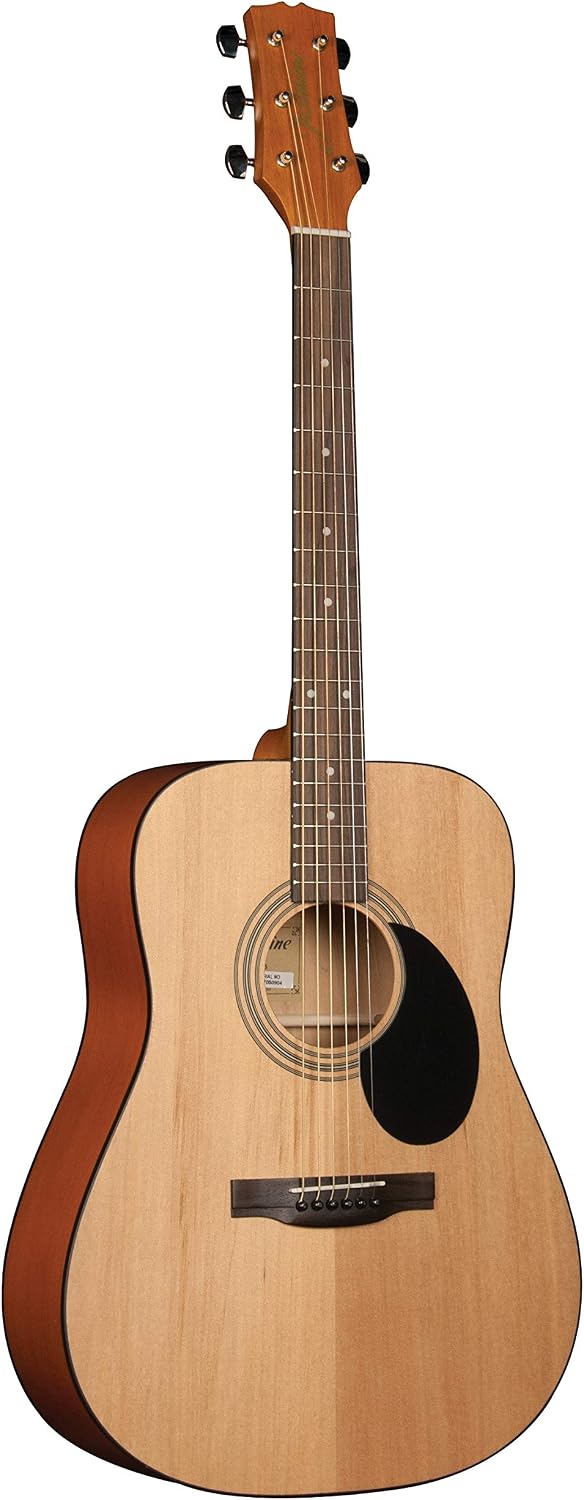
A Jasmine S35 owner who responded publicly to a wave of negative reviews made the diagnosis plain: a loose truss rod (the metal rod inside the guitar’s neck that controls its curvature) and a high saddle (the white piece at the base of the strings on an acoustic) account for nearly every complaint. Neither is a defect. Both are adjustments.
By the numbers:
- String action (the gap between strings and frets) on a properly set-up acoustic typically runs 3/32” on the bass side and 2/32” on the treble side at the 12th fret
- Most entry-level guitars ship 20–40% higher than that
- A professional setup typically corrects this in under two hours
The Four Adjustments That Matter Most
1. String Action and the Truss Rod
Action refers to how high the strings sit above the frets. High action makes fretting notes harder — your fingers have to press further, your hand fatigues faster, and barre chords (where you hold multiple strings down with one finger) become genuinely painful. Low action creates fret buzz, where strings vibrate against frets they shouldn’t touch.
The truss rod is the first place to look. If your guitar’s neck has an upward bow (strings farther from the frets in the middle of the neck than at either end), a small clockwise turn of the truss rod nut — usually accessible at the headstock, under a small cover — tightens the rod and flattens the neck. Quarter-turns, then wait 15 minutes. This is a legitimate DIY adjustment, and Sweetwater’s guitar setup guide explicitly walks players through the process.
If you’re not confident here, stop. Over-tightening a truss rod can crack a neck. If there’s any doubt, this is the job to hand to a tech.
2. Pickup Height
This one is consistently underreported in beginner content, which is frustrating because it’s genuinely easy and the payoff is audible within seconds. A pickup is the magnetic sensing unit under the strings on an electric guitar — it converts string vibration into electrical signal. The closer it sits to the strings, the hotter (louder, more compressed) the signal. Too far, and the tone gets thin and weak. Too close, and you get a muddy, slightly out-of-tune sound caused by the pickup’s magnetic field actually pulling on the strings.
Reviewers of the Fender Frontman 10G practice amp — which pairs well with entry Squiers — repeatedly cite pickup height adjustment as the unlock for the amp’s clean tone. The amp wasn’t the problem. The pickups were too close to the strings, adding compression and muddiness before the signal even reached the amp.
How to adjust: Most pickups sit on small springs under two Phillips-head screws at each end. Clockwise raises the pickup, counter-clockwise lowers it. Guitar World’s pickup height guide recommends a starting point of roughly 3/32” gap (bass side) and 2/32” (treble side) between the bottom of the string and the top of the pickup pole piece when the string is fretted at the last fret. From there, play. Trust your ears more than the ruler.
This adjustment does not void any standard manufacturer warranty and carries zero risk of damage when done carefully.
3. Intonation
Intonation is the guitar’s ability to play in tune with itself across the entire fretboard. A guitar with poor intonation sounds fine on open strings but drifts sharp or flat as you play higher up the neck. If you’ve ever wondered why your guitar sounds “right” but somehow wrong — this is usually the culprit.
The fix lives at the saddle (on acoustics) or the individual string saddles on the bridge (on electrics). Per Premier Guitar’s Intonation 101 guide, the process is simple to check: play an open string, then play the same string fretted at the 12th fret (which should produce exactly the same note, one octave higher). If the fretted note is sharp, the string length needs to lengthen (saddle moves back). If it’s flat, it needs to shorten (saddle moves forward).
One owner who purchased a Donner 30-inch children’s guitar adjusted intonation on every individual string and reported that the instrument played genuinely well afterward. That’s not a miracle — it’s just the math of string physics working correctly. Even sub-$100 instruments respond to this care.
4. Nut Slot Height
The nut is the small slotted piece at the top of the fretboard, near the tuning pegs. If its slots are cut too shallow, your open strings sit too high, making the first few frets hard to play. If slots are cut too deep, open strings buzz. Nut work is the one adjustment on this list where beginner DIY starts to carry real risk — files are unforgiving. If your guitar plays fine above the 3rd fret but feels stiff in the first two positions, the nut is the likely culprit, and this is a fair reason to visit a tech even if you’re handling everything else yourself.
The Tuner Pedal Question: Is It Worth It When You Have a Phone?
Phone tuner apps are good. Built-in guitar tuners on acoustic-electrics like the Fender CD-60SCE are adequate. So why does the Boss TU-3 chromatic tuner pedal show up in enthusiastic reviews from a church musician and an Americana multi-instrumentalist who both independently describe the same unexpected benefit?
Silent muting.
When you stomp the TU-3 into tuning mode, it mutes your signal to the amp completely. You can tune in silence in the middle of a set, swap between instruments during a live performance without sending a burst of noise through the PA, and stay in constant readiness without fumbling for a phone or peering at a clip-on tuner in stage lighting. MusicRadar’s 2025 tuner pedal roundup notes the TU-3’s display visibility as a particular strength in high-light environments where phone screens wash out.
Buy the Boss TU-3 if: You’re playing live with any regularity — church gigs, open mics, local shows — or building a pedalboard you intend to grow. The muting function alone earns its place on a board. The tuning accuracy is excellent.
Skip it if: You’re playing exclusively at home into a practice amp and a phone app covers your needs. There’s no shame in that call — the money is better spent on a setup at that stage.
Frequently Asked Questions
How do I know if my new guitar needs a setup or if something is actually broken?
Setup issues feel like difficulty — high action, tuning drift, buzzing in certain positions. Broken issues feel like failure — a snapped truss rod, a cracked top, a dead pickup. If your guitar responds differently in different positions on the neck, it almost certainly needs setup, not repair. If something is physically damaged or the electronics are completely dead, that’s repair territory.
Can I adjust pickup height myself without voiding any warranty or damaging the guitar?
Yes. Pickup height adjustment is a standard player-level tweak that falls well within normal use. No major manufacturer’s warranty excludes it. Turn screws slowly, listen as you go, and stop if you hear any odd buzzing against the strings.
Why does my guitar sound in tune on open strings but out of tune when I fret notes higher up the neck?
This is intonation — the guitar’s string lengths aren’t calibrated correctly for the fretboard’s scale. It’s fixable at the saddles, as described above. Acoustic Guitar Magazine’s guide on this specific problem is a clear walkthrough if you want the full technical explanation.
Is the Boss TU-3 worth buying if my guitar already has a built-in tuner or I use a phone app?
For home use, probably not urgent. For live use — especially if you switch instruments mid-set — the silent muting function is genuinely useful in ways that built-in and phone tuners can’t replicate.
How much should a professional guitar setup cost, and is it worth it on a $150 guitar?
A standard setup typically runs $50–$80 at most independent shops in 2026. On a $150 guitar, that’s a real percentage of the instrument’s value. The honest answer: yes, it’s worth it if you’re going to play the guitar seriously. A well-set-up $150 guitar will outplay a poorly set-up $400 guitar every time. Many players find that after one professional setup, they understand what to maintain going forward — and they do it themselves.
Does the Donner or Squier Debut arrive needing a setup, or are they ready to play out of the box?
Across aggregated owner feedback, the answer is: plan for it, and be pleasantly surprised if you don’t need it. Both brands have improved factory setup consistency, and some units arrive playing well. But Donner’s own customer service has stated in writing that shipping can undo setup — which means the honest expectation is that a basic action check and pickup height tweak are worth doing on arrival, regardless of brand.
The bottom line is this: budget guitars aren’t bad guitars. They’re instruments that require a little more attention at the starting line. Owners who bring that attention — or pay a tech to bring it — consistently end up happy. If you’re weighing a first setup appointment versus frustration-driven returns, the math almost always favors the setup. Get it right once, learn what “right” feels and sounds like, and you’ll hear the difference every time you plug in.