If you’ve ever plugged a guitar straight into an amp and wondered why your sound feels a little flat compared to recordings you love, the answer is almost always effects pedals — small boxes that sit between your guitar and amp and shape your tone in specific ways. Three effects show up on virtually every professional pedalboard in the world: overdrive (a controlled, warm distortion that adds grit and sustain), delay (an echo effect that repeats your notes one or more times), and reverb (a sense of space, like playing in a room or a cathedral). Together, these three cover probably 80% of the tonal moves you’ll ever need — from clean, shimmering chords to searing blues leads to atmospheric indie rock. This guide walks through the best options at budget, mid-range, and step-up price points, and answers the practical questions that come up the moment you’re actually standing in front of a checkout page.
Why These Three Pedals First (And Not Something Else)
New players often get drawn toward multi-effects units — big boards with dozens of sounds crammed into one box. That’s a reasonable move for pure exploration, but there’s a strong case for starting with three dedicated pedals instead.
Single-purpose pedals teach you one thing at a time. When you tweak a knob on an overdrive pedal and hear exactly what changes, you build intuition quickly. Multi-effects units can obscure that learning curve behind menus.
They hold their value. A Boss SD-1 bought in 2026 will still be worth close to what you paid for it in 2030. Gear World’s resale tracking, cited in Guitar World’s buyer’s guide coverage, consistently shows Boss compact pedals retaining 70–80% of street value on the used market.
They stack with anything. When you eventually upgrade your amp or add a fourth pedal, these three will integrate without drama.
The specific three — overdrive, delay, reverb — form a complete “texture stack.” Overdrive shapes your core tone. Delay adds rhythmic depth. Reverb puts the whole picture in a convincing acoustic space. In that order, you’ve gone from a dry signal to something that sounds finished and intentional.
Overdrive: Boss SD-1 vs. Boss BD-2
This is the category where beginners face the most confusing choice, because overdrive pedals vary enormously in character even when they’re similarly priced.
Boss SD-1 Super Overdrive
The SD-1 has been in continuous production since 1981. That’s not a marketing point — it’s evidence that working musicians keep buying it. Reviewers at Guitar World and Premier Guitar consistently describe its character as bright, mid-forward, and crunchy: the kind of overdrive that cuts through a band mix immediately, which explains why it’s been a live-stage staple for classic rock and blues leads for four decades.
The asymmetric clipping circuit (a technical design choice that produces harmonics closer to a cranked tube amp) is covered in Boss’s own technical documentation and cited across Premier Guitar’s historical coverage of the pedal. What that means in plain terms: the SD-1 tends to sound more “amp-like” and harmonically rich than cheaper drives at the same price.
Buy this if: You play blues, classic rock, or anything where you want a lead tone that feels slightly aggressive and cuts through a mix. Slash, Gary Moore, and countless session guitarists have used SD-1s on major recordings.
Boss BD-2 Blues Driver
The BD-2 has a different personality entirely. Owners consistently report that it’s dynamically responsive — meaning it cleans up when you roll back your guitar’s volume knob and gets grittier when you dig in harder. One long-run reviewer on Sweetwater’s product page noted they “leave mine on all the time,” treating it less like a boost and more like a permanently-improved amp tone.
MusicRadar’s 2025 beginner delay/drive roundup flags the BD-2 as one of the best platforms for stacking — running two drive pedals together, with the BD-2 often placed after a lighter drive to add complexity. That’s a more advanced technique, but it’s worth knowing that the pedal grows with you.
Buy this if: You play indie, country, roots rock, or anything where touch dynamics matter — where you want the pedal to respond to how hard you’re picking, not just sit at one fixed level of grit.
The Quick Comparison
| SD-1 | BD-2 | |
|---|---|---|
| Character | Bright, mid-forward, crunchy | Warm, dynamic, touch-sensitive |
| Best for | Classic rock, blues leads, cutting mixes | Indie, country, always-on tone shaping |
| Stacking | Good as a standalone boost | Excellent stacking platform |
| Price tier | Budget-friendly | Slightly higher, still accessible |
Both are Boss compact pedals, meaning they share the same bombproof build quality and run on standard 9V power.
Delay: Donner Yellow Fall vs. the Next Step Up
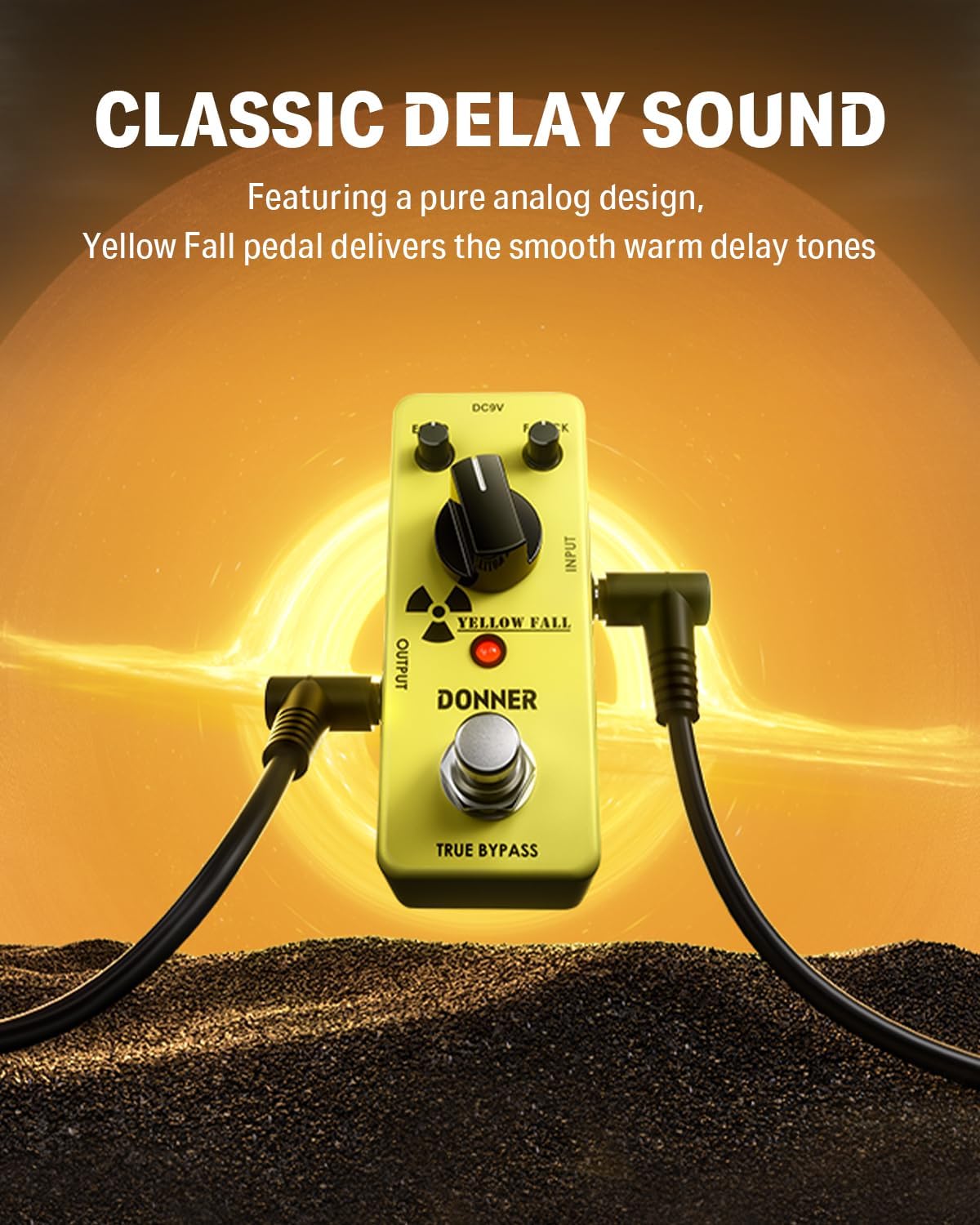
Donner Yellow Fall
Here’s something worth knowing before you dismiss this pedal based on price: multiple knowledgeable reviewers have identified the Yellow Fall as a rebadged version of a Mooer design (Mooer is a respected Chinese effects brand whose circuits are well-regarded in the boutique community). That lineage matters, because it means the Yellow Fall’s warm, natural-sounding repeats come from a circuit with serious design DNA, not from a cut-rate house design.
Owners consistently praise what they call the “organic” quality of the repeats — the way they decay naturally without sounding digital or sterile. For a beginner learning how delay interacts with rhythm guitar parts, that natural decay is actually ideal: it’s forgiving and musical, not clinical.
True bypass (meaning the pedal doesn’t color your tone when it’s switched off) is confirmed in the manufacturer’s spec documentation, which MusicRadar’s buyer’s guide flags as an important feature for players running multiple pedals in a chain.
Buy this if: You’re building your first board on a tight budget and want a delay that sounds genuinely good, not just adequate. For practice, home recording, and even low-stakes gigs, the Yellow Fall holds its own.
When to Step Up
If you find yourself reaching for more delay types — shimmer, modulated, reverse — or if you want tap tempo (a button that lets you set the delay speed by tapping in rhythm, rather than turning a knob), then you’re looking at mid-range analog and digital delay pedals in the $100–$180 range. That’s a natural second-board upgrade, not a first-board requirement.
Reverb: Boss RV-6
The Boss RV-6 is where reviewers get noticeably more enthusiastic. Sweetwater’s editorial overview describes it as one of the most versatile reverb pedals in the compact format, and across aggregated owner reviews, the language gets warmer than you typically see for utility effects. One owner quoted in Boss’s own community materials described it as “one of the best pedals I own, and maybe the best” — the kind of hyperbole that shows up when something exceeds expectations by a wide margin.
Eight reverb modes cover everything from Room (a small, natural-sounding space) to Hall (large, cathedral-style wash) to Shimmer (a pitch-shifted, ethereal effect popularized by ambient and worship music). The Modulate mode adds subtle chorus movement to the reverb tail, which works beautifully on clean chords.
One honest caveat: Reviewers consistently flag the Dynamic mode as genuinely confusing for newcomers. Dynamic reverb ducks in volume when you play and swells when you stop — an interesting studio effect, but not intuitive to use live. The practical advice from experienced players across Guitar World’s forum coverage is simple: ignore Dynamic mode for the first six months, use Room or Hall, and come back to it when you’re ready.
Buy this if: You want a reverb pedal that will still be on your board in five years, regardless of what else changes around it. The RV-6 is the kind of pedal that working musicians buy once and stop thinking about.
Signal Chain Order: Where Each Pedal Goes
This question comes up in almost every beginner conversation, and the answer matters more than most gear guides admit.
The standard order is: Guitar → Overdrive → Delay → Reverb → Amp
Here’s the logic in plain terms: overdrive should hit delay and reverb, not the other way around. If you put reverb before overdrive, the overdrive distorts your reverb tail, turning it into a wall of noise. If you put delay before overdrive, every repeat gets re-distorted, compounding the effect in ways that quickly become muddy.
Running overdrive first, then delay, then reverb means: you shape the core tone first, add rhythmic depth to that shaped tone, then place the whole picture in a room. Each step works on a clean version of the previous step’s output.
This isn’t a rigid rule — some players deliberately reverse the order for experimental sounds — but for a beginner board, this sequence solves more problems than it creates.
Power: Can One Supply Run All Three?
Yes, with one condition: use a regulated, isolated power supply (meaning each pedal gets its own power circuit, not a shared daisy chain). Boss compact pedals and the Donner Yellow Fall all run on standard 9V DC power. A regulated multi-output supply rated for at least 100mA per output will run all three quietly.
Why it matters: An unregulated daisy chain (a single power adapter with a splitter cable) can introduce audible hum, particularly when high-gain overdrive pedals are in the chain. Pedal-specific noise from power sharing is one of the most common frustrations for first-time pedalboard builders, and it’s entirely avoidable.
A quality regulated supply costs roughly $40–$80 and eliminates battery replacement across all three pedals simultaneously.
Frequently Asked Questions
Does the order of delay, overdrive, and reverb in the signal chain actually matter for a beginner? Yes — more than most beginners expect. The practical rule: overdrive first, delay second, reverb last. Running reverb into overdrive produces a noisy, unfocused tone. This order isn’t arbitrary; it follows how sound behaves in a natural acoustic environment.
Is the Donner Yellow Fall good enough to skip buying a more expensive delay? For the majority of beginner and intermediate use cases — practice, home recording, modest gigging — yes. The circuit lineage (widely identified by reviewers as a rebadged Mooer design) produces warm, musical repeats that punch well above the price point. If you need tap tempo or multiple delay types, plan an upgrade. If you don’t, the Yellow Fall is genuinely capable.
What is the difference between the Boss SD-1 and BD-2 and which should a beginner buy? The SD-1 is brighter and more forward in the mids — ideal for leads that need to cut. The BD-2 is warmer and more touch-sensitive — ideal for players who want the pedal to respond to how they pick. If you play blues rock or classic rock, SD-1. If you play indie, country, or want an always-on tone enhancer, BD-2. Both are excellent; the choice is about character, not quality.
Can I power all three pedals from one supply without noise issues? Yes, with an isolated regulated supply. Avoid daisy-chain splitters with gain pedals in the chain. A quality isolated supply running 9V at 100mA per output handles all three cleanly.
Is the Boss RV-6 worth the extra money over a cheaper reverb pedal? Based on aggregated owner reviews and coverage in Sweetwater’s editorial overview, the RV-6 consistently delivers results that surprise players expecting budget-pedal performance. The eight-mode range and quality of the Room and Hall algorithms justify the price for anyone who plans to keep the pedal long-term. Budget reverbs work — but owners of the RV-6 consistently report they stopped looking for alternatives after buying it.