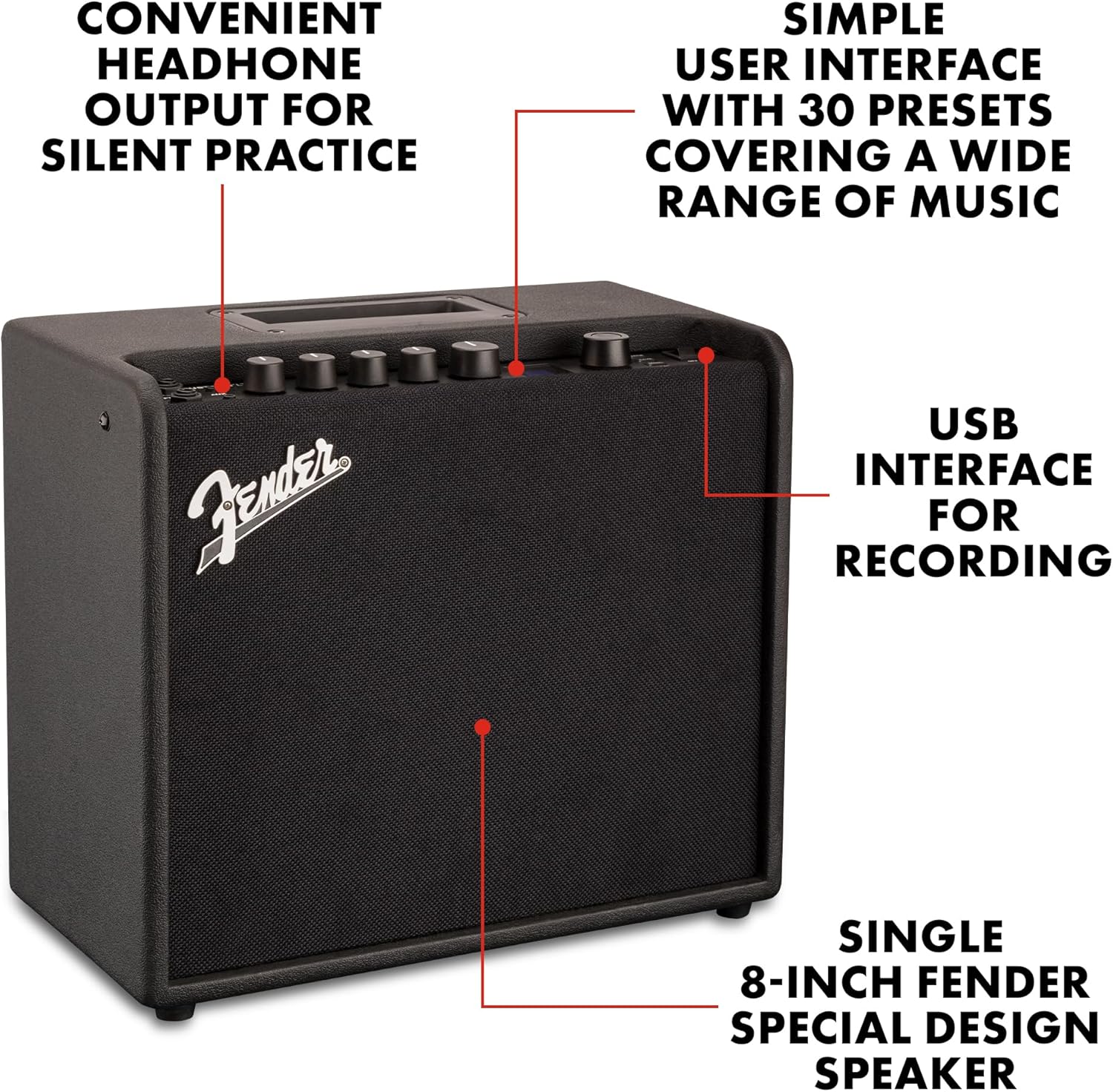
If you’ve ever plugged into a Fender Mustang LT25 — a modeling amp, meaning it uses digital processing to simulate dozens of different amp sounds in one small box — and thought, “wait, this thing is actually good,” you’re not alone. A lot of players buy the LT25 expecting a stopgap and end up keeping it for months longer than planned. The presets (factory-loaded sounds you can dial up instantly) are surprisingly usable, the app connectivity is genuinely fun, and for bedroom practice — playing at home at reasonable volume — it holds its own against amps that cost twice as much. But eventually the ceiling appears. Maybe you’ve joined a band. Maybe you want to record. Maybe you just keep wishing it were a little louder, or a little more yours. This guide is for that moment: when you’ve outgrown beginner mode and you need a clear-eyed look at what the next step actually buys you.
We’ll walk through the LT25’s honest strengths and limits, explain the case for the Fender Mustang LT50, and show you where the Boss Katana-50 Gen 3 fits as a credible alternative — especially if your priorities are tone depth over preset count. The goal is a concrete decision framework, not a spec-sheet recitation.
| EDITOR'S PICKBOSS Katana-50 Gen 3 Guitar Amp… | Mid-tierFender Mustang LT25 Guitar Ampl… | Budget pickFender Frontman 10G Electric Gu… | |
|---|---|---|---|
| Power | 50W | 25W | 10W |
| Speaker | 12" | 8" | 6" |
| Modeling presets | — | 30 | — |
| Onboard effects | ✓ | — | — |
| Amp characters | 12 | — | — |
| Overdrive | — | — | ✓ |
| Price | $343.37 | $179.99 | $89.99 |
| See on Amazon → | See on Amazon → | See on Amazon → |
What the Mustang LT25 Actually Gets Right (and Where It Hits a Wall)
Owners across aggregated reviews at Sweetwater consistently describe the LT25 as a genuine revelation — not because it’s the best amp ever made, but because it exposes how much of a beginner rig’s weakness lives in the cheapest link in the chain. Reviewers frequently surface a specific realization: the cheap pedal was the problem, not the guitar. Running a mid-range guitar straight into the LT25’s modeled overdrive sounds cleaner and more musical than the same guitar through a $30 distortion stomp box into a budget solid-state amp. That’s a legitimate win.
The ceiling shows up in three places:
Volume headroom. The LT25 is rated at 25 watts, but that figure doesn’t tell the whole story — real-world output from a single 8-inch speaker starts compressing and losing clarity before you get to conversation-drowning volume. For pure bedroom use, it’s fine. For outdoor practice, a garage jam, or any situation where a drummer is present, reviewers consistently report it running out of usable volume.
Speaker size. The single 8-inch speaker (the cone inside the cabinet that moves air and makes sound) caps how much low-end texture and spatial dimension you can extract from the amp’s modeled tones. You can hear the simulation; you just can’t feel it the same way a 12-inch speaker presents it.
Editing depth. The preset system is easy but shallow. Guitar World’s roundup of best practice amps notes the LT25 targets new players who want sounds without deep customization — which is exactly right for its audience, but limits experienced players who want to sculpt their signal.
The LT50 Upgrade: Louder, Yes — But Is That All?
The natural next rung on the Fender Mustang ladder is the LT50: same amp family, double the wattage, and a 12-inch speaker instead of an 8-inch. At least one reviewer at Sweetwater describes it as a deliberate “level up” purchase — someone who owned the LT25, liked the platform, and wanted more of it without starting over with a new ecosystem.
Here’s the honest tradeoff breakdown:
By the numbers — LT25 vs. LT50:
| Mustang LT25 | Mustang LT50 | |
|---|---|---|
| Power | 25W | 50W |
| Speaker | 8-inch | 12-inch |
| Presets | 30 | 100+ |
| App-controlled EQ | Yes | Yes |
| Headphone/USB out | Yes | Yes |
The 12-inch speaker is a meaningful upgrade in feel — it moves more air, delivers more tactile low-end response, and gives modeled amp tones more room to breathe. Players who play through both consistently report the LT50 sounds different, not just louder. The larger cab and speaker change the character of the same presets in noticeable ways.
The warning reviewers flag is worth repeating: the LT50 gets loud fast. If your primary use case is late-night bedroom practice, it can feel like overkill — the sweet spot on the volume knob sits at positions that are harder to control quietly. That reviewer note about “not recommended purely for quiet practice” is accurate. If you’re splitting time between home practice and a rehearsal space or small stage, the LT50 earns its cost. If your rig lives entirely in a bedroom, the volume headroom you’re paying for may go unused.
Buy the LT50 if: You’ve joined a band, you’re rehearsing with other players at least occasionally, or you want the same Fender ecosystem with meaningful sonic improvement. Don’t buy it if the only thing you’re solving for is slightly better bedroom tone.
The Katana-50 Gen 3: When You Want One Great Tone, Not Fifty Good Ones
The Boss Katana-50 Gen 3 is the other amp in almost every serious conversation about upgrading from the LT25, and it’s worth understanding why they appeal to different players rather than treating them as head-to-head competitors.
Boss built the Katana around what they call “tube logic” — analog circuit designs that mimic how a real tube amp (a traditional amplifier that uses vacuum tubes, which are electronic components that create a warm, responsive distortion many players prefer) responds when you push it hard. MusicRadar’s review of the Katana-50 MkII describes the resulting feel as unusually authentic for a solid-state digital amp — the amp reacts to your picking dynamics in a way that purely digital modeling sometimes doesn’t. Several reviewers describe it as “the right choice for players who want one great tone rather than fifty presets.”
That’s the trade in plain language: the Mustang ecosystem rewards preset-browsers and players who love variety. The Katana rewards players who’ve found a sound they love and want to chase it deep. The Katana’s Tone Studio app lets you download community-created patches (custom sound settings shared online), which adds versatility, but the base amp character — clean, crunch, lead, brown — is where the Katana shines most naturally.
Buy the Katana-50 Gen 3 if: You’ve started to identify “your sound” — a genre, a handful of classic tones, a particular amp character — and you want to dial that in deeply rather than cycle through 100 different amp models. Classic rock, blues, and vintage-style players consistently gravitate here. The Katana also takes well to external pedals, which matters if you’re building a pedalboard.
Stick with the Mustang family if: You’re still tone-exploring, you play across multiple genres in the same session, or you love the idea of preset-based quick recall (different sounds for different songs without twiddling knobs between them).
What About the Cheap Alternatives?
Two products come up in this conversation often enough to address directly.
The Fender Frontman 10G is the amp many LT25 owners replaced, and reviewers’ relationship with it is nuanced. Clean tones on the 10G are consistently praised — for a $50 practice amp, the clean channel is genuinely decent. The built-in overdrive is where reviews fall apart; it’s consistently described as harsh and thin. One reviewer specifically flags that pickup height adjustment — physically raising or lowering the magnets under your guitar strings, which changes output and tone — can extend the 10G’s usefulness considerably before you need to replace it. That’s a real and underrated point. If you’re considering an upgrade from the 10G because your tone feels lifeless, try adjusting your pickups first. You might be surprised.
The Spark GO by Positive Grid comes up whenever outdoor or portable practice enters the conversation. Reviewers who want battery-powered silent practice or yard-session volume describe it as a different category entirely — more portable companion than traditional practice amp. It’s not a replacement for either the LT25 or the Katana; it’s an addition to a rig when portability is the specific need.
Frequently Asked Questions
Can the Mustang LT25 get loud enough for outdoor practice or just bedroom use? For outdoor practice, the LT25 hits its limits. The 25-watt, 8-inch speaker combination compresses and loses definition before reaching volumes that carry well outdoors or cut through ambient noise. It’s a bedroom amp — a very good one — but outdoor practice consistently pushes it past its comfort zone.
Does the LT50 sound noticeably better than the LT25 or just louder? Both, and the “better” part is real. The 12-inch speaker changes how the modeled tones feel and sit in the room — there’s more low-end texture and the sound has more physical presence. Owners who’ve played both describe the difference as more than volume.
Do you still need pedals with a modeling amp like the Mustang or Katana? Not necessarily, and that’s part of the appeal. Both amps model effects (reverb, delay, chorus, distortion) built-in. If you’re coming from a guitar-into-pedal-into-amp setup, the modeling amp can replace most of your pedal chain on day one. As you advance, you might add a few favorites — a tuner pedal, a boost — but the out-of-box effects library covers most players’ needs.
How does the Frontman 10G compare to the Mustang once you add a multi-effects pedal? A multi-effects unit (a pedal that contains many effects in one box) into the Frontman 10G’s clean channel is a genuinely competitive setup for bedroom practice. The 10G’s clean signal path is good enough to let a quality multi-effects pedal shine. The Mustang wins on convenience and preset recall, but the 10G-plus-multi-effects combination costs similar money and is more flexible in some ways.
Is the Katana better for classic tones while the Mustang is better for variety? That’s a fair characterization. Katana reviews from MusicRadar and Guitar World both point to its organic amp-character as the selling point — it earns strong marks for blues, classic rock, and vintage-inspired tones. Mustang’s strength is preset breadth and genre-spanning coverage. Both are capable, but the feel of their strengths points in different directions.
Can the Mustang LT25 or LT50 be used as a USB audio interface for recording? Yes. Both models include USB audio output, meaning you can plug directly into a computer and record the amp’s modeled tones into recording software (like GarageBand, Reaper, or Logic) without a separate audio interface. For home recording on a budget, this is a meaningful feature — you get the amp and a basic recording solution in one.
The Decision Rule
Here’s the clean version: if the LT25 is your ceiling and you play with other people, step up to the LT50. If you’ve started caring more about how your amp responds than how many sounds it can make, look seriously at the Katana-50 Gen 3. If you’re still in the bedroom-only phase and your tone feels flat, adjust your pickup height and try a multi-effects unit before spending anything. The gear you have almost always has more in it than you’ve found yet — but when you genuinely need more, both paths above will reward the investment.