If you’re standing at the starting line of acoustic guitar shopping and someone hands you a list of model numbers — CD-60S, CD-60SCE, Redondo Debut — it’s easy to feel like you’re reading a parts catalog. So let’s slow down for a second. An acoustic guitar is simply a guitar that produces sound through its hollow wooden body, no electricity required (unless you want it). The letters and numbers in these model names are just Fender’s shorthand for different shapes, materials, and features. This article is your decoder ring. We’re going to sit with all three guitars side by side, look at what reviewers and players consistently report, show you the math on what you’re actually paying for, and hand you a clear decision rule at the end. Whether you’re buying your first guitar or picking up a dedicated practice-room instrument, you’ll leave knowing exactly which one to add to your cart.
Here’s where it gets more interesting than a typical “Guitar A vs. Guitar B” rundown. These three instruments overlap in price but diverge sharply in purpose. The differences in body shape, top wood (the face of the guitar — the piece of wood most responsible for how it sounds), and electronics tell you something real about who each guitar is built for. Let’s get into it.
| EDITOR'S PICK[Fender CD-60SCE Solid Top Dread…](https://www.amazon.com/dp/B01667J2QS?tag=greenflower20-20) | Mid-tier[Fender Acoustic Guitar](https://www.amazon.com/dp/B07FYBLG93?tag=greenflower20-20) | Budget pick[Fender California Debut Redondo…](https://www.amazon.com/dp/B0GZ5HL277?tag=greenflower20-20) | |
|---|---|---|---|
| Body wood | All Mahogany | All-Mahogany | — |
| Electronics | ✓ | ✗ | — |
| Case included | Hard case | No | — |
| Finish | — | Glossed | — |
| Bundle extras | ✓ | ✗ | — |
| Warranty | — | 2-Year | 2-Year |
| Price | $399.99 | $229.99 | $139.99 |
| See on Amazon → | See on Amazon → | See on Amazon → |
The Three Guitars at a Glance
Before diving deep, here’s the quick snapshot:
By the numbers (2026 street prices):
- Fender CD-60S (all-mahogany): ~$199 body-only, ~$299 with hard case bundle
- Fender CD-60SCE (all-mahogany with electronics): ~$329–$349
- Fender Redondo Debut: ~$169–$179
All three are manufactured to Fender’s entry-level spec, but that phrase undersells them. MusicRadar’s best beginner acoustic guitars roundup has repeatedly flagged the CD-60S as punching above its weight class, and Sweetwater’s editorial notes on the Redondo Debut describe it as delivering playability that surprises players who’ve handled guitars at twice the price.
CD-60S: The All-Mahogany Workhorse
Who It’s For and What It Sounds Like
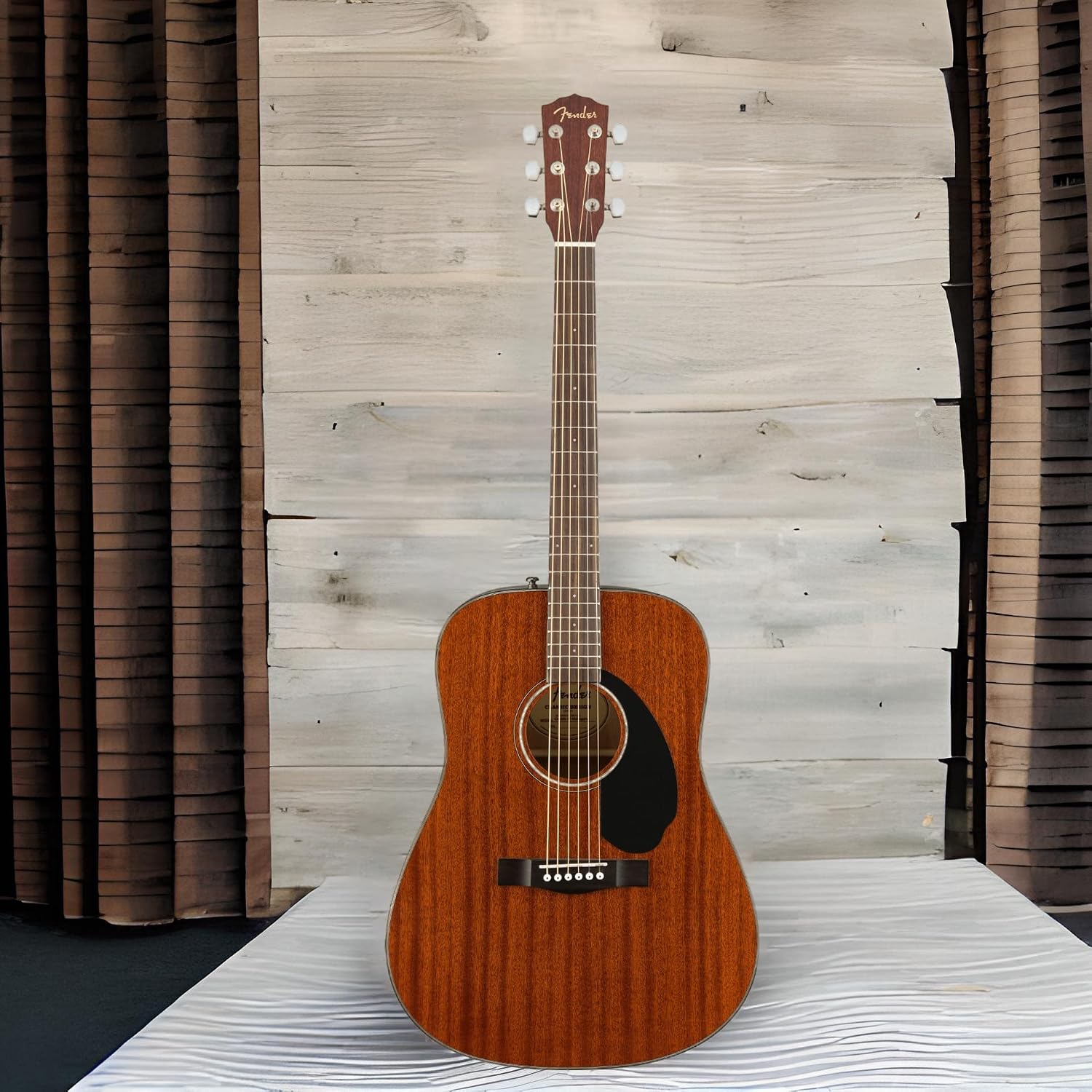
The CD-60S is a dreadnought — that’s the big, broad-shouldered body shape you’ve seen in every country and folk photo from the last sixty years. It produces a lot of volume and a lot of low-mid warmth. What makes this particular dreadnought unusual at its price is the all-mahogany construction: both the top (the face) and the back and sides are solid mahogany rather than spruce (a brighter, more common top wood) or laminate (thin layers of wood pressed together, cheaper but less resonant over time).
Acoustic Guitar magazine’s editorial overview of entry-level all-mahogany construction notes that mahogany-topped guitars tend to emphasize midrange frequencies over the sparkly high-end shimmer of spruce, which makes them especially flattering for fingerpicking styles and singer-songwriter strumming where you want the guitar to sit underneath the vocal rather than compete with it. The tradeoff is that all-mahogany instruments can read as slightly dark in a full-band context — worth weighing if you plan to jam with other instruments frequently.
Setup and Out-of-Box Quality
Players and reviewers consistently report something that surprises first-time buyers: the factory setup on the CD-60S is unusually good for this price tier. “Setup” refers to the physical adjustments a technician makes so the strings sit at the right height above the fretboard, making the guitar easier and more comfortable to play. Multiple review sources, including Sweetwater’s editorial notes for this model, point to minimal adjustment needed out of the box as a telling sign of quality-control care. Guitar World’s beginner acoustic buyer’s guide similarly positions the CD-60S as a guitar that typically plays acceptably without a visit to a shop — a genuine advantage for a beginner who doesn’t yet know what a setup entails.
Verdict
Buy the CD-60S if: You want an all-acoustic guitar that you’ll play unplugged, you lean toward fingerpicking or folk and country strumming, and you want the best possible tone-per-dollar without electronics in the signal chain. The bundle with the hard case is a legitimately strong value — hard cases (rigid protective shells, as opposed to soft gig bags) typically retail at $60–$100 purchased separately, so the bundle math works decisively in your favor.
Fender
$139.99
In stock on Amazon
Check price on AmazonCD-60SCE: Same Soul, Added Plug-In
The Upgrade Path Built In
The CD-60SCE (the “E” stands for Electronics, the “C” for Cutaway — that curved notch at the body’s upper horn that lets your fretting hand reach the higher frets) is built on the same all-mahogany platform as the CD-60S with two additions: that cutaway and a built-in pickup and preamp system. The pickup is a Fishman preamp — Fishman is the dominant name in acoustic guitar electronics at this price range — which means you can plug into an acoustic amplifier or a PA system (the main speaker system at a venue or studio) without a separate clip-on microphone.
The tonal character is nearly identical to the CD-60S, which is the point. You’re not paying for a different-sounding guitar; you’re paying for a guitar that can do double duty in a live setting. Guitar World’s beginner acoustic buyer’s guide consistently positions the CD-60SCE as the natural step up for players who know they’ll eventually perform at open mics or small gigs.
The Honest Tradeoffs
The cutaway body slightly reduces internal air volume, which can make the unplugged volume and low-end presence marginally softer compared to the full-body CD-60S. Most players don’t notice this until they A/B them directly, but it’s worth knowing. The more practical caveat — flagged in long-run player reports aggregated by both Sweetwater editorial notes and MusicRadar’s beginner acoustic roundup — is that the CD-60SCE more frequently arrives needing setup work than the CD-60S does. Specifically, saddle height (the small bone or plastic piece the strings rest on at the base of the guitar) and occasionally intonation (whether the guitar plays in tune all the way up the neck) are the common adjustment points. That’s not a dealbreaker, but factor in $40–$60 for a professional setup at your local shop if you’re not comfortable making those adjustments yourself.
Verdict
Buy the CD-60SCE if: You already know you’re going to plug in — open mics, small gigs, recording into an audio interface at home. The built-in Fishman pickup system saves you from purchasing a separate clip-on pickup later, and the cutaway earns its keep if you play leads or melodies above the 12th fret. If you’re purely playing unplugged in your living room, the extra cost is harder to justify.
Fender
$229.99
In stock on Amazon
Check price on AmazonRedondo Debut: The Comfort-First Outlier
A Different Philosophy
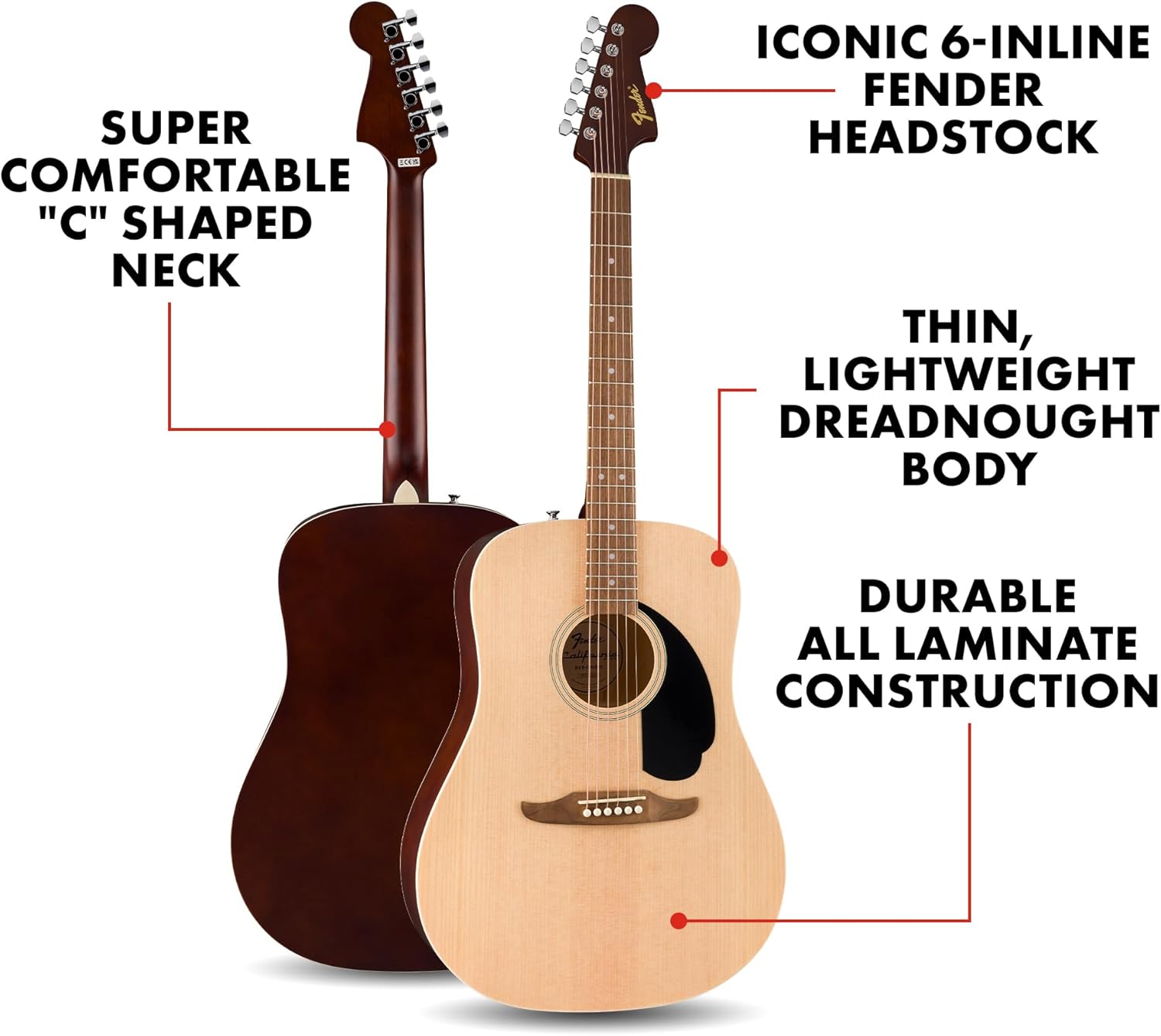
The Redondo Debut is a different animal. Where the CD-60S and CD-60SCE are traditional dreadnought shapes built for big acoustic volume, the Redondo is a California-series body — shallower depth, slightly smaller waist, and crucially, a neck profile (the shape of the back of the neck that your thumb wraps around) borrowed from Fender’s electric guitar DNA. It’s noticeably slimmer and more C-shaped than the CD-60S neck, which carries a rounder, more traditionally acoustic profile.
This matters enormously for a specific type of player: anyone coming to acoustic guitar from electric, or anyone who finds traditional acoustic necks thick and tiring to play. Sweetwater’s editorial notes for the Redondo Debut describe its action (the gap between the strings and the fretboard — lower action means easier pressing) as notably low for a guitar at this price, which directly translates to less finger soreness for beginners logging their first hours of practice.
Top Wood and Tonal Character
The top is a spruce laminate rather than solid mahogany, which gives it a slightly brighter initial tone. Acoustic Guitar magazine’s construction overview distinguishes between solid tops (one piece of wood that opens up tonally as it ages) and laminate tops (dimensionally stable and consistent, but without the same long-term tonal development). For a beginner, the difference is subtle — most players don’t hear it on Day 1. What they do hear is that the Redondo Debut, at roughly $170, consistently gets described in both Sweetwater editorial coverage and MusicRadar’s roundup as performing at a playability level well above its asking price.
How It Compares to the Yamaha FG800
The Yamaha FG800 comparison comes up constantly in this price window, and it’s worth addressing directly. The FG800 offers a solid spruce top that will improve sonically with age and presents a more conventional acoustic neck profile. MusicRadar’s best beginner acoustic guitars roundup positions the FG800 as the stronger choice if long-term tonal development from a solid top and a traditional acoustic feel are your priorities. The Redondo Debut wins on immediate playability and comfort, particularly for players with electric guitar backgrounds. They’re genuinely different tools serving different needs — neither is the wrong answer.
Verdict
Buy the Redondo Debut if: You’re coming from electric guitar, or you’ve tried acoustic guitars and found them uncomfortable to play. It’s also the right move if budget is your hard ceiling — at $170, the value-per-playable-hour is exceptional.
Fender
$139.99
In stock on Amazon
Check price on AmazonSide-by-Side Summary
| Feature | CD-60S | CD-60SCE | Redondo Debut |
|---|---|---|---|
| Body Shape | Dreadnought | Dreadnought + Cutaway | California / Redondo |
| Top Wood | Solid Mahogany | Solid Mahogany | Spruce Laminate |
| Electronics | None | Fishman Preamp | None |
| Street Price (2026) | ~$199 / $299 bundle | ~$329–$349 | ~$169–$179 |
| Best For | Unplugged tone, folk, fingerpicking | Live performance, gigging, recording direct | Comfort, electric crossover players |
| Setup Out of Box | Typically excellent | Variable; may need adjustment | Generally low and playable |
Fender
$139.99
In stock on Amazon
Check price on AmazonFrequently Asked Questions
What is the difference between the CD-60S and the CD-60SCE, and is the pickup worth the extra cost? The CD-60S is acoustic-only; the CD-60SCE adds a Fishman pickup and preamp plus a cutaway for upper-fret access. The pickup is worth the roughly $130–$150 premium if you plan to perform live or record direct. If you’re a home player who never plugs in, save the money and buy the CD-60S — possibly with the hard case bundle.
Does the all-mahogany construction sound noticeably different from spruce-top guitars? Yes, though “noticeably” depends on context. Mahogany tops produce a warmer, more midrange-forward tone compared to the brighter, more articulate ring of spruce. Acoustic Guitar magazine’s editorial coverage of entry-level construction describes the mahogany sound as one that sits well under vocals in a mix. Side-by-side, most experienced players notice the difference; beginners in isolation may not register it immediately.
Is the hard case in the bundle actually good quality or is it flimsy? Sweetwater’s editorial notes on the CD-60S bundle describe the hard case as a genuine value-add rather than a marketing afterthought. The case is a traditional hardshell style — rigid exterior, plush interior cradle — and is reported to protect the guitar adequately for travel and storage. It’s not a premium boutique case, but at $299 for guitar-plus-case, the math is compelling given that comparable standalone cases retail at $60–$100.
How does the Fender Redondo Debut compare to the Yamaha FG800 at the same price? The FG800 has a solid spruce top that will improve sonically with age and offers a more conventional acoustic neck profile. MusicRadar’s best beginner acoustic guitars roundup positions the FG800 as the better choice if long-term tonal development and acoustic tradition matter to you. The Redondo Debut wins on immediate playability and comfort, especially for players with electric guitar backgrounds. Buy the FG800 if you want a conventional acoustic that grows with you; buy the Redondo Debut if you want the most comfortable beginner experience on Day 1.
Do these guitars need a professional setup when they arrive, or are they ready to play? The CD-60S has a strong reputation for arriving well set up for the price, per both Sweetwater editorial notes and MusicRadar’s roundup commentary. The CD-60SCE is more variable and more frequently benefits from professional saddle-height and intonation work. The Redondo Debut generally ships with low, playable action. For any guitar under $300, budgeting an optional $40–$60 professional setup is smart planning, not a knock on the instrument.
Fender’s beginner acoustic lineup is narrower than it looks at first glance. The CD-60S is the tonal core — all-mahogany warmth, solid build, and surprisingly good out-of-box playability. The CD-60SCE is the same guitar with a performing musician’s upgrade path baked in. The Redondo Debut is the comfort-first outlier that earns its place by making new players actually want to pick it up every day. Match the guitar to your real use case, not just the price tag, and you won’t go wrong with any of the three.