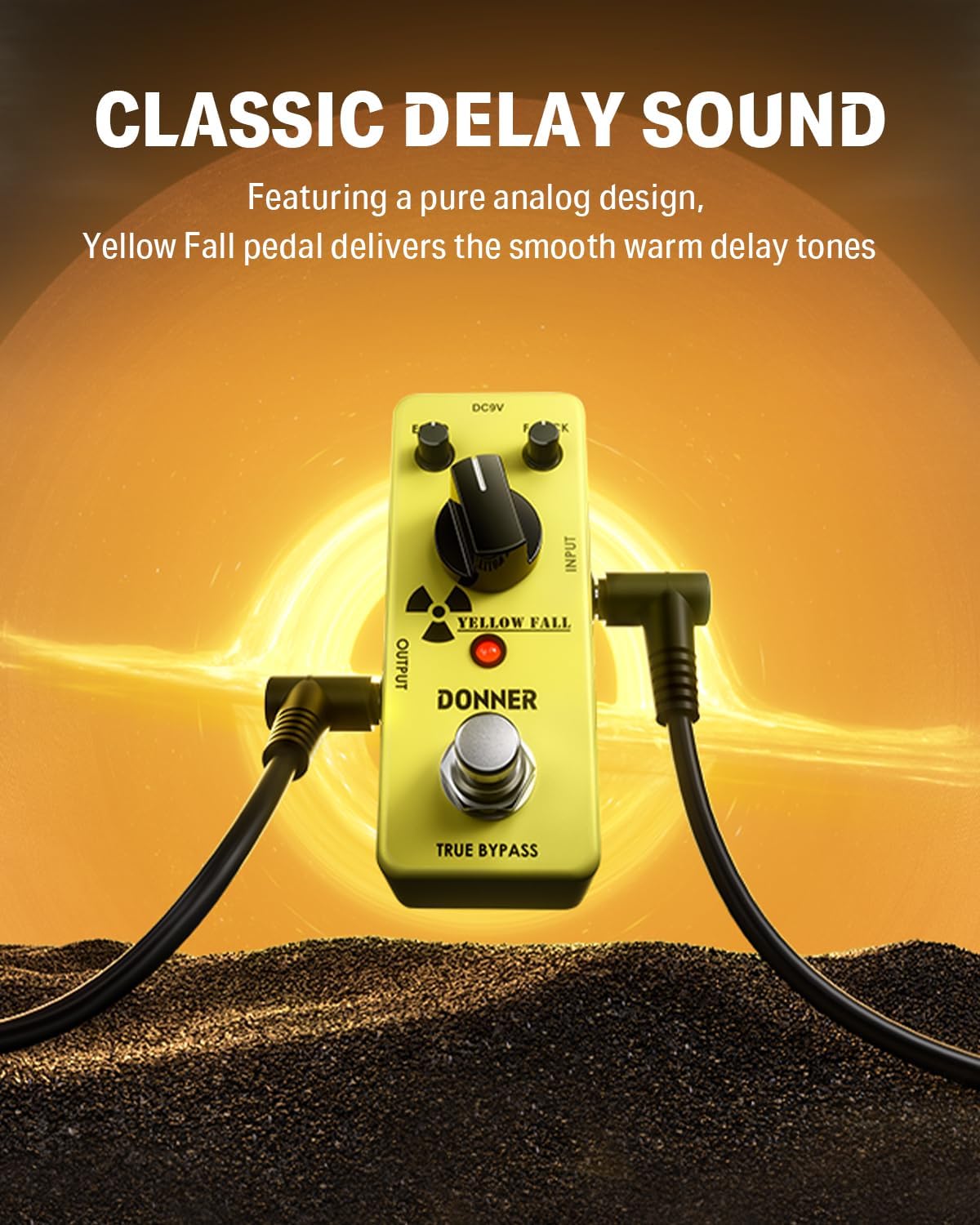
A delay pedal is exactly what it sounds like: it listens to your guitar signal, then plays it back a fraction of a second later — sometimes just once, sometimes over and over in a series of echoing repeats. It’s one of the oldest and most beloved effects in guitar history, responsible for everything from the slap-back twang on classic rockabilly records to the cascading walls of sound in post-rock. If you’ve ever heard the iconic echo on Elvis Presley’s early Sun Studio recordings, or the shimmering repeats on a U2 track, you’ve heard delay at work. The question today is a very specific one: does a pedal that costs less than a tank of gas — the Donner Yellow Fall — actually deliver a usable version of that effect? Based on aggregated owner reviews and published analysis from sources including Guitar World and Premier Guitar, the answer is more interesting than a simple yes or no.
What “Analog” Actually Means — And Why It Matters at This Price Point
When we say a delay pedal is analog, we mean it processes your guitar signal using physical electronic components — specifically a type of chip called a bucket-brigade device, or BBD — rather than converting it to digital data and math. The result has a character that many players describe as warmer, slightly darker, and more organic than digital alternatives. Digital delay can be cleaner and more precise; analog delay tends to degrade the repeats gently as they fade, which mimics the natural way an echo sounds in the real world.
The Donner Yellow Fall uses a genuine BBD circuit, and that’s not a marketing claim. Sweetwater’s infobase article on analog delay confirms that true bucket-brigade circuits produce the warm, slightly degraded repeat tail that players associate with classic analog delay tones. The Yellow Fall isn’t faking it. For under $50, that matters — and it’s the starting point for everything this pedal does well and everything it doesn’t.
The three controls are simple and honest: Time (how long the gap is between your original note and the first repeat), Repeats (how many times the echo bounces back before fading), and Mix (how loud the delayed signal is relative to your dry, unaffected guitar tone). No tap tempo. No modulation. No preset slots. You get one job done on this pedal, and it does it with zero pretense.
What the Yellow Fall Sounds Like in Practice
Across aggregated owner reviews and editorial impressions, a consistent picture emerges. One veteran reviewer with six decades of playing experience — cited in multiple buyer review threads — flatly calls it Donner’s best pedal and says “buy it” without qualification. That’s not faint praise from someone who has likely played through Roland Space Echoes and Memory Man units. It says something real about the Yellow Fall’s tonal utility at its price tier.
Where it genuinely works:
- Slapback delay — Setting Time short (roughly 8 o’clock on the dial), Repeats low (one or two bounces), and Mix moderate gives you the classic rockabilly and early rock ‘n’ roll slap. It adds presence and dimension to a clean tone without cluttering the mix. This is arguably the pedal’s strongest suit.
- Classic rock single-repeat echo — Think David Gilmour’s restrained use of delay to fill space between phrases. The Yellow Fall handles this with warmth and without harshness.
- Practice and learning — A second reviewer category worth noting: players using the Yellow Fall specifically to understand how delay works before committing to a higher-cost unit. Premier Guitar’s beginner guide to delay pedals recommends starting simple for exactly this reason — learning to dial in Time to your tempo, understanding Repeats thresholds, and developing your ear is genuinely easier on a three-knob pedal than a menu-driven unit.
- Budget pedalboard foundation — Multiple owners cite it as a first pedal on a new board, noting (in the words of one buyer) that Donner offers “pretty great quality hardware for rock bottom prices.”
Where it hits a ceiling:
- Ambient and post-rock — If your reference point is Explosions in the Sky, Mogwai, or the long, swelling repeats of a Strymon Timeline set to shimmer, the Yellow Fall will disappoint you. Maximum delay time is spec-rated at approximately 600 milliseconds — enough for a rhythm delay but not the multi-second trails that ambient playing requires.
- Dotted-eighth rhythmic delay — The U2 sound (think “Where the Streets Have No Name”) requires tap tempo so you can sync the delay to the exact tempo of your song. The Yellow Fall has no tap tempo. You can approximate it by ear, but you cannot lock it rhythmically to a live band or a click track.
- Long feedback trails with self-oscillation — You can push Repeats high and get a buildup, but the BBD circuit here doesn’t have the headroom for the dramatic runaway oscillation that players use as a textural effect. It fades before it gets truly wild.
The honest framing, echoed by the reviewer who noted they “may replace it” later: the Yellow Fall is a tool for a specific zone of delay use, not a universal delay solution. Knowing that boundary is more useful than pretending it doesn’t exist.
By the Numbers
| Spec | Donner Yellow Fall | MXR Carbon Copy | Boss DM-2W |
|---|---|---|---|
| Circuit type | Analog BBD | Analog BBD | Analog BBD |
| Max delay time | ~600ms | ~600ms | ~300ms (standard) / ~800ms (custom) |
| Tap tempo | No | No | No |
| True bypass | Yes | Yes | Buffered |
| Street price (2026) | ~$40–$50 | ~$130–$150 | ~$170–$200 |
How the Yellow Fall Compares to the MXR Carbon Copy and Boss DM-2W
Guitar World’s roundup of best delay pedals consistently places both the MXR Carbon Copy and the Boss DM-2W Waza Craft among the top analog options in the sub-$200 range. Comparing them to the Yellow Fall is not really a competition — it’s a map of what money buys.
The MXR Carbon Copy at roughly three times the price adds a modulation switch that adds subtle, watery movement to the repeats (think a slow chorus on the echo, not the source signal). That modulation is a significant tonal tool — it pushes the pedal from classic rock territory into something more expressive. The Carbon Copy also has a reputation for slightly cleaner, more refined repeats across its full range.
The Boss DM-2W Waza Craft is a premium reissue of one of the most beloved analog delays in history. Its Custom mode extends the delay time and gives it a richer, warmer saturation on the repeats that owners consistently describe as more musical and touch-sensitive than budget options.
The Yellow Fall doesn’t match either pedal on repeat quality, tonal range, or modulation options. But the gap between a $45 pedal and a $150 pedal isn’t nothing — that $105 delta funds a tuner pedal, a power supply, or a significant contribution toward a quality overdrive. If you are building your first board and need delay as one ingredient in a larger rig, the Yellow Fall holds its position. If delay is the centerpiece of your sound — if you are a player for whom the exact character of the repeat matters deeply — the Carbon Copy or DM-2W is the correct spend.
Signal Chain Placement: Where the Yellow Fall Lives in Your Rig
Premier Guitar’s guide to delay pedals and Sweetwater’s signal chain resources both converge on the same standard placement logic: delay goes after your dirt pedals (overdrive, distortion, fuzz) and before reverb. Here’s why that ordering matters:
- Overdrive into delay means your delay repeats are clean echoes of an already-distorted signal. This is the classic sound.
- Delay into overdrive means the overdrive is clipping the repeats too, which creates a muddier, less defined wash. Occasionally useful as an effect; generally messy.
- Delay into reverb puts the room sound last, which feels natural — the echo happens, then it decays in a space. Reversing this (reverb into delay) delays the reverb tail, which is an unusual and often cluttered effect.
For a working board: tuner → dynamics/compression → overdrive → the Yellow Fall → reverb → amp. If you are running a true stereo rig or a modeler, adjust accordingly, but that chain is the baseline.
Frequently Asked Questions
Is the Donner Yellow Fall actually analog or is it a digital pedal marketed as analog? It is a genuine analog pedal using a bucket-brigade device (BBD) circuit — the same fundamental technology in vintage Electro-Harmonix Memory Man units and the MXR Carbon Copy. Sweetwater’s infobase on analog delay confirms what BBD circuits do and sound like; the Yellow Fall uses one.
Does true bypass make a meaningful difference on a budget pedalboard? True bypass means that when the pedal is off, your signal passes through it on a direct wire with no buffering or coloration. On a short board with two or three pedals, the practical difference is minimal. On longer boards with many pedals, true bypass across all of them can actually cause treble loss from cable capacitance — which is why some players prefer at least one buffered pedal in the chain. For a beginner or intermediate board, true bypass is a clean, honest design choice that won’t hurt you.
How does it compare to the MXR Carbon Copy or Boss DM-2W at three times the price? The Carbon Copy adds modulation and more refined repeat quality. The DM-2W is a premium vintage-voiced reissue with extended range in Custom mode. The Yellow Fall is a simpler, warmer tool that covers classic and slapback territory well. The gap is real; whether it matters depends on whether delay is your main effect or one element in a fuller rig.
Where in the signal chain should a delay pedal go relative to overdrive and reverb? After overdrive, before reverb. Overdrive → delay → reverb is the standard and most musical order for most genres.
Can this pedal handle ambient or post-rock delay sounds or is it strictly a slapback tool? Strictly speaking, no. The ~600ms maximum time and the absence of tap tempo mean it is not equipped for ambient, post-rock, or rhythmically synchronized delay. It is best suited to slapback, single-note echo, and classic rock delay applications.
Is the build quality solid enough for regular gigging? No reviewers in aggregated coverage report hardware failures, footswitch problems, or chronic noise issues with the Yellow Fall — which is notable given that other Donner products receive power supply and noise complaints. The metal enclosure is standard for the price tier. It is not built to the spec of a boutique pedal, but owners using it on real boards report it holds up to normal use.
The Decision Rule
If delay is a seasoning — something you reach for on solos or to add depth to a clean passage — and your budget for the effect slot is under $50, the Donner Yellow Fall is a clear, honest yes. It does what it promises, sounds genuinely analog, and won’t embarrass you in a mix.
If delay is a primary voice in your playing — if you rely on it for rhythmic textures, ambient swells, or long trailing repeats — save the $45 and put it toward the Carbon Copy or DM-2W. The Yellow Fall will frustrate you before it serves you at that level.
And if you are trying to understand delay as an effect, learning how time and repeats interact, and building the ear to eventually justify a more expensive unit: the Yellow Fall is arguably the perfect learning tool. One reviewer’s honest note that they “may replace it” isn’t a criticism — it’s an accurate description of a pedal that teaches you what you actually need.