If you’ve ever watched a guitarist crouch down mid-song to fiddle with a box on the floor, you’ve already seen a pedalboard in action. Pedals are small electronic devices that sit between your guitar and your amplifier and shape the sound along the way — they can tune your instrument silently, layer your playing into repeating loops, or add the kind of lush, cathedral-like depth called reverb (the natural echo effect you hear when sound bounces off walls in a large room). Building a pedalboard for the first time can feel overwhelming, but three Boss pedals — the TU-3 tuner, the RC-1 loop station, and the RV-6 reverb — have a way of rising to the top of nearly every “start here” conversation, and for reasons that go deeper than brand loyalty. This guide breaks down exactly what each pedal does well, where each one has a learning curve, and how to decide whether all three belong on your board at once or whether you phase them in over time.
Why These Three, and Why Boss
Boss has been making compact effects pedals since 1977, and their reputation rests on something reviewers across MusicRadar’s buying guides and Sweetwater’s long-run user aggregations consistently surface: these pedals simply don’t quit. They’re built in a die-cast metal housing that’s been standardized across the lineup for decades, and they run on a standard 9-volt power supply (the same type used by most other pedals on the market), which makes them easy to integrate into any powered board.
The case for leading with these three specific models isn’t aesthetic — it’s functional. Every guitarist needs to be in tune, most guitarists practicing alone benefit enormously from a looper, and reverb is the single most universally useful ambient effect in any genre. These three categories solve real, immediate problems. What makes the Boss versions worth the conversation is that each one has held up in long-run real-world use in ways that more feature-rich competitors sometimes don’t.
By the numbers:
- TU-3: ±1 cent tuning accuracy, 21 chromatic notes displayed, supports 7-string and 4/5/6-string bass
- RC-1: Up to 12 minutes of stereo loop time, single-switch operation
- RV-6: 8 reverb types, stereo I/O, analog dry signal path
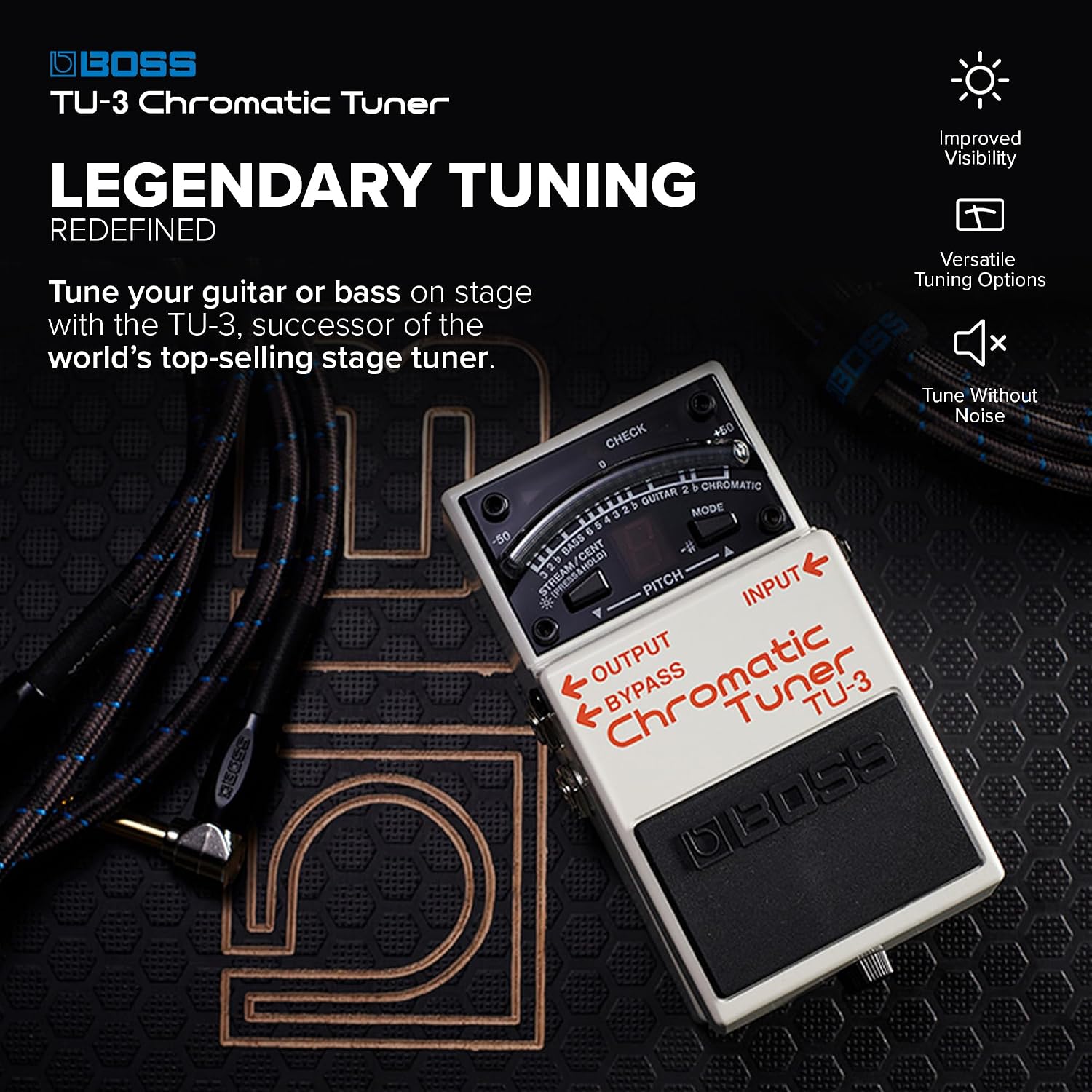
The TU-3 Chromatic Tuner: The One That Goes on Every Board
A chromatic tuner (one that can detect every note across the full musical scale, not just the standard six open guitar strings) is the least glamorous thing on a pedalboard and probably the most important. If you’re out of tune, nothing else matters.
The Boss TU-3 has been the industry default for compact tuner pedals long enough that its design has become almost invisible — it’s just what a tuner looks like. But the details behind that familiarity are worth naming. Owners consistently report ownership timelines that are unusual for electronics: in Sweetwater’s aggregated review pool, it’s common to see notes like “had this for ten years before any issue” followed immediately by the person buying the exact same model again. That pattern — malfunction after a decade, replaced by the identical unit — is a strong loyalty signal. It suggests the product earned trust the hard way.
The practical feature that working musicians highlight most is mute mode, which means the TU-3 silences your signal to the amplifier and PA system (the house sound reinforcement system at a venue) while you tune. You engage it by pressing the footswitch; when active, your guitar’s signal stops flowing to anything downstream, including the main house mix. Church musicians and live performers on quiet stages name this specifically: you can tune between songs without sending the click of an open string through the PA at full volume. That’s not a small thing when you’re mid-service or mid-set.
The tradeoff is nil. There’s no real alternative recommendation to make here. At this price point and use case, the TU-3 is the one most players keep.
Buy this if: You play live at all, plug into a PA, or practice with other people. Even if you use a clip-on tuner for home noodling, a pedalboard tuner with mute capability solves a different problem.
The RC-1 Loop Station: Simplicity as a Feature, Not a Compromise
A loop station records a phrase you play and then repeats it continuously, so you can play along with yourself — essentially turning one guitarist into a one-person band for practice and performance. The RC-1 is Boss’s simplest loop pedal, and that simplicity has been the center of almost every conversation about whether it’s the right buy.
Here’s the honest framing: the RC-1 does less than more expensive loopers. It has one track, no built-in rhythm patterns, no USB connectivity, and no onboard effects. MusicRadar’s guide to looper pedals positions it clearly as a practice and songwriting tool rather than a performance-first unit. If you’re planning to use a looper as a solo performance centerpiece with multiple layers and a click track, the RC-1 will frustrate you within six months.
But for its actual intended use — giving you a rhythm bed to solo over, helping you hear how chord progressions actually sound in real time, or letting an older player (reviewers specifically note this demographic) practice without the complexity of a deep menu system — it’s excellent. Multiple long-run reviews make the point that simplicity was the deliberate choice, not a budget compromise. One common thread across aggregated owner feedback: players who chose it because they didn’t want complexity were happier than players who chose it expecting to grow into more features.
The one area where the RC-1 has a genuine learning curve is its stop/pause/overdub deletion workflow. The pedal uses footswitch timing and press-hold combinations to differentiate between stopping a loop, pausing it, and deleting an overdub layer. This is not intuitive on first use and is worth addressing directly (see the FAQ section below).
Buy this if: You practice alone and want a tool that forces you to play in time against yourself. If you’re a songwriter, it’s invaluable for hearing how changes feel under a repeated phrase. If you already know you want multi-track performance looping, step up to the RC-5 or RC-500.
The RV-6 Reverb: Eight Types, One Pedal, No Regrets
Reverb is the effect that makes a dry, close-miked guitar sound like it exists in a physical space — a small room, a large hall, a spring-loaded reverb tank like the ones built into vintage amplifiers. Every genre uses it to some degree. Without any reverb, electric guitar sounds clinical. Too much, and it turns to wash.
The RV-6 offers eight reverb types: Room, Hall, Plate, Spring, +Reverb (which adds modulation), Dynamic (which ducks the effect while you’re playing and lets it bloom during rests), Shimmer (a pitch-shifted reverb popular in ambient and post-rock), and Modulate. That’s a wide range, and Premier Guitar’s RV-6 review notes that the variety is paired with an analog dry path — meaning the unaffected part of your signal stays fully analog through the pedal, which matters to players who are sensitive to the digital “thinning” effect some reverb units introduce.
The most compelling owner account pattern in aggregated reviews involves players who describe spending significant time auditioning reverb pedals before landing here. One account that circulates in long-form review spaces describes trying “a ton of pedals” searching for satisfying reverb and finding it specifically in how the RV-6’s Level, Tone, and Time knobs interact — the controls have enough range that small adjustments produce audible, meaningful differences rather than subtle ones. That kind of control responsiveness is harder to achieve than it sounds.
In practice, most players end up living on two or three of the eight types — Room and Hall for everyday playing, Spring for vintage-style tones, and Shimmer for anyone with ambient tendencies. The others are available when you want them.
Buy this if: You’re playing any genre where you want your guitar to sound like it lives in a space rather than directly in someone’s ear. That’s most genres. The exception might be pure heavy metal rhythm playing where reverb obscures articulation — but even then, the Dynamic mode is designed for exactly that context.
Signal Chain Placement: Where Do These Three Go?
The standard rule — and Guitar World’s pedalboard setup guides reinforce this consistently — is that the tuner goes first in the chain, immediately after your guitar and before any other pedal. The reason is that every effect after your guitar adds harmonic complexity or noise to the signal, and a tuner reads pitch most accurately when the signal is clean. If your tuner comes after a distortion pedal, it’s trying to read pitch from a harmonically saturated signal, which introduces error.
Reverb goes last, or very close to last. Reverb is a space effect — it’s meant to simulate the room that all your other sounds exist in. Putting reverb before drive pedals means your reverb tail gets distorted, which is occasionally intentional but usually not what you want.
The RC-1 can go in a few places depending on what you want to loop. Before drive pedals, you loop a clean signal and can shape it afterward. After drive pedals, you capture the full effected sound.
Frequently Asked Questions
Can the TU-3 mute your signal to a PA system while you tune live? Yes — this is one of its primary use cases among live performers. When you engage the TU-3 by pressing its footswitch, the output signal is completely cut. Nothing reaches your amp or the PA. You tune, then disengage the pedal to bring the signal back. Multiple church musicians and live performers name this as their primary reason for choosing it over clip-on tuners.
What is the correct footswitch sequence on the RC-1 to delete an overdub without erasing your whole loop? This is the most common stumbling block new RC-1 owners hit. According to Boss’s official RC-1 documentation, to undo the most recent overdub layer, you press and hold the footswitch while the loop is playing. A brief hold undoes one layer. A longer hold clears everything. The key distinction: a quick press while playing triggers overdub; a hold triggers undo. Practice this before you need it live.
Which of the RV-6’s eight reverb types do most players actually use regularly? Across aggregated long-form reviews — including accounts on Sweetwater and Premier Guitar’s reader discussions — Room, Hall, and Spring come up most frequently as everyday workhorses. Shimmer gets significant mentions from players in ambient and post-rock contexts. Dynamic is praised specifically by players who want reverb on notes but need attack clarity on rhythmic passages.
Does the tuner pedal go at the very start of the signal chain, or can it go elsewhere? The strong consensus — reinforced by Guitar World’s signal chain guides — is that the tuner belongs first, immediately after your guitar. This gives the tuner the cleanest possible signal to read. Placing it after drive or modulation pedals makes accurate pitch detection harder. The only exception some players make is using a tuner in an effects loop (a send/return circuit built into some amplifiers), but for most boards, first in chain is correct.
Is the Boss RC-1 too simple — will you outgrow it quickly? It depends entirely on what you want to do with a looper. If your goal is practicing scales and hearing chord progressions loop underneath you, you won’t outgrow it. If you’re building toward solo live performance with layered multi-track loops, you’ll likely hit its ceiling within a year. MusicRadar’s looper guide frames it explicitly as a practice and composition tool. Know which you are before you buy.