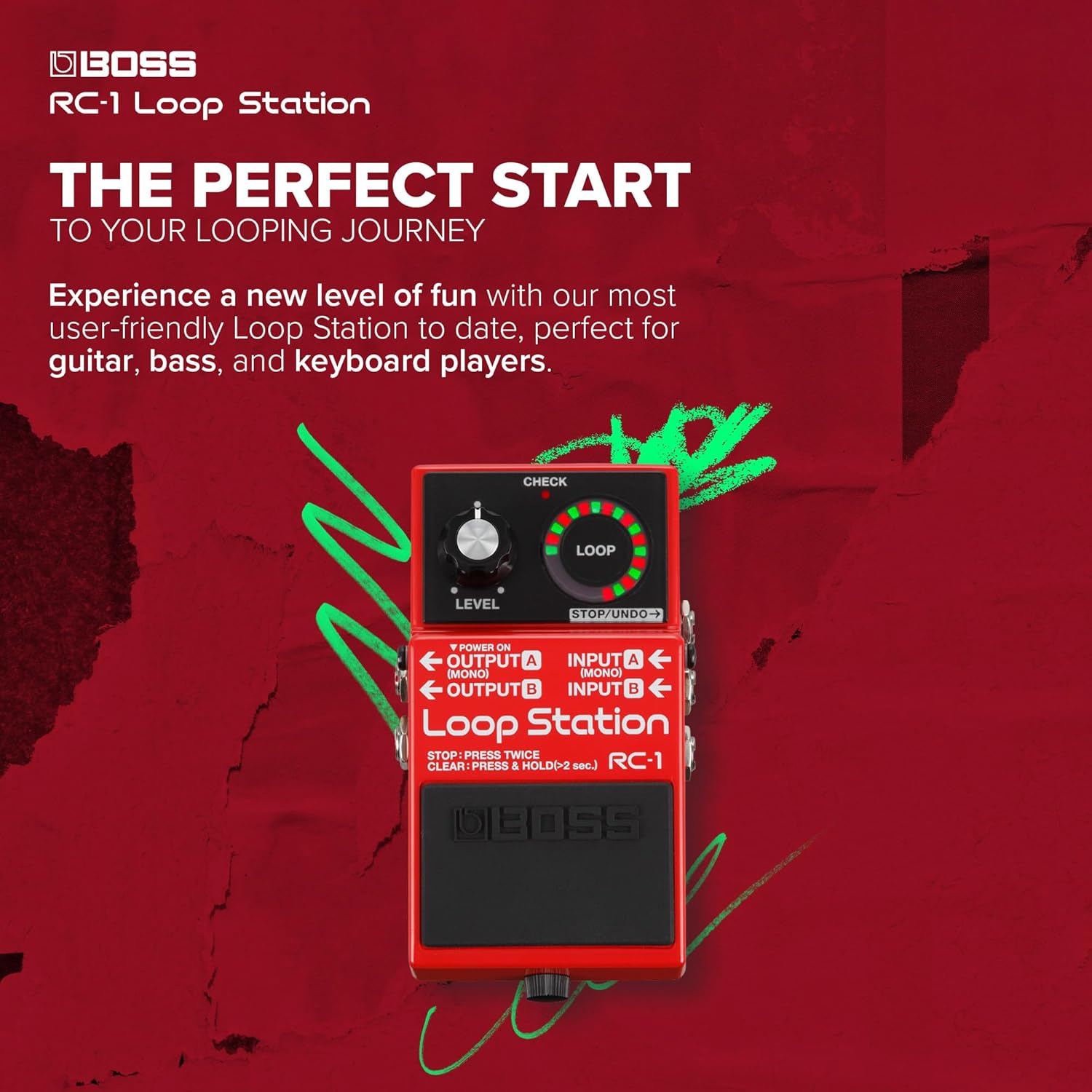
Imagine having a second guitarist in the room who can play exactly what you just played, on repeat, while you solo or improvise over the top of it. That’s what a looper pedal does. You play a chord progression — maybe four bars, maybe eight — press a foot switch, and the pedal records it and plays it back in a continuous loop. Then you play along: melodies, solos, harmonies, whatever you want. It’s one of the most transformative practice tools a guitar player can own, and it’s genuinely useful whether you’ve been playing for six months or sixteen years. This guide is going to focus on one specific looper: the Boss RC-1, which retails around $99–$109 depending on where you shop. We’re going to explain exactly what it does, who it’s built for, why it beats cheaper alternatives in the ways that matter most, and how it fits into a real-world pedalboard setup.
What the Boss RC-1 Actually Does (and Doesn’t Do)
The RC-1 is Boss’s entry-level loop station — “loop station” being Boss’s branded term for a looper pedal. It’s a single-footswitch pedal with one main job: record a loop, play it back, overdub (layer new parts on top), and stop. That’s it. There’s no drum machine, no built-in effects, no memory banks for saving multiple loops, and no USB connectivity. You get 12 minutes of total recording time and a circular LED display that shows you where you are in the loop — a feature that sounds trivial until you’re actually playing and realize you need to know when to come back in.
By the numbers:
| Spec | RC-1 |
|---|---|
| Loop time | 12 minutes |
| Undo/Redo | Yes (single press during playback) |
| Stereo I/O | Yes (mono or stereo) |
| Memory slots | 1 (no preset saving) |
| Street price (May 2026) | ~$99–$109 |
That 12 minutes is more than you’ll ever use in a single practice session. A typical rhythm loop — one that you’d actually play over — runs 4 to 16 bars, which at most tempos is somewhere between 8 seconds and a minute. The RC-1 can hold dozens of those back-to-back in a session; it just doesn’t save them between power cycles.
What the RC-1 does have is build quality and timing accuracy that Boss has spent decades refining. Owners consistently report zero hiss, zero timing drift, and a responsiveness to foot-switch presses that cheaper loopers simply don’t match. More on that in the next section.
The One Technical Reason Cheap Lookers Fail (That Nobody Warns You About)
Here’s the argument that should settle the “why not just buy a $30 looper?” debate, and it comes straight from the people who made the mistake first.
Looper pedals live and die on latency — the gap between the moment your foot hits the switch and the moment the pedal actually starts or stops recording. On an expensive looper, that gap is effectively zero. The pedal responds at the exact millisecond you tap. On a cheap looper, there’s a slight but real delay — sometimes 20, 30, even 50 milliseconds — between your tap and the actual record/stop event.
That might sound like nothing. But when you’re looping, you’re building a rhythmic structure. If your loop starts 30 milliseconds late but ends exactly on time, your loop is 30 milliseconds shorter than it should be. Play that back on repeat and the rhythmic foundation drifts. What started as a clean four-bar progression sounds slightly rushed or slightly dragged by the third or fourth repeat. You can’t play in time over something that isn’t in time.
Reviewers at Sweetwater specifically flag this: the difference in responsiveness to the exact tapping moment is noticeable, and when looping, that makes all the difference. This is a precise engineering problem, not a vague quality issue. Boss has solved it. Many budget options have not.
This is the core argument for the RC-1 over anything cheaper. It’s not about build quality, warranty, or brand prestige. It’s about whether the tool can do the one job it exists to do. A looper that drifts rhythmically is worse than useless — it actively trains bad habits by making you feel like your timing is off when the pedal is the problem.
Who the RC-1 Is Built For (And Who Should Skip It)
Let’s be direct about the audience, because the RC-1 is genuinely not the right pedal for everyone.
Buy the RC-1 if:
- You’re buying your first looper and want to learn how looping works without fighting your gear
- You practice alone and want a backing structure to solo, improvise, or work on scales over
- You value simplicity — one switch, one job, done
- You’re building a starter pedalboard and want a reliable anchor point
- You’re a home-studio player who needs real-time loop capture without a computer
Skip the RC-1 and consider the RC-3 or RC-5 if:
- You need to save multiple loops and recall them between sessions
- You want built-in drum rhythms to practice with
- You’re playing live and need to switch between pre-recorded loops mid-set
- You’re a looping-as-performance artist (think Ed Sheeran-style one-man-band sets)
The RC-3 (around $159–$179) adds 99 memory slots, a drum machine, and USB connectivity. The RC-5 (around $199–$229) adds stereo operation, phrase playback options, and a more advanced display. Both are genuinely great pedals. But they also introduce complexity that beginners consistently report slows down the learning curve. Multiple reviewers across Guitar World and Sweetwater note that simpler gear gets used more often — especially by players who identify as older or less tech-comfortable — because there’s no menu-diving between you and the music.
One owner captured it perfectly in their review: they bought the RC-1 specifically because they’re at a point in life where they want gear that isn’t complicated. That’s not a weakness. That’s clarity of purpose. And it’s an underserved perspective in gear writing that tends to celebrate feature counts.
Where the RC-1 Fits in a Real Pedalboard
Signal chain placement — meaning where in your chain of pedals the looper sits — matters. Here’s the principle:
A looper should be at or near the end of your signal chain, after all your other effects. The reason is straightforward: the looper records whatever signal arrives at its input. If your overdrive pedal is after the looper, the loop plays back clean while you play dirty — and they won’t blend the way you expect. Put the looper last, and whatever tone you’ve dialed in gets recorded exactly as it sounds.
A simple beginner pedalboard built around the RC-1 might look like this:
Guitar → Tuner → Drive Pedal → Reverb/Delay → Looper (RC-1) → Amp
The Boss TU-3 tuner (another Boss stompbox, around $99) is a natural pairing here. Owners who use both report that the TU-3’s mute function — which cuts the signal completely while you tune — means no hum or feedback bleeds into your loop while you’re adjusting between takes. The Boss BD-2 Blues Driver (around $79–$89), a popular entry-level overdrive, stacks cleanly into this chain as well, with multiple reviewers noting its flexibility across clean-to-gritty settings.
If you’re using an acoustic-electric guitar (a guitar with built-in pickup electronics that you plug into an amp or PA system), the RC-1 works just as well — its input doesn’t care whether the signal is from an electric or an acoustic pickup. You run the guitar’s output cable into the RC-1 the same way.
Frequently Asked Questions
What is the difference between the Boss RC-1 and RC-3 or RC-5 — do I need the more expensive one?
The RC-1 records one loop at a time with no saving between sessions. The RC-3 adds 99 memory slots, built-in drum rhythms, and USB connectivity. The RC-5 adds stereo I/O, additional phrase modes, and a more readable display. For most beginners, the RC-1 is enough — and its simplicity is genuinely a feature. Step up to the RC-3 or RC-5 when you know you need to save loops between sessions or want a drum machine to practice with. Per MusicRadar’s best looper pedals roundup, the RC-1 consistently earns its recommendation as the entry point precisely because it doesn’t overwhelm new users.
Where in my signal chain should I put a looper pedal?
At or near the end of your chain, after all drive, modulation, and time-based effects (reverb, delay). This ensures the loop captures your full, processed tone rather than a dry signal. Premier Guitar’s signal chain guides consistently place loopers in this position for exactly this reason.
How long can I actually record on the RC-1’s 12 minutes of memory?
More than you’ll ever need in one session. A typical practice loop is 4–16 bars, which runs roughly 8–60 seconds at most tempos. Twelve minutes holds many loops’ worth of material. The practical limit isn’t storage — it’s that the RC-1 holds only one loop at a time and doesn’t save between power cycles.
Will a cheap $30 looper do the same thing as the RC-1?
Not reliably. As described above, latency in budget loopers causes rhythmic drift — your loops don’t stay in time over multiple repetitions. Owners who’ve gone budget-first and then upgraded consistently identify timing responsiveness as the difference that justifies the extra $60–$70. Guitar World’s RC-1 coverage echoes this: the pedal’s reliability under real playing conditions is what separates it from no-name competitors.
Can I use a looper to practice scales and solos on my own without a band?
Absolutely — this is arguably its best use case. Record a chord progression, loop it, then work on solos, scale runs, or improvisation over the top. You get real rhythmic context (something a metronome can’t provide) without needing another person in the room. Home-studio owners and bedroom players consistently cite this as the primary reason they bought the RC-1.
Does the RC-1 work with acoustic-electric guitars as well as electrics?
Yes. The RC-1 accepts any signal that comes through a standard 1/4-inch cable — electric guitar, acoustic-electric, bass, or even a keyboard. As long as your acoustic-electric has an onboard pickup system and an output jack, it plugs in the same way as an electric.
The RC-1 is, in the plainest terms, the looper pedal you’ll actually use. It does one thing, it does it precisely, and it gets out of your way. For most players at the beginning of their looping journey, that’s exactly what they need — not more features, but more music.