If you’ve ever stared at a pedalboard — that flat board musicians use to organize and connect individual effects pedals — and thought there has to be a simpler way, you’ve just discovered the appeal of a floor multi-effects processor. Instead of buying a separate box for distortion, reverb, delay, and a dozen other sounds, a floor processor packs hundreds of effects into a single unit you can control with your feet. The three units in this comparison — the Boss GT-1, the Mooer GE100, and the Mooer GE150 — all live in roughly the same price bracket (street prices have held between $100 and $200 through mid-2026), and they all promise to replace a complicated chain of individual pedals. But they’re not interchangeable. One is a workhorse that demands a specific setup step before it sounds right. One is an honest hobbyist tool that doesn’t pretend to be more than it is. And one adds a forward-looking feature — neural amp modeling, which we’ll explain below — that’s either a genuine leap or a marketing checkbox, depending on how you use it. This guide sorts all of that out.
| EDITOR'S PICKPositive Grid Spark 2 50W Smart… | Mid-tierBOSS GT-1 | Budget pickMOOER GE100 Multi-Effects Guita… | |
|---|---|---|---|
| Built-in Looper | ✓ | — | ✓ |
| Drum Rhythms | — | — | 40 |
| Presets | — | — | 80 |
| Effects Count | — | — | 66 |
| Power Output | 50W | — | — |
| Expression Pedal | — | — | ✓ |
| Price | $345.00 | $189.98 | $95.99 |
| See on Amazon → | See on Amazon → | See on Amazon → |
The Setup Step Nobody Tells You About: Boss GT-1 and Output Select
Boss GT-1: What Reviewers Actually Praise — and Why Context Is Everything
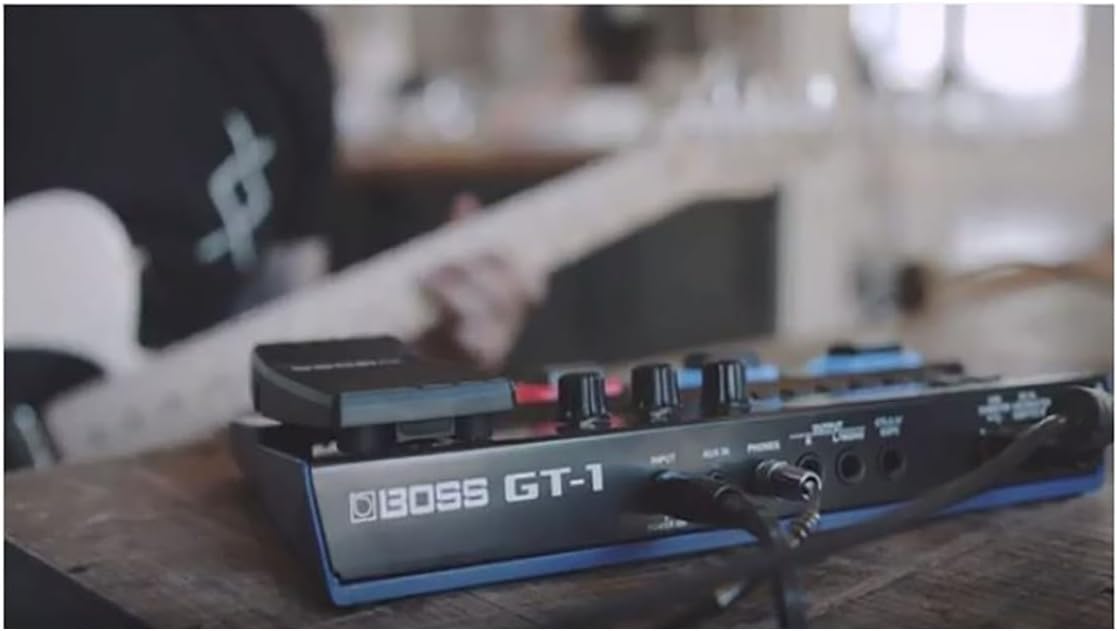
The Boss GT-1 is frequently the first recommendation you’ll see when budget multi-effects come up, and for good reason. MusicRadar’s Boss GT-1 multi-effects processor review calls its sound quality “excellent,” and that sentiment runs consistently through long-term owner reports. But there’s a crucial asterisk attached to that praise, and it explains why some players swear by the GT-1 while others return it within a week.
The GT-1 ships with its Output Select parameter set to a default that assumes you’re running into a guitar amplifier. If you plug it into a PA system (a full-range speaker system used in live venues), a studio interface, or headphones instead — which is exactly what many home players and gigging musicians want to do — you’ll get a noticeably thin, brittle sound that doesn’t represent what the unit can actually do. Changing Output Select to “LINE/PHONES” mode engages Boss’s COSM speaker cabinet simulation and EQ compensation, which transforms the sound into what reviewers actually praise.
This is not a flaw — it’s a design choice that requires awareness. Once you set the correct Output Select value for your signal chain, the GT-1 delivers warm, studio-ready amp tones that punch well above its price tag. The lesson: before you judge the GT-1, confirm this setting. It’s accessible from the main system menu and takes about sixty seconds to find and change.
Beyond that setup step, the GT-1 earns its reputation through sheer breadth. It handles amp simulation, effects chains, looping, expression pedal control, and USB audio interface duties in one compact form factor. Guitar World’s coverage of the best multi-effects pedals consistently places the GT-1 near the top of the budget tier for exactly this reason — the consolidation it offers has its own kind of freedom, particularly for players who are midway through building a traditional pedalboard and feeling overwhelmed by cabling and power supply logistics.
MOOER
$95.99
In stock on Amazon
Check price on AmazonThe Mooer GE100: An Honest Hobbyist Tool
GE100: Candid Expectations, Real Strengths
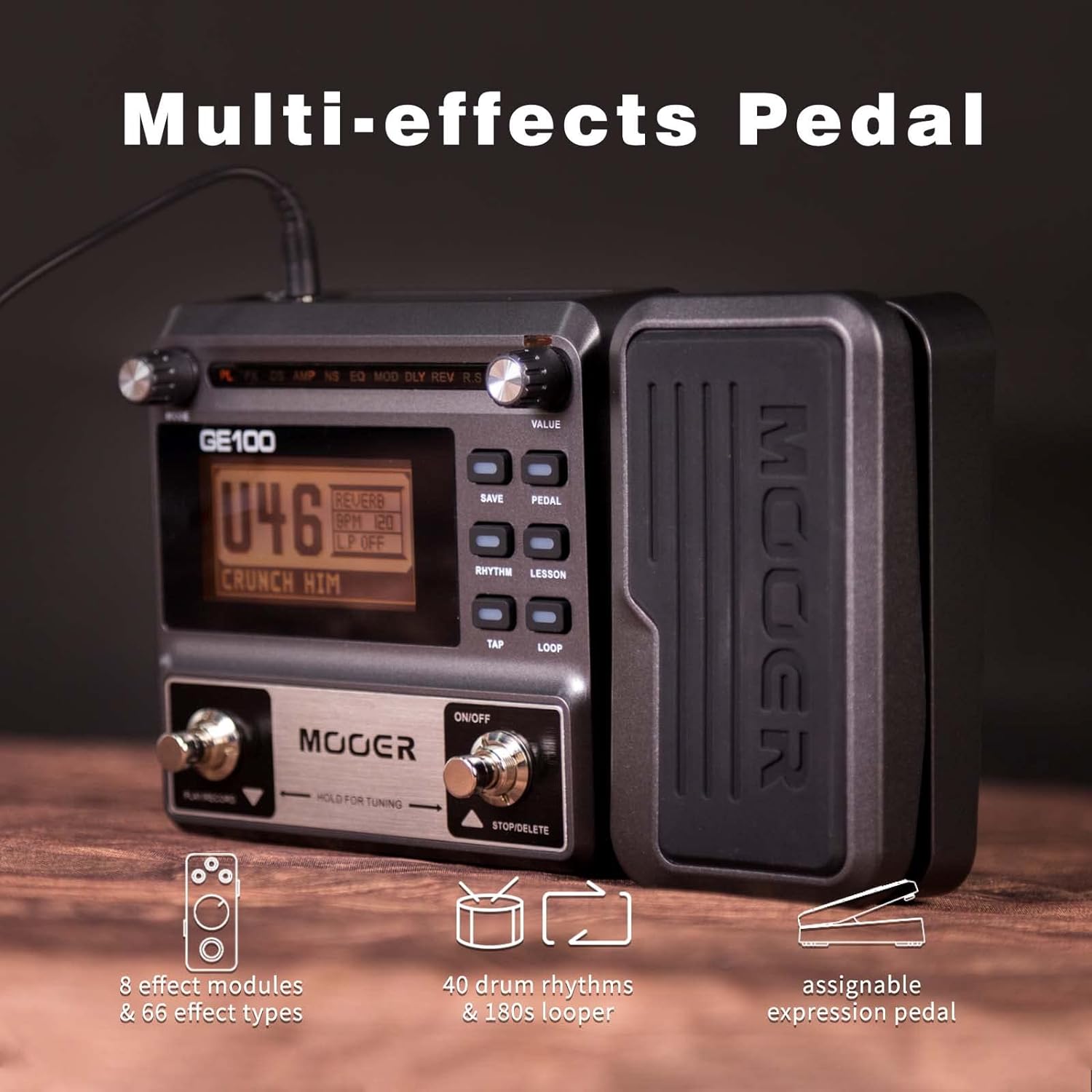
The Mooer GE100 occupies a curious position in this lineup. Reviewers who’ve spent real time with it tend to reach for unusually candid language: it falls short of professional quality in tone depth and parameter control, but it “does a lot” for the price — and they keep using it anyway. That framing is actually the most useful thing you can know about the GE100 before you buy.
What the GE100 does well: it gives you drum machine patterns for practice, a wide menu of amp and effects models, a compact footprint, and a price point that makes it genuinely low-risk. What it doesn’t do: deliver the depth of tone or the parameter control that serious gigging players will want. The EQ options are limited compared to the GT-1, and the amp models, while functional, lack the nuanced feel that experienced players notice in side-by-side comparisons.
Who the GE100 actually serves: someone who wants to practice different sounds at home, explore genres, and play along to a beat without buying a separate drum machine. For bedroom playing, quiet practice, and first-time exploration of multi-effects, the GE100 earns its place. It’s not trying to be a GT-1. The problem arises when buyers expect it to be.
The harder question as of 2026 is whether the GE100 is still worth buying given that the GE150 exists at a modest price premium. We address that directly in the FAQ section, but the short answer involves budget margin and specific use case.
MOOER
$95.99
In stock on Amazon
Check price on AmazonThe Mooer GE150: NAM Support, Firmware Reality, and What “Neural Amp Modeling” Actually Means
GE150: A Genuine Swing at Something New
The GE150 is where Mooer took a genuine swing. It includes support for NAM — Neural Amp Modeling — which is a way of capturing a real amp’s behavior using machine-learning algorithms. Think of it as a very sophisticated snapshot of how a specific amplifier responds to your playing. The NAM open-source format has become a legitimate tool in the home-studio world, and having it in a floor unit at this price point is notable.
The practical question is whether NAM on the GE150 is usable or a checkbox feature. Based on owner reports collected through Sweetwater’s Mooer GE150 Air Guitar Multi-Effects Processor product page and Q&A section, the answer is nuanced: NAM capture playback works, but the workflow for loading captures onto the unit — which involves the Mooer companion app — has had documented friction. Specifically, multiple owners reported Bluetooth connectivity problems between the GE150 and the app.
Update status as of May 2026: Mooer has pushed firmware updates that long-run owner reports credit with resolving the Bluetooth and app-sync issues that affected earlier units. If you’re buying new, confirm you have the current firmware version loaded by checking Mooer’s official product support page for the GE150 before your first session. If you’re buying used, treat the app connectivity as something to verify before completing the transaction.
Once the workflow is stable, the NAM support gives the GE150 a genuine ceiling that the GE100 and GT-1 can’t match in the same way. The ability to load real-amp captures means the unit can grow with your ear — as better NAM captures become available from the community, your GE150 gets meaningfully better. That’s a different value proposition than a closed ecosystem.
BOSS
$189.98
In stock on Amazon
Check price on AmazonBy the Numbers
| Unit | Approx. Street Price (mid-2026) | Amp Models | Looper Length | USB Audio | NAM Support |
|---|---|---|---|---|---|
| Boss GT-1 | ~$150 | 108 (COSM) | 38 seconds | Yes | No |
| MOOER — $95.99 Mooer GE100 | ~$100 | 55 | 60 seconds | No | No |
| BOSS — $189.98 Mooer GE150 | ~$180–200 | 90+ | 60 seconds | Yes | Yes |
| Positive — $345.00 Zoom G1X FOUR | ~$100–120 | 75+ | 30 seconds | No | No |
Prices reflect aggregated retailer data as of May 2026. Spec figures drawn from manufacturer published documentation.
A Note on the Zoom G1X FOUR: A Different Use Case Worth Naming
This comparison centers on three specific units, but one name keeps appearing in the same conversation: the Zoom G1X FOUR. It earns consistent praise for a reason none of the above units can match — it runs on AA batteries. That single feature opens a use case the GT-1, GE100, and GE150 all require workarounds for: plugging directly into a PA at an open mic, busking, or any situation where a power outlet isn’t guaranteed.
Premier Guitar’s floor modeler and multi-effects coverage has specifically highlighted battery operation as a practical live advantage for acoustic-electric players and singer-songwriters who need to travel light. Guitar World’s best multi-effects pedals guide echoes this, noting the G1X FOUR as a standout for players whose primary venue is anywhere other than a fixed stage with reliable power. If your primary scenario involves PA use at venues where backstage power access is uncertain, the G1X FOUR belongs in your consideration set even though it isn’t directly part of this three-way comparison. Different tool, different context.
MOOER
$95.99
In stock on Amazon
Check price on AmazonFrequently Asked Questions
What is Output Select on the Boss GT-1 and why does it matter so much?
Output Select tells the GT-1 what kind of destination your signal is going to. Set it to “AMP” and it bypasses cab simulation, assuming your guitar amplifier will handle that coloring. Set it to “LINE/PHONES” and it engages full speaker cabinet simulation and EQ shaping for direct-to-PA, interface, or headphone use. MusicRadar’s Boss GT-1 review and aggregated owner reports consistently document that the unit sounds thin and disappointing until this setting is corrected — and excellent once it is. Find it in the system settings menu before your first serious session.
Can any of these processors replace a real amp, or do they need to go through one?
All three can run direct — into a PA, an audio interface, or headphones — without a traditional guitar amp, provided Output Select (on the GT-1) or the equivalent output mode is correctly configured. None of them require an amp. The GE150 with NAM captures arguably does this most convincingly, since you’re loading actual amp behavior rather than a modeled approximation. For home practice and recording, these units are fully capable. For a loud stage without a monitoring system, you’ll want to route them through a PA or a powered speaker with a full-range flat-response driver.
Is the Mooer GE150’s NAM support actually usable or is it a gimmick at this price?
Based on owner feedback documented through Sweetwater’s Mooer GE150 product page Q&A, NAM support on the GE150 is functionally real — but only after resolving the app connectivity friction that affected earlier firmware versions. With current firmware installed, owners report successfully loading and using NAM captures. The ceiling it provides — access to an expanding community library of real-amp captures — is a genuine differentiator. Call it a promising feature that required a firmware maturation period rather than a gimmick.
How does the Zoom G1X FOUR’s battery operation work in a live PA setting?
The G1X FOUR runs on two AA batteries, giving it a manufacturer-rated battery life of approximately 18 hours under standard use. For a live PA setting, you’d connect the unit’s output directly to a DI box or the PA’s line input, bypassing any amp entirely. Premier Guitar’s multi-effects floor modeler coverage notes this makes it uniquely practical for acoustic performance contexts, open mics, and travel where power access isn’t guaranteed.
Which of these units has the best looper for practicing?
On raw looper length, the GE100 and GE150 both offer 60-second loops versus the GT-1’s 38 seconds. For most practice scenarios — working through a chord progression, drilling a solo phrase — 38 seconds is workable, but the extra headroom in the Mooer units is a legitimate advantage for players who want to layer longer loops. None of these are looper pedals in the dedicated sense; if looping is your primary use case, a dedicated looper will serve you better.
Is the GE100 worth buying in 2026 or has the GE150 made it obsolete?
The GE150 outperforms the GE100 across nearly every technical measure. But “obsolete” is a budget conversation, not just a spec conversation. If the price difference between the two units represents a meaningful portion of your current gear budget, the GE100 remains a rational buy for pure bedroom-practice and tone-exploration use. If you’re within $50–60 of the GE150, the NAM support and USB audio output make the upgrade easy to justify. The GE100 isn’t obsolete — it’s been repositioned by the GE150 into a narrower, more specific use case.
The Decision Rule
Here’s the framework, stated plainly:
- Buy the Boss GT-1 if you want the most polished-sounding unit in the bracket, you’re running direct to a PA or interface, and you’re willing to spend five minutes finding the Output Select setting before you judge it. Also strong if you’re mid-build on a traditional pedalboard and starting to wonder whether consolidation makes more sense.
- Buy the Mooer GE100 if your budget is firm at the entry level, you’re primarily a bedroom player who wants variety and a drum machine to practice against, and you understand you’re buying a hobbyist tool rather than a professional rig.
- Buy the Mooer GE150 if you want a growth path — specifically NAM support and the ability to load real-amp captures as the community library expands — and you can confirm the current firmware is installed before your first session.
- Consider the Zoom G1X FOUR instead if your primary use case is acoustic-electric performance at open mics, busking, or any scenario where battery operation and PA-direct simplicity matter more than amp modeling depth.
The budget floor processor market in 2026 is better than it has any right to be at these prices. The trick is matching the unit’s actual strengths to your actual use case — not the use case you imagine you’ll have someday.