If you’ve ever stood in front of a wall of guitar pedals — those little colored boxes that sit on the floor between your guitar and your amp — and wondered what any of them actually do, you’re in the right place. A drive pedal (the umbrella term for overdrive and distortion effects) is the single most common first pedal purchase a guitarist makes. In plain terms: your guitar signal goes into the pedal, the pedal makes it grittier, crunchier, or more aggressive, and then it hits your amp. That’s it. The difference between overdrive (a warm, mild breakup that feels like a pushed amp) and distortion (a heavier, more saturated wall of gain) is mostly a matter of degree and character. Boss, a brand that has been making stompboxes since 1977, built four pedals that have collectively sold millions of units and shaped the sound of virtually every genre of popular music. This article breaks down the DS-1, SD-1, MT-2, and BD-2 — what each one actually does, who it’s for, and which one makes sense for where you are right now.
The Four Pedals at a Glance
Before we go deep, here’s a quick orientation. All four pedals share Boss’s famously rugged metal chassis. Writers at Guitar World and MusicRadar have consistently described the build quality as among the most durable in the stompbox category — these pedals survive decades of bar-gig abuse in a way that cheaper plastic-housed alternatives simply don’t. They all run on a standard 9V power supply (more on that in the FAQ), and they all sit in the under-$60 price range new, making them among the most accessible name-brand gear in existence.
By the numbers:
| Pedal | Type | Controls | Best-fit genre |
|---|---|---|---|
| DS-1 Distortion | Hard distortion | Level, Tone, Dist | Rock, grunge, punk |
| SD-1 Super OverDrive | Asymmetric overdrive | Level, Tone, Drive | Blues, classic rock, country |
| BD-2 Blues Driver | Overdrive/light distortion | Level, Tone, Gain | Blues, jazz, clean boost |
| MT-2 Metal Zone | High-gain distortion | Level, 3-band EQ, Dist | Metal, hard rock |
DS-1, SD-1, MT-2, and BD-2: Full Breakdown
DS-1 Distortion — The Budget Pick for Rock, Punk, and Grunge
BOSS
$69.99
In stock on Amazon
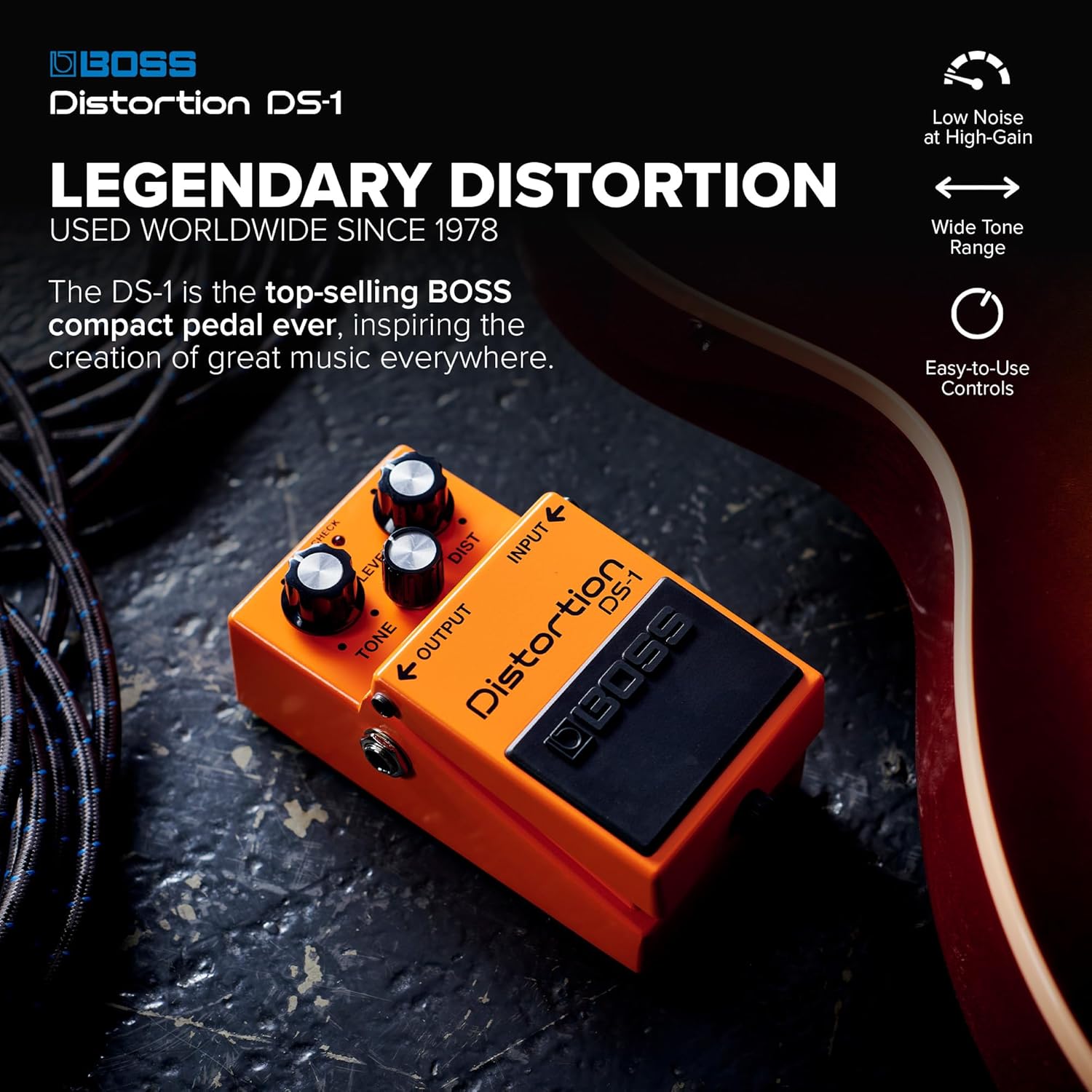
Check price on AmazonThe DS-1 has been in continuous production since 1978, which makes it older than a lot of the people buying it right now. It is, by any reasonable measure, the most iconic affordable distortion pedal ever made. Kurt Cobain used one. So did Frank Zappa. So does a large percentage of working guitarists who never mention it publicly because it costs $50 and that doesn’t make for good gear-forum bragging rights.
Guitar World’s staff review archive on the DS-1 has noted that the pedal gets unfairly dismissed by players who equate low price with low quality — a bias the publication pushes back on directly. The stock DS-1, unmodified and straight out of the box, deserves a fair listen before anyone pays four times the price for something with a smaller production run.
What the DS-1 delivers is a hard-clipping distortion — meaning the signal is cut off sharply at the top and bottom of its waveform, producing that compressed, aggressive character — with a single Tone knob that sweeps from dark and woolly to bright and cutting. It’s not subtle. The Dist knob goes from mild crunch at 7 o’clock to full-on sizzle at 5 o’clock. The consistent pattern across reviews is that it sounds best with the Dist knob in the 10-to-2 o’clock range — maxing it out tends to compress the pick attack into indistinct mush.
Best for: Rock, punk, and grunge players with modest amps who want a pedal that will not fail them for twenty years. The DS-1 is the default answer when someone asks “what distortion pedal should I start with?” for a reason.
BOSS
$69.99
In stock on Amazon
Check price on AmazonSD-1 Super OverDrive — The Mid-Tier Pick for Blues and Classic Rock
BOSS
$69.99
In stock on Amazon
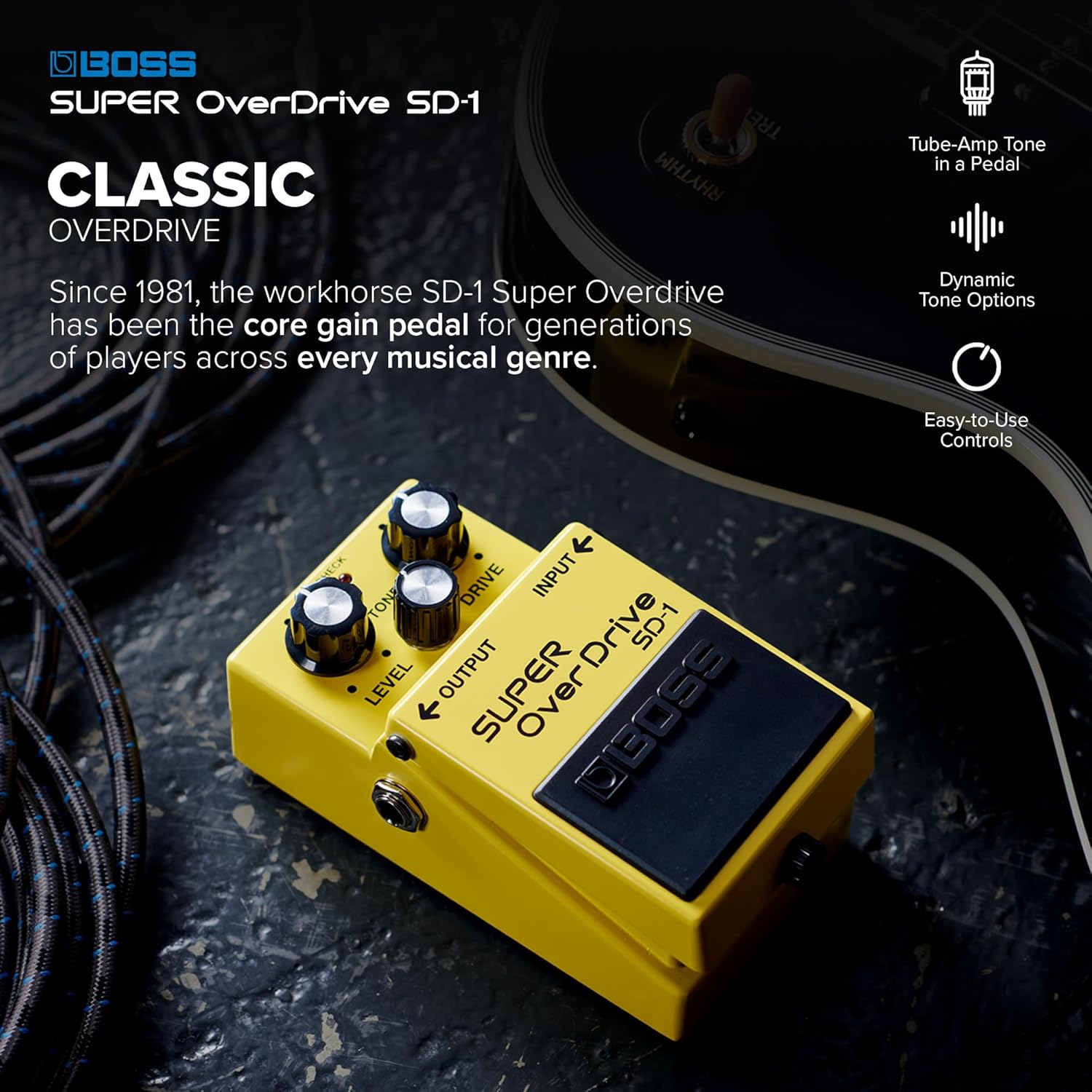
Check price on AmazonThe SD-1 looks almost identical to the DS-1 and costs about the same. The difference is fundamental: the DS-1 is a distortion pedal; the SD-1 is an overdrive. The distinction matters more than it might seem.
The SD-1 uses asymmetric clipping — one side of the waveform is clipped differently than the other — which produces harmonics (overtones that add richness to a sound) that many players describe as warmer and more amp-like than the DS-1’s harder character. It’s the same basic circuit topology used in the famous Ibanez Tube Screamer, a pedal that costs considerably more and has inspired entire cottage industries of boutique clones.
Premier Guitar’s SD-1 buying guide coverage has flagged a use case that most beginners miss entirely: the SD-1 works brilliantly at low gain settings with the Level knob turned way up — essentially functioning as a clean boost that thickens the signal and, as multiple long-term owners have reported to that publication, removes flub from the low end. That’s not how most people think about an overdrive pedal. Most beginners crank the Drive knob and wonder why it sounds fizzy. Try it the other way: Drive at 9 o’clock, Level at 3 o’clock, and let the pedal push your amp into its own natural breakup. The result is often more convincing than a heavy-handed drive setting.
Best for: Blues, classic rock, and country players who want a pedal that doubles as a clean boost and a mild overdrive. If you’ve heard the Tube Screamer name but can’t justify the price jump yet, the SD-1 is the honest starting point.
BOSS
$69.99
In stock on Amazon
Check price on AmazonMT-2 Metal Zone — The Premium High-Gain Pick for Metal and Hard Rock
Epiphone
$199.00
In stock on Amazon
Check price on AmazonThe MT-2 Metal Zone has a reputation problem, and it’s largely self-inflicted — by the players using it incorrectly, not by the pedal itself.
Here’s what actually happens: someone buys an MT-2, cranks all three EQ bands and the Dist knob to maximum, and then declares it sounds harsh and scooped. “Scooped” means the midrange frequencies — the frequencies that make a guitar cut through a mix — are carved out. Of course it sounds harsh under those conditions. That’s exactly what happens when you run any high-gain distortion pedal with the mids removed and everything else at full tilt.
Sweetwater’s buyer Q&A section for the Boss MT-2 Metal Zone product page reflects a consistent pattern among satisfied owners: the three-band EQ is the whole game. Boost the mids. Dial back the bass. Run the Dist knob at no more than noon. MusicRadar’s “Best distortion pedals 2025: our top picks for every genre and budget” makes a similar point, noting that the MT-2 rewards players who invest time learning the EQ section rather than treating the knobs as volume controls. The other critical variable is signal chain placement: running the MT-2 in an amp’s effects loop — a dedicated insert point that routes signal after the amp’s preamp section — rather than in front of the amp produces a tighter, more controlled response that many players find substantially more workable.
The MT-2 is not for everyone, and it is not the right first pedal for a player whose primary interest is classic rock. But for players seriously pursuing metal or hard rock, dismissing it without learning the EQ section is leaving the tool half-used.
Best for: Metal and high-gain hard rock players who are willing to invest fifteen minutes learning the EQ section and want a pedal that covers extreme gain territory without a boutique price tag.
Epiphone
$199.00
In stock on Amazon
Check price on AmazonBD-2 Blues Driver — The Always-On Tone Shaper
The BD-2 has a different relationship with its owners than the other three pedals on this list. Where the DS-1, SD-1, and MT-2 are typically engaged for specific moments — a lead section, a heavier verse — Premier Guitar’s Blues Driver coverage has noted that players in the know tend to leave the BD-2 on permanently and adjust knobs depending on which guitar they pick up. That usage pattern tells you something important about the pedal’s character.
The BD-2 occupies a sweet spot between a true overdrive and a light distortion. It’s more open and dynamic than the DS-1 — meaning it responds to how hard you pick, cleaning up when you play softly and breaking up when you dig in — but it has more edge than the SD-1. At low Gain settings it functions as a transparent clean boost that adds presence and definition. At higher Gain settings it moves into crunchy territory covering everything from early Clapton to lighter Hendrix.
Premier Guitar’s BD-2 long-term coverage describes the pedal as a foundational always-on tone-shaper rather than a go-to “effect on” device. At least one long-term reviewer has written about running a BD-2 into a second overdrive into a heavier distortion pedal as a layered gain stack — using each pedal to cover a different level of saturation depending on what the song demands. The BD-2 earns the base position in that kind of rig because of how naturally it interacts with whatever comes after it.
Best for: Blues, jazz, and classic rock players who want a single pedal that functions as both a clean boost and a light drive — one that will interact with their fingers rather than flatten their dynamics.
Frequently Asked Questions
What’s the actual difference between the DS-1 and SD-1 — aren’t they both just distortion?
They share the same compact orange housing, but the circuits are meaningfully different. The DS-1 is a true distortion pedal with hard clipping that produces a dense, compressed sound. The SD-1 is an overdrive with asymmetric clipping that produces warmer, more harmonic-rich breakup. Think of the DS-1 as a wall of gain and the SD-1 as a pushed amp. They serve different tonal purposes even though they’re priced identically.
Can I use a Boss drive pedal with my amp’s built-in overdrive channel, or do I pick one or the other?
You can use both simultaneously, but it rarely sounds good. Stacking the amp’s built-in overdrive channel with a drive pedal usually produces a muddy, indistinct result — each stage of gain compounds the other. The cleaner, more controllable approach is to run your amp on its clean channel and let the Boss pedal do the work. This gives you far more control over your tone and is how most players with small practice amps use drive pedals.
Is the MT-2 Metal Zone actually bad, or just misunderstood?
Mostly misunderstood. As Sweetwater’s MT-2 buyer Q&A and MusicRadar’s distortion pedal roundup both reflect, the consistent pattern among players who have spent time with the three-band EQ — specifically boosting mids and dialing back bass — is that they find it a capable, versatile high-gain tool. Players who dismiss it have typically run it with all knobs maxed and declared it harsh. The harshness is real under those settings; it’s also preventable with basic EQ adjustment.
What does “always-on” mean and why do reviewers use the BD-2 that way?
“Always-on” means the pedal is engaged from the moment you start playing and never clicked off during a performance. Reviewers use the BD-2 this way because at low-to-moderate Gain settings it adds warmth, presence, and definition to a clean signal without sounding like an obvious effect. It becomes part of the base tone rather than a distinct effect layer.
Do Boss pedals need a specific power supply, or can they run on a standard 9V adapter?
Boss pedals run on standard 9V DC power with a center-negative barrel connector — the most common power supply format in the guitar world. They also accept a standard 9V battery. Any quality 9V pedal power supply from a reputable manufacturer will work. Boss’s own PSA adapter is the reference standard, but you are not locked into it.
Which Boss drive pedal is best for a beginner who plays mostly classic rock?
The SD-1 is the clearest answer for classic rock. It covers the warm, amp-pushed breakup of early Cream, Led Zeppelin, and Rolling Stones territory more naturally than the DS-1’s harder distortion character. Run it with moderate Drive and a boosted Level, keep the Tone around noon, and let your amp do the rest of the work. If your budget allows only one pedal and classic rock is your primary territory, the SD-1 is where to start.