If you’ve ever stood in a guitar store — or scrolled through Sweetwater at midnight — staring at a wall of acoustic guitars priced between $99 and $300, you already know the problem. They all look like guitars. They all have strings. A few of them are genuinely good. A surprising number of them will make you want to quit playing inside of six months, not because you lack talent, but because a poorly made instrument fights you at every step. An acoustic guitar (a hollow, wooden instrument you play without plugging in) in the under-$200 price bracket is where most players start, and it’s a category full of landmines and hidden gems. This guide is here to help you spend your money on one of the gems. We’ll cover which guitars actually hold up for real practice and growth, which specs matter at this price point (and which are marketing noise), and why the Yamaha FG800J in particular has become a reference point that other guitars at this price get measured against.
You’re probably coming to this with a decision already partially made — maybe you’ve seen the Yamaha FG800 recommended on every list, or maybe a friend steered you toward a Fender CD-60S, or a Taylor Academy popped up just slightly above budget. The goal here isn’t to hand you one answer and send you home. It’s to give you the framework to make the right call for your situation: your budget, your living space, your musical goals, your hands.
| EDITOR'S PICK[Fender CD-60S Solid Top Dreadno…](https://www.amazon.com/dp/B00BMJ3OFG?tag=greenflower20-20) | Mid-tierFender Acoustic Guitar | Budget pick[Jasmine S35 Dreadnought Acousti…](https://www.amazon.com/dp/B0002F58TG?tag=greenflower20-20) | |
|---|---|---|---|
| Solid top | ✓ | ✗ | — |
| Top wood | Mahogany | Mahogany | — |
| Back/sides | Mahogany | Mahogany | — |
| Fingerboard | — | Walnut | Rosewood |
| Bracing | — | — | Advanced X |
| Bundle | ✓ | ✗ | — |
| Price | $299.99 | $229.99 | $119.00 |
| See on Amazon → | See on Amazon → | See on Amazon → |
Why This Price Tier Is Surprisingly Complicated
The $100–$200 range is the most crowded and most misleading segment in the acoustic guitar market. At $500+, brand reputation and build quality tend to align. At $50–$100, you know you’re buying a wall decoration. But from $100 to $200, the spread between the best and worst options is enormous — and the packaging rarely tells you which you’re holding.
Here are the things that actually separate a playable beginner guitar from a frustrating one:
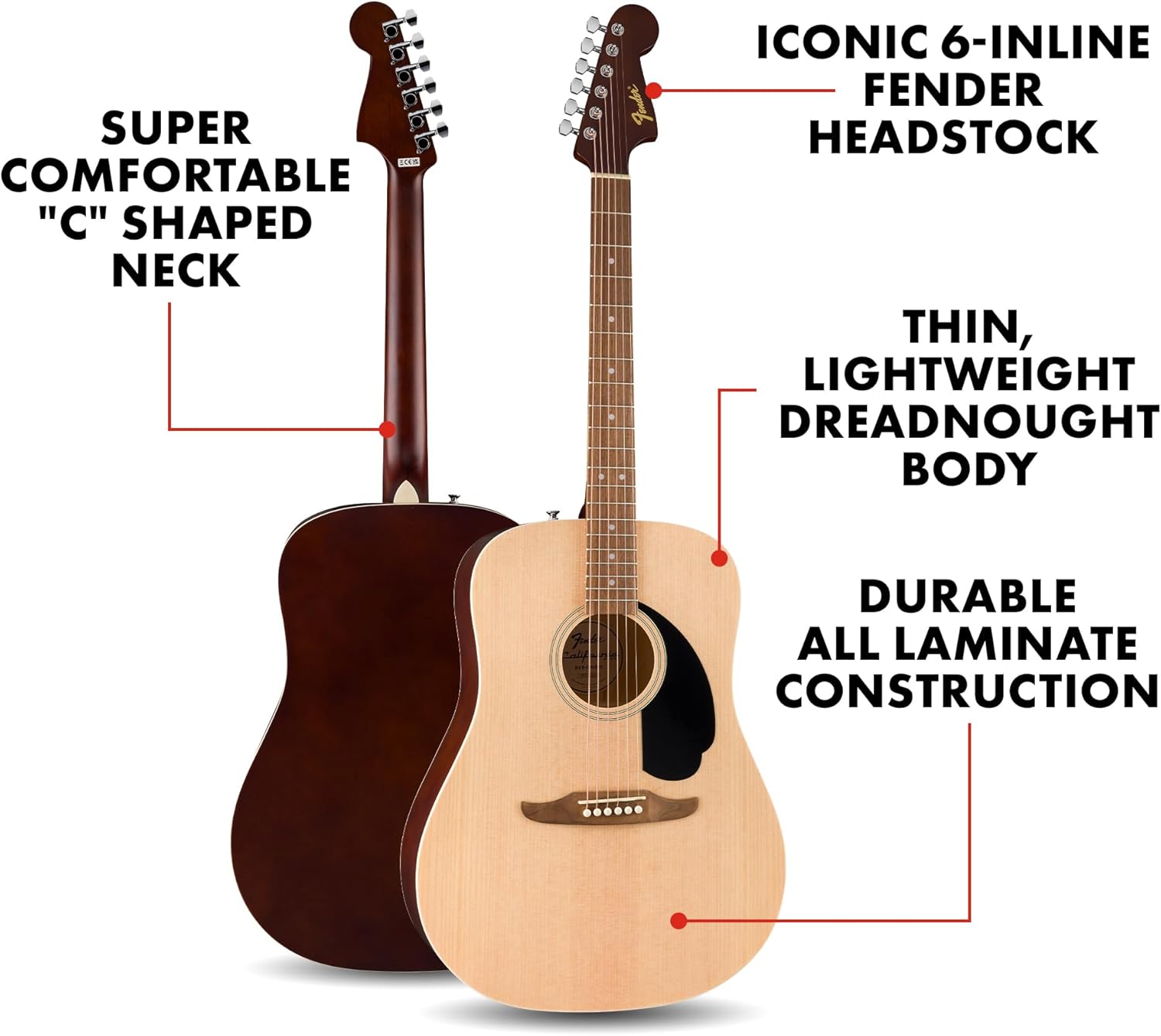
Solid vs. laminate top. The top (the flat piece of wood you strum against) is the most sonically important part of the guitar. A solid top — one piece of real wood — resonates better and actually improves in tone over years of playing. A laminate top is layers of wood pressed together; it’s more resistant to humidity damage but sounds noticeably flatter, especially as you develop your ear. Most guitars under $200 use laminate tops. That’s okay — but it’s worth knowing.
Nut and saddle material. The nut (the small slotted piece at the top of the neck, near the tuning pegs) and saddle (the white strip on the bridge where strings contact the body) dramatically affect playability and tone. Bone and Tusq (a synthetic ivory material) are good. Cheap plastic is not — it tends to bind strings in the slots and kill sustain.
Action. Action refers to the height of the strings above the fretboard. High action means you have to press down harder to fret notes, which causes hand fatigue, buzzing, and finger pain for new players. Many budget guitars ship with action that’s too high and needs a setup (a professional adjustment, usually $40–$75) to play comfortably. Some don’t; that’s a meaningful differentiator.
Bracing pattern. Inside the body of an acoustic guitar, thin strips of wood called braces support the top and shape the tone. Scalloped X-bracing (a specific internal pattern used on most better-sounding acoustics) is generally preferred for its resonance and projection. It’s not always disclosed clearly on budget models.
The Contenders: What the Evidence Says
Let’s run through the guitars that consistently appear in recommendation lists and review roundups at or under the $200 ceiling.
Yamaha FG800J
This is the guitar that changes the conversation in this tier, and here’s why: it ships with a solid Sitka spruce top — genuine one-piece wood, not laminate — at a price point where most competitors use laminate. That’s the headline. But it doesn’t stop there.
Yamaha uses scalloped bracing internally on the FG800J, and the build quality coming out of their manufacturing facilities has been consistently praised across nearly every major reviewer in this space. MusicRadar’s roundup of beginner acoustics calls the FG800 series “the benchmark against which other beginner guitars are measured.” Guitar World’s 2025 best beginner acoustic guide rates it among the top two options under $250, specifically citing its tonal projection and intonation accuracy relative to price. Sweetwater’s editorial team consistently surfaces it as a top pick in this bracket.
Owners across aggregated reviews report that the guitar arrives with action low enough to play out of the box — not always a given at this price — and that the solid top rewards players who stick with it; the resonance reportedly opens up and improves meaningfully after months of regular playing. That’s real-wood behavior, and it’s rare here.
Buy the FG800J if: You want the most guitar for the money, plan to stick with playing for at least a year, and value tone development over the long haul. It’s our top pick in this category.
Fender CD-60S
The CD-60S is Fender’s main entry in this bracket, and it earns its recommendations. Like the FG800J, it features a solid spruce top — Fender made this upgrade to their CD-60 lineup specifically to compete. The mahogany back and sides give it a warmer, slightly rounder tone compared to the Yamaha’s more forward mid-range presence.
Wirecutter (New York Times) evaluated this guitar in their beginner acoustic roundup and praised it specifically for its comfortable neck profile and approachable playability for new players. The CD-60S also ships with scalloped X-bracing.
Where it trails the FG800J slightly, based on published specs and aggregated owner feedback: the factory setup tends to be less consistent, with some owners reporting higher-than-ideal action out of the box. Not a dealbreaker, but worth budgeting for a setup if you go this route.
Buy the CD-60S if: You’re drawn to Fender’s brand, prefer a warmer tonal character, or the Yamaha is sold out — it’s a genuinely strong alternative.
Orangewood Sage
Orangewood is a direct-to-consumer brand (meaning they sell online and skip the traditional retailer markup), and the Sage — their flagship entry model — frequently surprises reviewers. It ships with a solid spruce top and, notably, bone nut and saddle — materials you typically don’t see until the $400+ range from established brands. Acoustic Guitar Magazine’s budget roundup noted the Orangewood lineup as a “direct-to-consumer value anomaly” for exactly this reason.
The tradeoff is brand equity and support infrastructure. Yamaha and Fender have established dealer networks, warranty service at hundreds of locations, and decades of trust. Orangewood is newer and primarily online. For players comfortable buying online and comfortable with that tradeoff, the Sage punches above its price class.
Buy the Sage if: You’re buying online anyway, want bone nut/saddle at this price, and are comfortable with a newer brand.
What to Skip (and Why)
Some guitars consistently appear in search results at this price but draw concern across review sources:
Generic “starter pack” bundles under $120 — the ones that come with a digital tuner, a nylon gig bag, and five picks — almost universally use laminate tops, plastic nut and saddle, and imprecise fretwork. The Guitar World and MusicRadar roundups both note that these “value packages” frequently require more investment in setup fees than the guitar itself costs to reach playable condition. They’re not evil; they’re just not a good return on your $120.
Unbranded imports sold only through marketplace listings — guitars with no established brand, no published spec sheet, and no warranty pathway. Reviewer notes across aggregated sources consistently flag unpredictable quality control, high action, and tuning instability as the primary complaints.
By the Numbers: How the Top Picks Stack Up
| Guitar | Top Material | Nut/Saddle | Approx. Street Price (May 2026) | Setup Needed? |
|---|---|---|---|---|
| Yamaha FG800J | Solid Sitka Spruce | Urea (synthetic) | ~$200 | Rarely |
| Fender CD-60S | Solid Spruce | Synthetic bone | ~$200 | Sometimes |
| Orangewood Sage | Solid Spruce | Bone | ~$160–$180 | Rarely |
The Setup Question: Budget an Extra $50 If You Can
One thing the sticker price never tells you: a guitar that ships with high action (strings too far from the fretboard) is genuinely harder to learn on. Most local music shops will do a basic setup — adjusting the truss rod (the metal rod inside the neck that controls its curve), filing the nut slots, and adjusting the saddle — for $40–$75. For guitars like the FG800J or CD-60S where reviews suggest factory setups are often already good, you may not need this. But if your guitar feels like you’re pressing through wet concrete to fret a chord, get a setup before you decide you’re “not cut out for this.” You might just have high action.
The Decision Framework
If this is your first guitar and you want the most playable, best-sounding instrument for your money:
- Under $180, buying online: Orangewood Sage. Bone hardware at this price is legitimately unusual.
- Around $200, want maximum long-term value: Yamaha FG800J. Solid top, consistent quality control, strong resale if you ever upgrade.
- Around $200, prefer warmer tone or want a Fender: Fender CD-60S. Budget $50 for a setup just in case.
- Have $250–$300 and want to skip the ceiling entirely: The Taylor Academy 10 or Seagull S6 Original enter the conversation and represent meaningful step-ups in build quality. Neither is under $200, but if you can stretch, the jump is audible.
The Yamaha FG800J earns its reputation not through marketing but through the unusual decision to put a solid wood top on a guitar at this price. That’s the equation shift the title promises — and based on consistent reporting from Guitar World, MusicRadar, Acoustic Guitar Magazine, and Sweetwater’s own editorial team, the FG800J delivers on it. At this price, for most players in most situations, it’s the one to beat.