If you’ve ever watched your pedalboard footprint grow from two pedals to six to ten — and then stared at a photo of a full touring rig and thought, I cannot manage that — you’re exactly who this article is for. A multi-effects floor processor is a single unit that packages dozens of effects (reverb, delay, distortion, modulation, and more) plus amplifier simulations into one pedalboard-sized box. Instead of buying, powering, and cabling twenty individual stompboxes, you plug one unit in and start building sounds. That’s the core appeal. But not all of these units are the same, and the gap between a good choice and a frustrating one often comes down to details that don’t show up on the spec sheet. Below, we’re breaking down four units aimed at the advancing player — the Boss ME-90, Valeton GP-200, Donner Arena 2000, and Flamma FX100 — with clear tradeoffs so you can match one to your actual situation.
| EDITOR'S PICKBOSS ME-90 Guitar Multi-Effects | Mid-tier[VALETON GP-200 Multi-Effects Gu…](https://www.amazon.com/dp/B0GFKB5H7K?tag=greenflower20-20) | Budget pick[FLAMMA FX100 Guitar Multi-effec…](https://www.amazon.com/dp/B08977J7HR?tag=greenflower20-20) | |
|---|---|---|---|
| Amp models | 11 | — | 55 |
| Effects | 60 | — | 151 |
| Looper | — | — | 80 sec |
| Cab sim/IR | — | ✓ | ✓ |
| MIDI | — | ✓ | — |
| Expression | ✓ | ✓ | — |
| Price | $384.99 | $328.90 | $109.99 |
| See on Amazon → | See on Amazon → | See on Amazon → |
What Separates These Four Units
Before diving into individual units, two technical distinctions shape almost every meaningful difference in this category.
Impulse Response (IR) loading is the ability to import third-party speaker cabinet simulations — essentially audio snapshots of real cabinets — that dramatically improve the realism of direct-to-PA or direct-to-DAW tones. According to Sweetwater’s Multi-Effects Processors Buying Guide, IR support is one of the clearest markers separating serious recording and direct-play tools from stage-convenience units. Three of the four units here support it; the ME-90 does not.
Interface philosophy — knob-per-function versus block-based menu navigation — is the other axis. It determines how fast you can edit a patch under pressure and how long initial setup takes. Neither approach is universally better; they suit different players in different situations.
The Four Units, Matched to Real Use Cases
Boss ME-90: The Live-First Option
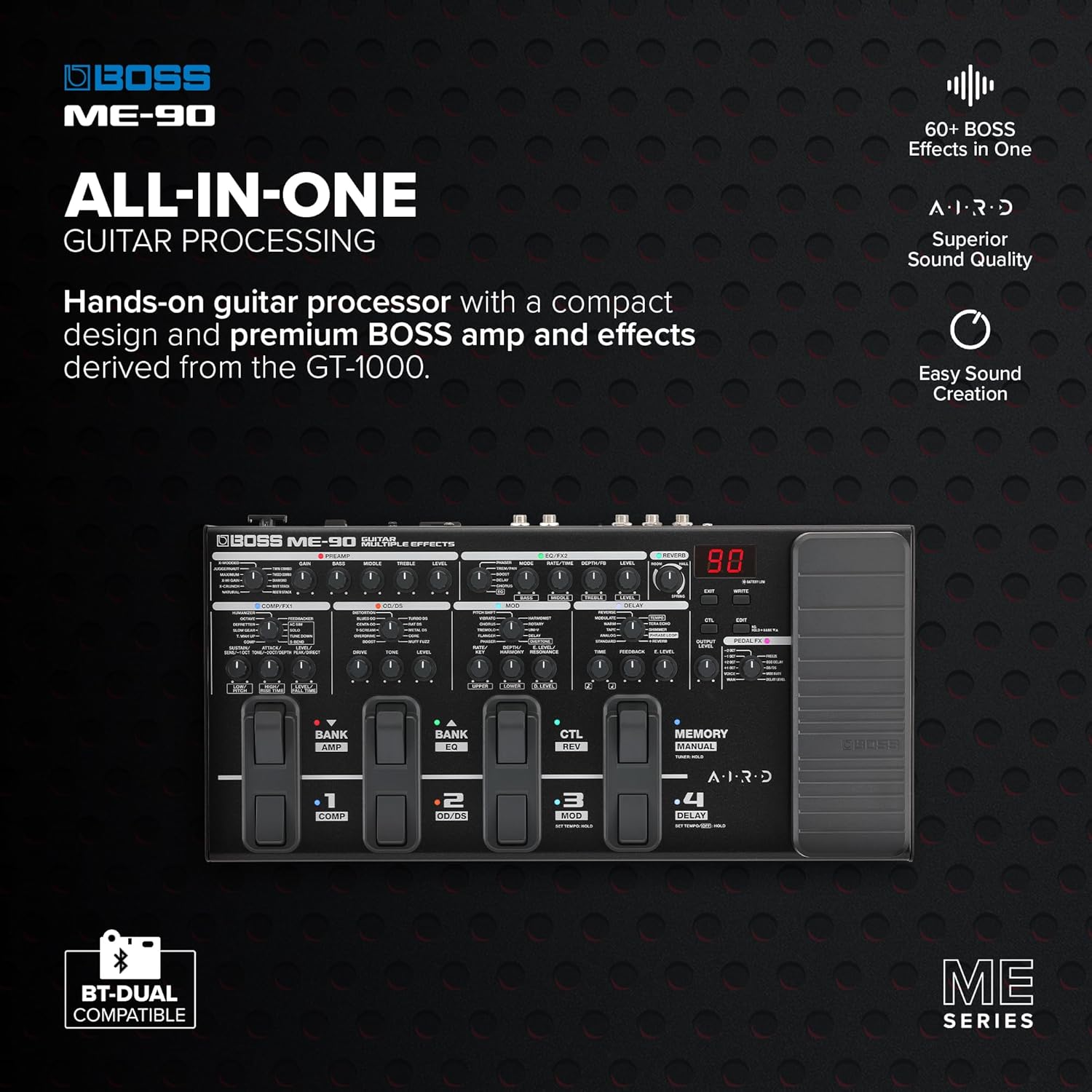
There’s a narrative that surfaces consistently in Guitar World’s Boss ME-90 review: a player builds a collection of individual Boss stompboxes — a DS-1, a CE-5 chorus, a DD-8 delay — and then hits a wall of complexity when trying to use them all live. The ME-90 becomes the answer precisely because Boss designed it to feel like a row of familiar analog-style knobs rather than a menu-driven computer.
One knob per function. No deep parameter burial for basic operation. Guitar World’s review of the ME-90 notes that players coming from traditional pedalboards find the interface immediately legible. If you’ve used a Boss pedal before, you already know roughly how this works.
The trade-off is depth. The ME-90 does not offer IR loading, and its routing options are less flexible than competitors at a similar price. What it offers is reliability, an interface designed for live use without consulting a manual onstage, and the weight of Boss’s decades of effect algorithm refinement behind every patch. MusicRadar’s Best Multi-Effects Pedals guide lists the ME-90 as a consistent recommendation for players who want to gig with confidence on night one rather than spend three weekends building a preset architecture.
This unit is for you if: You’re coming from individual Boss stompboxes, you play live regularly and need an interface that works under pressure, or you want something that feels physical and immediate rather than menu-driven.
VALETON
$328.90
In stock on Amazon
Check price on AmazonValeton GP-200: The Recording-Ready Deep Diver
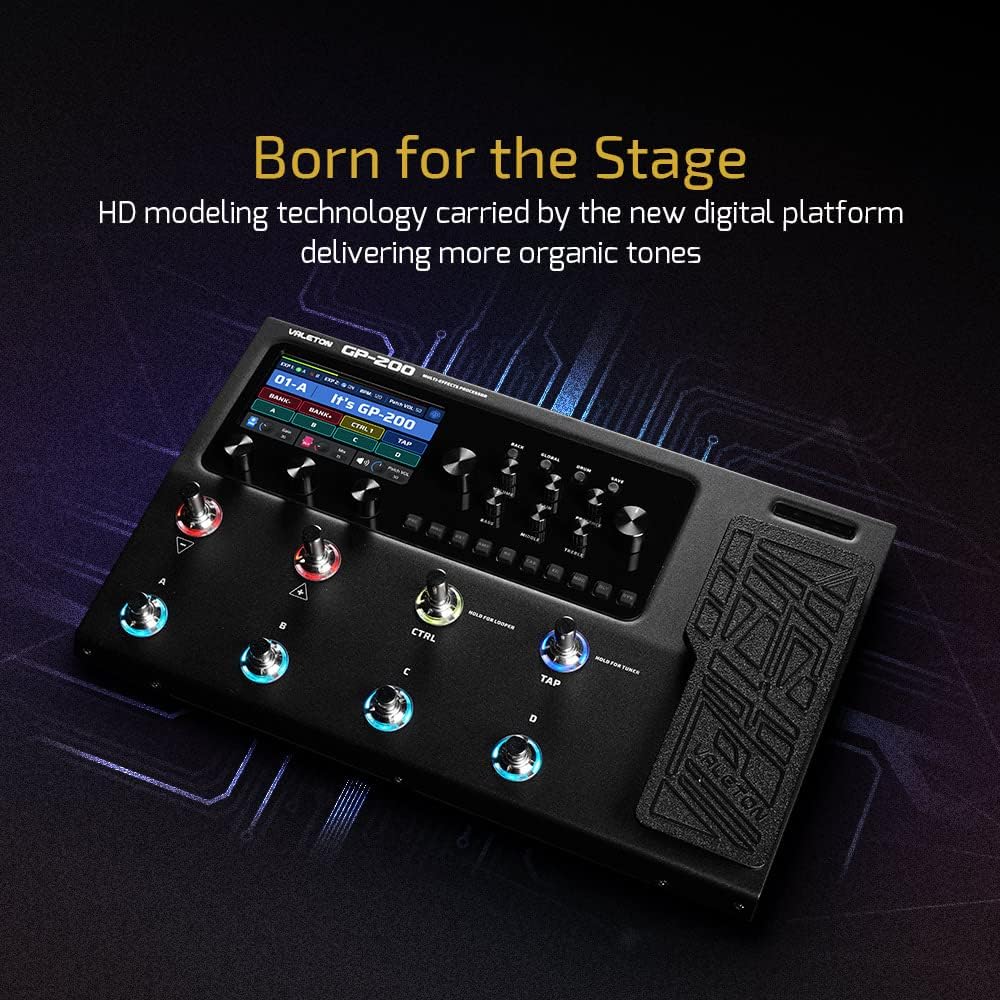
The GP-200’s most instructive context in user coverage involves players upgrading from older Line 6 POD-style units — workhorses that served faithfully for years before aging out of relevance. The GP-200 positions itself as that kind of successor, offering a significantly deeper feature set than the ME-90 at a mid-range price.
More amp models, more effect types, more signal-chain routing flexibility, and — critically — impulse response loading. As Sweetwater’s Multi-Effects Processors Buying Guide explains, IR support allows players to import their own speaker cabinet simulations, delivering direct-to-PA realism that rivals units costing considerably more. The GP-200 carries this capability at a price point where it stands out against similarly priced competitors.
It also functions as a USB audio interface, meaning you can record directly into a DAW without a separate audio interface. For players building a home studio setup alongside a live rig, that dual functionality meaningfully increases the unit’s practical value.
The learning curve is real. Players who have never worked with a block-based multi-effects unit will spend more time in initial setup than they would with the ME-90. Players upgrading from a POD-style workflow will find the GP-200’s architecture logical within a session or two. MusicRadar’s Best Multi-Effects Pedals guide positions units in this feature tier as strong choices for home recording and direct-play applications — and the GP-200 fits that framing accurately.
This unit is for you if: You want IR loading and deep tone-shaping at a mid-range price, you record at home and want USB audio interface functionality, or you’re upgrading from an aging POD-type unit.
VALETON
$328.90
In stock on Amazon
Check price on AmazonDonner Arena 2000: The Creative Sandbox
A useful framing for the Arena 2000 comes from reviewers who reach for this unit specifically as a sandbox — a place to experiment, layer sounds, and push into sonic territory they wouldn’t risk with a primary rig. That framing sets honest expectations.
The Arena 2000 is not the unit you reach for when you need a faithful recreation of a specific vintage Fender or Marshall tone. Premier Guitar’s coverage of the modern multi-effects market has consistently observed that value-tier processors with ambitious effect counts often trade amp-model realism for breadth and playability — and the Arena 2000 leans into that trade deliberately. Its strength is in having a wide range of sonic territory available: heavy gain, ambient textures, looping, experimental layering, without demanding that any of it meet a strict authenticity standard.
For a player who wants to sketch ideas, build unusual sounds, run heavy gain without committing to expensive amp purchases, or simply have a creative tool that operates without worrying about “correct” tone, the Arena 2000 is genuinely effective. Its touchscreen interface gives it a modern feel, and its effect count makes it hard to run out of material quickly.
Owners consistently report that satisfaction increases when expectations are calibrated toward exploration rather than authenticity. That’s not a knock — it’s an accurate description of what the unit does well.
This unit is for you if: You want a low-stakes creative tool for writing, practice, and heavy gain experimentation, or you need a wide palette of effects and amp-model realism is not your primary concern.
FLAMMA
$109.99
In stock on Amazon
Check price on AmazonFlamma FX100: The Effects-Loop Specialist
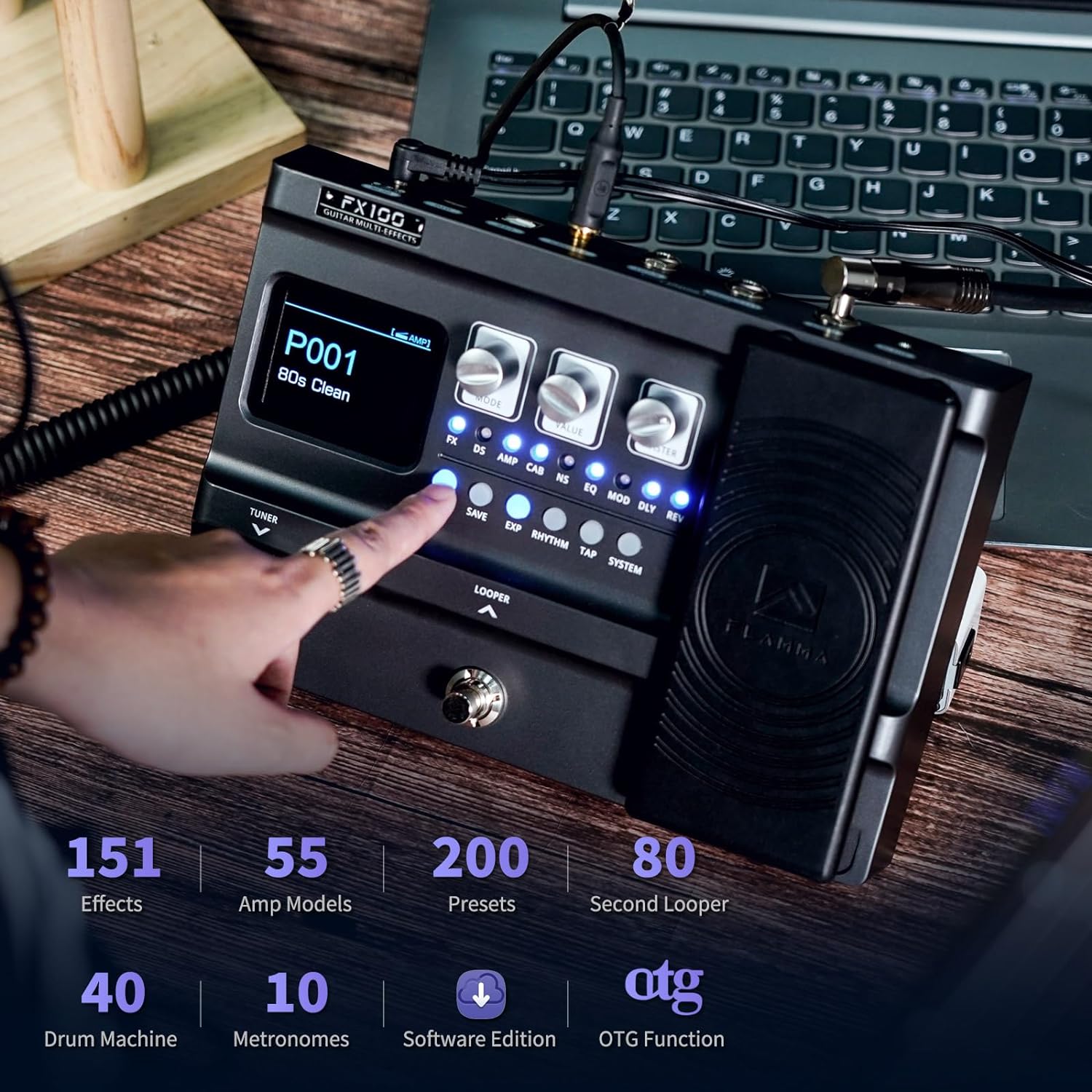
The Flamma FX100 occupies a specific and useful niche: players who already own a tube amp they love and want to add powerful time-based and modulation effects without replacing the amp’s preamp character with modeled alternatives. In an effects-loop deployment — where the amp handles preamp and overdrive, and the multi-effects unit handles only downstream processing — the FX100’s strengths align well with the application.
Gear coverage in MusicRadar’s Best Multi-Effects Pedals guide and in Sweetwater’s Multi-Effects Processors Buying Guide both note that this effects-loop use case is one of the clearest ways to extract maximum value from a mid-range processor, particularly for players who already own a tube amp they don’t want to replace. Running the FX100 direct to PA is serviceable, but the amp models are not the unit’s primary selling point. Behind a good preamp — your tube amp’s own circuit — the time and modulation effects perform well for the price.
One recurring theme worth flagging: across reviews of the Flamma line, factory preset patches are almost universally described as over-saturated with reverb and delay out of the box. Sweetwater’s buying guidance on multi-effects processors echoes this observation for the broader category — default presets are built to impress in a quick demo context, not to be performance-ready. Once players build their own patches from scratch, satisfaction increases substantially. Budget time for initial setup.
The FX100 also includes USB audio interface functionality, making it a dual-purpose tool for players who record at home in addition to playing through a tube amp live.
This unit is for you if: You have a tube amp you love and want powerful modulation and time effects for the loop without paying for amp modeling you won’t use, or you’re willing to invest time building custom patches from the ground up.
VALETON
$328.90
In stock on Amazon
Check price on AmazonSide-by-Side Comparison
| Unit | IR Loading | USB Audio Interface | Primary Strength | Interface Style | Tier |
|---|---|---|---|---|---|
| Boss ME-90 | No | No | Live reliability, familiar workflow | Knob-per-function analog layout | VALETON — $328.90 |
| Valeton GP-200 | Yes | Yes | Deep routing, recording-ready | Block-based menu + display | VALETON — $328.90 |
| Donner Arena 2000 | Yes | Yes | Creative breadth, heavy gain | Touchscreen + footswitches | FLAMMA — $109.99 |
| Flamma FX100 | Yes | Yes | Effects-loop use, tube amp pairing | Block-based display | VALETON — $328.90 |
Frequently Asked Questions
Can the Boss ME-90 replace a full pedalboard, or does it work best alongside existing pedals? It functions as a complete standalone rig — amp modeling, effects chain, output to a PA or amp. Owners also report using it selectively alongside existing pedals, running individual stompboxes in front or integrating a favorite drive pedal through the effects loop. For most advancing players, it works well as a primary setup rather than a supplement.
How does the Valeton GP-200 compare to a Line 6 Helix at a fraction of the price? The Helix carries more refined amp modeling, a more polished software ecosystem, and a more established reputation in professional live rigs. MusicRadar’s Best Multi-Effects Pedals guide positions the Helix as the benchmark in its category. The GP-200 closes more of that gap than its price suggests — especially with IR loading — but the difference in algorithm quality and long-term firmware support is real. The GP-200 is the right call if the Helix’s price is genuinely out of reach; it is not a lateral replacement for players who can comfortably afford the Helix.
Is the Donner Arena 2000 good for realistic amp tones, or mainly for experimental and heavy sounds? Reviewers who approach it as a realistic amp simulator tend to be disappointed. Reviewers who approach it as a creative sandbox with a wide palette — particularly those playing heavy or ambient music — tend to be satisfied. If tonal authenticity is the priority, the ME-90 or GP-200 will serve better. If breadth and playability matter more than strict realism, the Arena 2000 earns its place.
Does the Flamma FX100 work well in an effects loop with a tube amp? Based on owner reports and coverage in MusicRadar’s Best Multi-Effects Pedals guide, the FX100 performs well in an effects-loop application. It’s arguably best deployed there rather than as a standalone amp-modeling unit. Players running it direct to PA find the amp models serviceable but not exceptional. Behind a good preamp, the time and modulation effects are where the unit delivers its best results.
How steep is the learning curve on the Valeton GP-200 compared to the Boss ME-90? The ME-90 is designed for minimum friction — most players are building usable patches within an hour. The GP-200 requires more initial investment, particularly for players unfamiliar with block-based routing and IR loading. Players upgrading from a Line 6 POD-style workflow consistently report the GP-200 feels intuitive faster than expected. Budget an evening for initial GP-200 setup; budget an hour for the ME-90.
The Decision Rule
Here’s the clean version: if you’re gigging and want to walk in with something that works without setup panic, choose the ME-90. If you’re recording at home and want the deepest feature set for the price — IR loading, USB audio interface, and flexible routing — the GP-200 earns serious consideration. If you want to experiment and create without worrying about authentic amp tones, the Arena 2000 is an honest creative tool at a price that removes the stakes from sonic exploration. And if you already have a tube amp you love and want to add powerful effects without replacing it, the FX100 in your effects loop is the most targeted solution in this group.
None of these units is a wrong choice within its intended use case. The wrong choice is spending two hundred dollars on the unit that doesn’t match how you actually play.