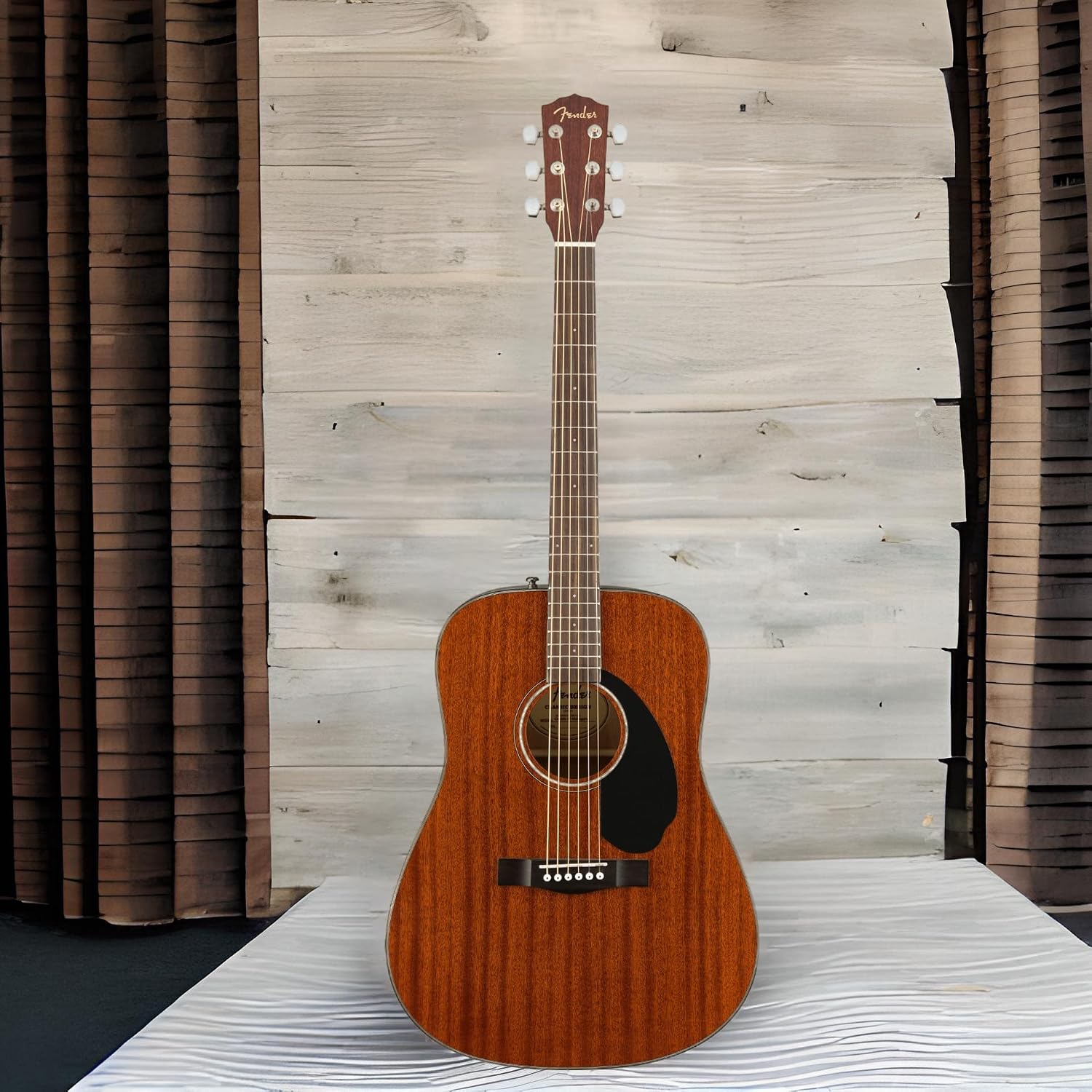
Walk into any guitar store and you’ll see it immediately: the dreadnought dominates the wall. The dreadnought is a large-bodied acoustic guitar shape — think the classic silhouette that most people picture when they imagine “an acoustic guitar” — and it became the default partly because it projects loudly and fills a room, which made it useful for bluegrass and country strumming before amplification was widespread. That’s fine if strumming rhythm in a loud band is your goal. But if you play fingerpicking patterns, struggle with a wider body pressing into your strumming arm, or you’re coming over from electric guitar and find acoustics awkward to hold, a dreadnought might be working against you without either of you knowing it. This guide breaks down the main acoustic body shapes — dreadnought, orchestra, grand auditorium, parlor, and thinline — explains what each one actually does for your playing, and helps you figure out which silhouette fits the music you’re making and the body you’re living in.
| EDITOR'S PICK[Yamaha FG830 Solid Top Acoustic](https://www.amazon.com/dp/B01CFOAI64?tag=greenflower20-20)… | Mid-tier[Fender Acoustic Guitar](https://www.amazon.com/dp/B00BMJ3OFG?tag=greenflower20-20) | Budget pick[Jasmine S35 Dreadnought Acousti](https://www.amazon.com/dp/B0002F58TG?tag=greenflower20-20)… | |
|---|---|---|---|
| Body wood | Solid top | All-mahogany | — |
| Fretboard | — | Walnut | Rosewood |
| Finish | Autumn burst | Glossed | Natural |
| Bracing | — | — | Advanced X |
| Warranty | — | 2-year | — |
| Price | $429.99 | $229.99 | $119.00 |
| See on Amazon → | See on Amazon → | See on Amazon → |
The Big Four Body Shapes (and What They Actually Do)
Dreadnought: The Loud One
The dreadnought’s wide waist and large lower bout (the bottom half of the guitar body) push air hard. That produces volume and low-end punch that cuts through a noisy room. Sweetwater’s acoustic guitar buying guide characterizes it as the workhorse of rhythm playing — good for strumming chords, bluegrass flatpicking, and campfire situations where projection matters more than subtlety.
The tradeoff is physical. Owners of dreadnoughts consistently mention the body sitting awkwardly against their forearm, especially players with shorter arms or smaller frames. The wide lower bout also forces the strumming arm into a slightly elevated position for some players, which creates fatigue over long playing sessions. If you’ve ever played a full-size dreadnought for two hours and noticed your right shoulder aching, that’s the shape doing that — not the strings, not the action.
Buy a dreadnought if: You play rhythm-forward music (country, folk, bluegrass, singer-songwriter strumming), you play in loud environments or with other acoustic players, and you want maximum volume-per-dollar.
Orchestra Model (OM): The Fingerpicker’s Friend
The Orchestra Model — sometimes called the OM — is narrower in the waist and slightly smaller in the lower bout than a dreadnought. That changes the physics meaningfully. Guitar World’s analysis of acoustic guitar shapes notes that the OM’s reduced body volume tightens up the bass response, which lets individual notes in fingerpicking patterns ring with more definition rather than blurring together. A strummed G chord on a dreadnought can sound lush and wide; the same chord on a good OM sounds more focused, with each string more audible as a distinct note.
The Collings OM2H — a flagship example of what this shape can do in skilled luthier hands — is a guitar that acoustic guitarists at the high end of the market treat as a reference instrument for fingerstyle. At $4,500 and up, it’s not an entry point, but it illustrates what the body geometry is optimized for. The principles apply down-market too.
Buy an OM if: Fingerpicking is a primary part of your playing. You want to hear individual notes clearly, especially in the midrange. You want a guitar that fits closer to your body.
Grand Auditorium: The Middle Ground
The Grand Auditorium (GA) is probably the most versatile acoustic body shape available — wider than the OM but with more of a pronounced waist than the dreadnought, which lets it handle both strumming and fingerpicking without clearly failing at either. MusicRadar’s buyer guides consistently describe it as the shape most likely to serve a player who doesn’t know yet exactly what their style will become, or who does both rhythm and lead work in different contexts.
This is where guitars like the Yamaha FG830 live — not technically a Grand Auditorium by traditional labeling (Yamaha calls it a “folk” body), but functionally landing in that versatile middle space with enough volume for strumming and enough clarity for picked passages.
Buy a GA if: You play a mix of strumming and fingerpicking, you’re not sure which direction your playing will develop, or you want one guitar that handles multiple genres.
Parlor: The Intimate One
Parlor guitars have a smaller, more compact body overall — narrower and shorter than any of the above. Fretboard Journal has documented the parlor guitar’s 19th-century origins as a drawing-room instrument, designed for quiet rooms and close listening. What that history translates to in 2026: parlor guitars sit closer to the body, feel almost like a large lap instrument, and reward players who generate tone with light fingertip control rather than aggressive strumming.
The sonic character tends toward a focused, slightly nasal midrange — often described as “dry” compared to the bloom of a dreadnought. For solo fingerstyle players, blues players, or anyone who records at home and wants a guitar that doesn’t overwhelm a room microphone, this can be exactly right.
Buy a parlor if: You play solo fingerstyle, delta blues, or classic folk. You record at home and want a guitar that sits in a mix without eating the whole frequency spectrum.
The Case for Thinline Bodies: The Shape Nobody Talks About Enough
The thinline acoustic — a guitar built with a significantly shallower body depth than a standard acoustic — deserves its own conversation because it solves a specific problem that rarely gets discussed in buying guides: strumming-arm soreness from the upper body edge.
The Yamaha APX600 is the textbook thinline example at an accessible price. Reviewers of the APX600 consistently describe genuine surprise at the output quality given the shallow body — and one widely cited review pattern involves players who came from electric guitar, or from instruments with wider bodies, reporting that the reduced body depth solved a strumming-arm discomfort they’d assumed was just part of acoustic playing. One bass player who picked up the APX600 as a casual side instrument awarded it five stars with what reviewers described as genuine astonishment at the playability and sound-to-size ratio.
The question reviewers keep asking: Is the APX600 actually quieter because of its thin body? The short answer, based on aggregated owner reports, is: slightly, yes, when played unplugged in a large room — but equipped with Yamaha’s System66 preamp and pickup, plugged in it competes with full-size acoustics without compromise. For most situations where a thinline gets chosen — stage use, practice, home playing — the volume difference is not meaningful.
By the numbers:
- Standard dreadnought body depth: ~4.75 inches
- Grand Auditorium body depth: ~4.0–4.25 inches
- APX600 thinline body depth: ~2.76 inches
- Typical 12th-fret action on a factory APX600: ~2.0–2.1mm (high E), reviewers note this is playable out of the box
Buy a thinline if: You play amplified, you experience strumming-arm fatigue with standard-depth bodies, or you’re an electric player adding an acoustic to your setup and want the transition to feel natural.
Electric-to-Acoustic Crossover: The Neck Is More Important Than You Think
If you’re primarily an electric guitarist adding an acoustic, the neck profile and scale length are usually what determine whether you’ll actually pick the guitar up regularly. A classical guitar neck at 2 inches wide at the nut will feel foreign if you’ve spent years on a Stratocaster neck at 1.65 inches.
The Fender Redondo Debut has collected a specific type of review praise: electric guitar players who found standard acoustic necks discouraging and picked up the Redondo specifically because the neck geometry feels closer to an electric. Reviewers specifically describe the nut width and profile as friendly to electric players. One owner noted factory action just over 2mm at the 12th fret — on the edge of what most players find comfortable, but importantly, reviewers confirmed that’s addressable without a full fret job, just a simple saddle adjustment by any tech.
This matters because acoustic guitar action (the height of the strings above the fretboard) is often set higher at the factory than electric players are used to, and high action makes the guitar harder to play. The Redondo’s setup, according to owner reports, is closer to what an electric player expects without requiring immediate work.
Is the Redondo Neck a Good Thing or Bad Thing? Depends on where you’re coming from. If you’re primarily an acoustic player or an acoustic purist, the narrower neck might feel less substantial. If you’re an electric player who wants to add acoustic textures to your playing without relearning hand mechanics, it’s a genuine comfort advantage.
The Mahogany vs. Spruce Question (In Plain Language)
Most acoustic tops — the flat piece of wood on the front of the guitar — are made from spruce, either Sitka or Engelmann. Spruce is bright, clear, and responsive across a wide dynamic range: strum softly and it sounds soft; dig in and it opens up with volume and presence.
Mahogany tops sound warmer and darker. Where spruce has a V-shape volume response (quiet when light, loud when pushed), mahogany has a more consistent sound across dynamics — it doesn’t bloom as dramatically, but it also doesn’t thin out when you play gently. Acoustic Guitar Magazine’s tonewood analyses consistently describe the all-mahogany acoustic as particularly well-suited to fingerpicking, blues, and any playing style that lives in the midrange rather than the high or low extremes.
The Yamaha FG800M (all-mahogany body) exemplifies this character at an accessible price point. Owners describe it as warmer and more “woody” than the spruce-topped FG800, which makes sense given the physics. Neither is better; they suit different playing styles and recording contexts.
The FG830 vs. FG800J question: Owners of the FG830 who also own Martin HD-28s describe the FG830 as a legitimate camp or backup guitar that doesn’t embarrass itself next to a premium instrument — a significant credibility signal. The FG830 features a solid spruce top vs. the laminate tops on lower-tier FG models; solid wood resonates more freely and often improves with age, while laminate is stable and consistent but doesn’t open up over years of play. Whether that difference justifies the price gap depends on how long you plan to own the guitar and how much long-term tonal development matters to you.
Frequently Asked Questions
Is a thinner-body acoustic like the APX600 actually quieter or just more comfortable? Both, to a degree — but it depends heavily on context. Owners playing unplugged in a large room notice a modest volume reduction compared to a full-size dreadnought. Plugged in via the onboard pickup, the volume difference disappears. For most players who choose a thinline, the comfort benefit dominates the decision, and the slight unplugged volume reduction is irrelevant to how they actually use the instrument.
Does the Fender Redondo Debut play like an electric guitar neck — and is that good or bad? Reviewers consistently say yes, the neck profile and nut width feel closer to an electric guitar than a typical acoustic. Whether that’s good depends entirely on your background. Electric players crossing over tend to find it a significant comfort advantage. Acoustic-first players sometimes find it less substantial than they prefer. Know which camp you’re in before you decide.
Is the Yamaha FG830 actually worth twice the price of the FG800J? The key difference is the solid Sitka spruce top on the FG830 vs. laminate on the FG800J. Reviewers note that Yamaha’s quality control is a differentiator from other options at similar prices. If you’re buying a guitar you expect to own for a decade, the FG830’s solid top will reward you with improved resonance over time. If you need a reliable instrument for travel, teaching, or backup use, the FG800J represents strong value without apology.
What does an all-mahogany top sound like compared to spruce, in plain language? Mahogany is warmer and darker — think less shimmer on the high strings, more thickness in the mids. Spruce is brighter and more responsive to dynamic changes (how hard you strum). If you play blues, fingerstyle folk, or any style that lives in the mids, mahogany often suits it better. If you strum chords and want that full, glassy acoustic sound, spruce is usually the better match.
Is the Fishman pickup on the CD-60SCE good enough to gig with? Based on aggregated owner reports, the Fishman-branded pickup system included with the CD-60SCE bundle performs reliably for small-to-medium venue gigging. Reviewers and owners describe it as functional and honest-sounding rather than exceptional — a good match for the guitar’s price point and target use case. Bundle buyers also consistently praise the hard-shell case inclusion as adding meaningful value. A 72-year-old first-time buyer’s review of the bundle described the all-in-one nature of the package as the deciding factor — everything needed to start playing, in one box. For touring professionals or high-end acoustic-electric rigs, more sophisticated options exist. For gigging at the level the CD-60S buyer is likely playing, it’s a capable system.